Does Mulch Break Down? Lifespan, Benefits & Care
- Disclosure: This post may include affiliate links. If you click a link and complete a purchase, I may earn a commission. Additionally, as an Amazon Associate, I earn from eligible purchases.
Yes, mulch breaks down over time. Organic materials such as wood chips, bark, leaves, straw, and similar plant-based materials are gradually decomposed by microorganisms in the garden.
As this happens, the original mulch becomes smaller organic particles and contributes to the soil environment. It does not simply turn into ordinary “dirt” overnight. Instead, decomposition is a gradual biological process in which organic material is transformed and incorporated into the soil system.
For gardeners, this is an important distinction: mulch becoming thinner or changing appearance is not necessarily a problem. Decomposition is one of its useful functions.
How Long Does Mulch Take to Break Down?
Organic mulch can take approximately 4–7 years to completely break down, although the actual rate varies according to the material and growing conditions.
However, complete decomposition is not the same as how long mulch looks attractive or provides a full protective layer.
| What changes? | Approximate time |
|---|---|
| Complete breakdown of a mulch layer | 4–7 years |
| Noticeable aesthetic decline | 1–2 years |
| Common time to refresh/top up | About 1 year |
| Hardwood mulch top-dressing | 12–16 months |
| Cedar mulch lifespan | Up to 3+ years |
| Colored mulch’s strongest color | About 1 year |
The difference explains why a garden may need fresh mulch visually long before the original material has completely decomposed.
Why Does Mulch Decompose?
Decomposition is carried out by microscopic organisms, particularly fungi, bacteria, and actinomycetes.
These organisms use organic compounds such as cellulose and lignin as food sources. Fungi are particularly useful during the early stages of breaking down tougher woody material. As the material becomes softer and more fragmented, bacteria continue the conversion process.
The process also requires suitable oxygen and moisture. Under favorable conditions, the organic material is gradually converted into carbon dioxide, water, energy, and smaller organic compounds.
Does Mulch Turn Into Soil?
Mulch contributes to the soil, but it is more accurate to think of the process as organic matter transformation rather than mulch instantly becoming soil.
As organic material decomposes, the resulting substances interact with soil minerals and contribute to soil structure and fertility. Complete decomposition can produce humus, a stable form of organic matter that helps retain water and nutrients and supports better soil structure.
The decomposition process can also return nitrogen, phosphorus, and potassium to the soil through mineralization.
What Determines How Fast Mulch Breaks Down?
Several factors can change the decomposition rate considerably.
1. Mulch Material
Not every type of mulch decomposes at the same speed.
Faster-decomposing materials include:
- Straw
- Hay
- Pea straw
- Sugar cane
- Lucerne
- Grass clippings
- Shredded leaves
Slower materials include:
- Wood chips
- Bark
- Coarse woody material
The difference is partly related to the material’s composition and its carbon-to-nitrogen ratio. Materials with a high C:N ratio generally take longer to decompose.
2. Particle Size
The size of the pieces matters.
Smaller pieces expose more surface area to microorganisms, which can accelerate decomposition. Large wood chips and nuggets generally break down more slowly.
If the goal is faster breakdown, reducing large pieces into smaller material can help.
3. Temperature
Decomposition is affected by temperature.
Warm, damp conditions encourage microbial activity, while very dry conditions can slow the process. Excessively saturated conditions can also interfere with efficient decomposition.
4. Moisture
Moisture supports the microorganisms responsible for decomposition.
A mulch environment that becomes excessively dry can slow biological activity. On the other hand, too much retained moisture can create undesirable conditions. Maintaining an appropriate moisture environment is therefore important.
5. Climate and Weather
Climate can make a noticeable difference.
Warmer environments can encourage faster decomposition, while colder conditions can slow it. Frequent rainfall and wind can also accelerate degradation or physically affect the mulch layer.
Direct sunlight and very wet ground are also identified as environmental conditions that can affect mulch longevity.
How Often Should You Refresh Mulch?
You usually do not need to remove all the old mulch simply because it has become faded or thinner.
A practical approach is to inspect the layer after approximately 1 year and consider topping it up when the protective or visual benefits have declined. Some organic mulch may remain useful for several more years even though its appearance has changed.
Look for these signs:
- Bare soil becoming visible
- Noticeable loss of color
- A thinner mulch layer
- Weeds appearing through exposed areas
- Mulch being displaced by weather or animals
- Reduced visual coverage
A top-up can restore coverage without throwing away useful older material.
Should You Remove Old Mulch Before Adding New Mulch?
In general, the guidance from these sources favors refreshing rather than completely removing older organic mulch.
Old material can continue contributing organic matter and nutrients as it decomposes. Adding fresh material on top can restore protection and improve the appearance of the garden bed.
This approach also means you do not have to replace the entire original layer every year.
How Deep Should Mulch Be?
One source recommends maintaining a mulch depth of approximately 2–3 inches for weed-control purposes.
A layer that is too thin may provide less effective coverage, while an excessively thick layer can create moisture-related problems and may interfere with plants.
When refreshing an existing layer, approximately 1 inch of new material can be used as a top-dressing according to the guidance provided.
How Can You Make Mulch Decompose Faster?
If you want organic mulch to break down more quickly, several practices can encourage the process.
Use smaller pieces:
Smaller particles provide greater surface area for microbial activity.
Maintain moisture:
A suitably moist environment encourages bacteria and fungi.
Mix the material:
Regular mixing can distribute moisture and organic material throughout the pile. One source recommends mixing every day when actively trying to accelerate decomposition.
Choose faster-decomposing materials:
Straw, hay, grass clippings, and shredded leaves can break down more rapidly than coarse wood chips or bark.
Which Mulch Lasts the Longest?
Among the materials discussed, cedar mulch can last 3 years or more, while hardwood mulch may require top-dressing after roughly 12–16 months.
Wood chips and bark generally decompose more slowly than straw and similar soft organic materials. However, a slower decomposition rate can also mean longer-lasting ground coverage.
| Material | Relative breakdown/lifespan information |
|---|---|
| Straw | Faster breakdown |
| Hay | Faster breakdown |
| Pea straw | Faster breakdown |
| Sugar cane | Faster breakdown |
| Lucerne | Faster breakdown |
| Grass clippings | Rapid breakdown |
| Shredded leaves | Rapid breakdown |
| Wood chips | Slower breakdown |
| Bark | Slower breakdown |
| Hardwood mulch | Top-dress around 12–16 months |
| Cedar mulch | Up to 3+ years |
These differences make material selection important. The ideal choice depends on whether the priority is faster organic turnover, longer-lasting coverage, or maintaining a particular appearance.
What Happens to Nutrients During Decomposition?
As microorganisms break down organic material, nutrients become part of the soil cycle.
The process can release nitrogen, phosphorus, and potassium, making these nutrients available in the soil. Stable organic matter produced later in decomposition can also help the soil retain water and nutrients.
There is an important detail with high-carbon materials such as coarse wood chips and bark. Microorganisms may temporarily draw nitrogen from the surrounding soil while processing the carbon. This is known as nitrogen immobilization.
According to the source material, this effect is limited to the surface layer and reverses as decomposition progresses.
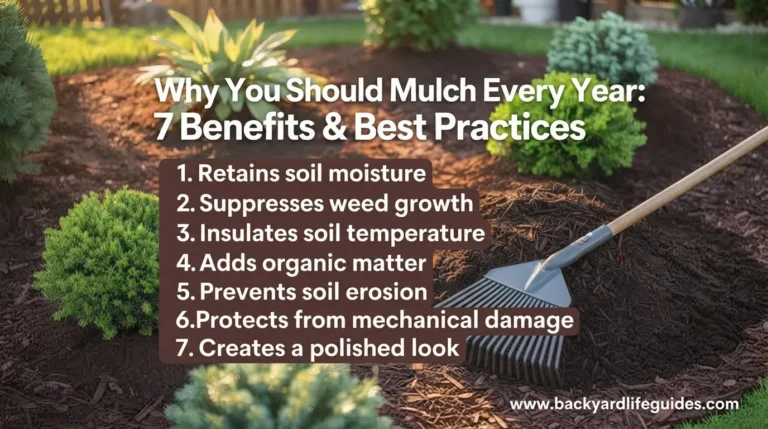
What Are the Main Benefits of Keeping Mulch in Place?
Mulch provides several functions while it is gradually decomposing.
| Benefit | How mulch helps |
|---|---|
| Moisture | Helps reduce moisture evaporation |
| Weeds | Provides ground coverage that suppresses weeds |
| Soil | Adds organic matter as it decomposes |
| Erosion | Helps protect soil from erosion |
| Frost | Provides a layer of protection |
| Soil structure | Decomposed organic matter contributes to structure |
| Nutrients | Decomposition supports nutrient cycling |
| Appearance | Creates a cleaner, more finished garden-bed look |
The useful part is that these functions can overlap. A mulch layer can protect the ground while simultaneously undergoing the biological process that eventually contributes organic matter to the soil.
What Are the Signs That Mulch Needs a Refresh?
You do not have to wait until mulch has completely disappeared.
A refresh may be appropriate when:
- Soil is visible through multiple areas.
- The original color has significantly faded.
- The layer has become noticeably thinner.
- Weeds are beginning to establish in exposed patches.
- Rain or wind has displaced substantial amounts.
- The garden bed no longer has consistent coverage.
A mulch layer can still be biologically useful even after its appearance declines, so refreshing is primarily about restoring coverage, protection, and appearance rather than removing material that has no value.
A Simple Mulch Maintenance Routine
For an easy maintenance approach, use this checklist:
- Inspect the bed after roughly 1 year.
- Look for bare soil and fading.
- Check whether the mulch layer remains adequately covered.
- Gently turn or redistribute existing material where appropriate.
- Add a fresh top layer rather than automatically removing everything.
- Keep the overall depth around 2–3 inches where that depth is being used for weed control.
- Monitor moisture and drainage.
- Recheck the bed periodically as the organic material continues to decompose.
This approach lets the older material continue its natural decomposition while fresh material restores the layer’s practical appearance and coverage.
Quick Answers About Mulch Decomposition
Does mulch eventually disappear?
Yes. Organic mulch gradually decomposes through the activity of microorganisms. Complete breakdown can take around 4–7 years, depending on material and environmental conditions.
How long does mulch look good?
Its aesthetic life is generally around 1–2 years. Color can fade, and patches of soil may become visible before the material has completely decomposed.
Do I need to remove old mulch every year?
No. The guidance indicates that old organic mulch can remain in place and be topped up when necessary.
What mulch breaks down fastest?
Straw, hay, pea straw, sugar cane, lucerne, grass clippings, and shredded leaves are among the faster-decomposing materials discussed.
What mulch breaks down slowly?
Wood chips and bark generally break down more slowly than softer organic materials. Their higher carbon content is one factor associated with slower decomposition.
Does mulch improve soil?
As organic mulch decomposes, it contributes organic matter and can improve soil structure, water retention, nutrient cycling, and other soil properties.
How often should mulch be refreshed?
A visual inspection after about 1 year is useful. Many beds can be refreshed by adding new material rather than completely replacing the old layer. Some specific materials may remain effective for 12–16 months or 3+ years, depending on type.
Final Takeaway
Mulch does break down, and that is a normal part of its role in the garden. Organic materials are gradually processed by fungi, bacteria, and other decomposers, eventually contributing stable organic matter and nutrients to the soil.
The important number to remember is 4–7 years for complete breakdown, but gardeners should not use that figure as the only maintenance schedule. The layer can lose its appearance and coverage after just 1–2 years, which is why a timely top-up often makes more sense than removing everything.
For practical maintenance, watch the condition of the layer, keep appropriate coverage, consider a 2–3-inch depth where applicable for weed control, and add approximately 1 inch when top-dressing an existing layer.
The result is a simpler approach: let old organic mulch continue its natural work while refreshing the surface when your garden actually needs it.