
Can Mosquitoes See in the Dark? How They Find Humans at Night
Can Mosquitoes See in the Dark?
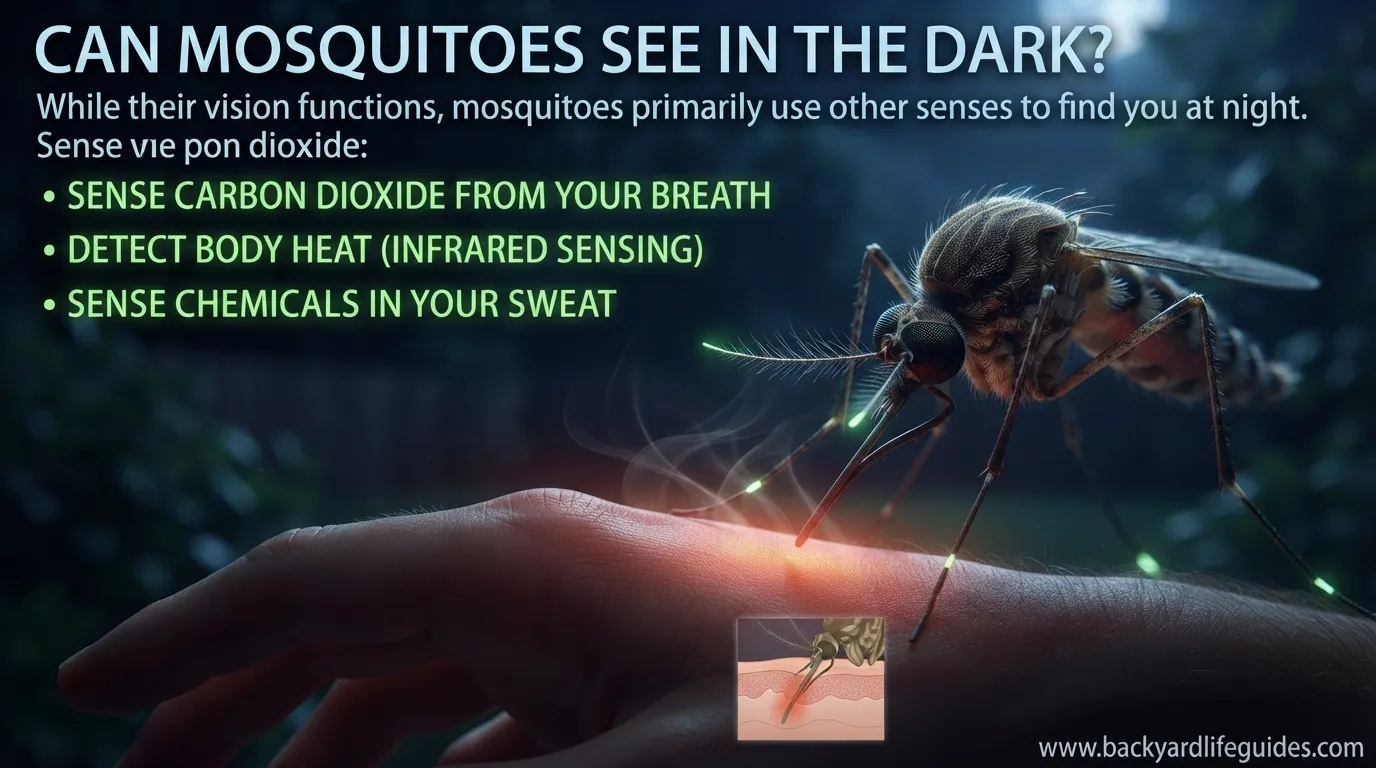
Yes, mosquitoes can see in dark conditions, but their vision is not the same as human eyesight. They do not depend on their eyes alone to find a person at night. Instead, mosquitoes combine vision with other sensory signals, including carbon dioxide (CO₂), human odor, body heat, movement, and visual clues.
This explains why a mosquito can still locate you when a room is dark or when you are outside at night. Its ability to detect different signals allows it to continue searching for a human host even when normal visibility is limited.
The important point is that mosquito nighttime hunting is not simply a matter of “seeing” a person. It is a combination of several detection methods working together.
How Mosquitoes See in Darkness
Mosquitoes have compound eyes, which are different from human eyes. Their eyes contain many small visual units that help them detect changes in their surroundings.
Their vision can help them recognize shapes, movement, and contrast, but it does not provide the same detailed image that humans experience. This means a mosquito does not necessarily need to clearly see your entire body to continue moving toward you.
When light is limited, visual information becomes less useful by itself. This is where the mosquito’s other sensory abilities become especially important.
Do Mosquitoes Need Light to Find You?
No. A mosquito does not need normal daylight to locate a human.
In darkness, mosquitoes can use several signals at the same time. CO₂ released through breathing provides an important clue, while human odor and body heat provide additional information about where a potential host may be.
Vision can then contribute information about movement, shapes, and contrast.
So, even when your surroundings appear completely dark to you, a mosquito can still gather information from its environment.
How Mosquitoes Find Humans at Night
The process can be understood as a series of 4 main detection stages. These signals work together rather than acting as completely separate systems.
1. Carbon Dioxide Detection
One of the major clues mosquitoes use is carbon dioxide.
Humans release CO₂ when they breathe. In a dark environment, this chemical signal can help a mosquito recognize that a potential host is nearby.
This is particularly important because vision becomes less reliable as available light decreases. Instead of depending entirely on what it can see, the mosquito can follow the chemical information in its surroundings.
2. Human Odor Detection
The next important signal is human odor.
Mosquitoes can detect odor molecules associated with humans. These chemical clues work together with CO₂ to help the insect identify a possible host.
This means that simply being difficult to see does not necessarily make a person difficult for a mosquito to locate. The mosquito is processing information from more than one sense.
3. Body Heat Detection
Body heat provides another useful signal.
Humans are warm-bodied hosts, and mosquitoes can detect temperature differences associated with a warm body. The competitors also describe heat-sensitive mechanisms and thermal infrared radiation as part of the mosquito’s ability to detect warmth.
As a result, heat can help guide a mosquito toward a potential host after chemical signals have indicated that one may be nearby.
4. Visual Confirmation
Vision still has a role.
Once a mosquito is using chemical and heat-related information, its eyes can help detect movement, shapes, and contrast. This visual information can support the mosquito’s overall host-finding process.
This is why it is more accurate to say that mosquitoes have limited nighttime vision rather than saying they are completely blind in darkness.
Mosquito Vision vs. Human Vision
Human vision and mosquito vision work differently.
People generally depend heavily on visible light to recognize detailed objects and surroundings. Mosquitoes, however, can combine their limited visual information with chemical and heat-related signals.
A mosquito’s compound eyes can help it detect environmental changes, but the available information is not equivalent to the detailed images humans see.
This difference is important when answering the question, “Can mosquitoes see in the dark?” They can use their vision in low-light conditions, but they do not need clear visual images to find a person.
What Do Mosquitoes Detect Besides Vision?
The 7 competitor articles repeatedly identify several signals that mosquitoes use when locating humans.
Carbon dioxide helps provide information about breathing.
Human odor provides chemical information associated with a possible host.
Body heat provides temperature-related information.
Movement and visual contrast can provide additional visual clues.
Together, these signals create a much more effective detection system than vision alone.
Why Mosquitoes Can Find You in a Dark Room
A dark room may look completely empty to a person, but darkness does not remove all of the signals a mosquito can detect.
A person may still be breathing, producing odor, generating body heat, and moving. These signals can give mosquitoes information even when there is very little visible light.
That is why turning off the lights does not necessarily prevent mosquitoes from finding you.
The key difference is that darkness affects visibility, but it does not eliminate every sensory clue available to a mosquito.
Can Mosquitoes See Movement at Night?
Yes, movement is one of the visual clues associated with mosquito vision.
Their compound eyes can help detect changes such as movement, shapes, and contrast. However, their vision should not be confused with the detailed eyesight humans use to identify objects.
Movement is therefore one part of the larger detection system rather than the only way mosquitoes find humans.
Do Mosquitoes Use Heat to Find Humans?
Yes. Heat detection is an important part of the mosquito host-detection process described across the competitor content.
The articles discuss body warmth, temperature differences, and thermal infrared radiation as signals mosquitoes can use.
This becomes particularly useful when visual information is limited. Instead of relying only on what an insect can see, heat-related information can help it identify a warm-blooded host.
Can a Mosquito Find You in Complete Darkness?
A mosquito can still locate a human when visible light is extremely limited because it does not depend exclusively on eyesight.
In complete darkness, visual information may be limited, but CO₂, odor, and body heat remain relevant signals. The mosquito can therefore continue its host-searching behavior without needing the same level of visibility that a human would require.
This is one of the main reasons mosquitoes can remain effective nighttime hunters.
Does Moonlight Matter to Mosquito Vision?
Low-light environments do not necessarily stop mosquito activity.
The competitor content emphasizes that mosquitoes can use their visual system for shapes, movement, and contrast while also relying on chemical and heat-related signals.
Therefore, whether the environment has very little light or somewhat more natural nighttime light, mosquitoes have multiple ways of gathering information.
Why Mosquitoes Are Active at Night
The competitor material connects nighttime mosquito activity with environmental conditions that can support their hunting behavior.
Cooler temperatures and reduced risk of dehydration are mentioned as reasons nighttime can be favorable for mosquito activity. Dawn and dusk are also associated with mosquito activity in the supplied content.
Their ability to combine vision with CO₂, odor, and heat detection makes nighttime host finding possible even when visibility is poor.
What Makes Mosquito Night Hunting Effective?
The effectiveness of mosquito nighttime hunting comes from sensory combination.
If vision alone were required, darkness would create a major problem. Instead, mosquitoes can gather information from several sources.
First, chemical signals such as CO₂ and human odor can provide clues. Heat can offer another indication of a warm-blooded host. Finally, visual information such as movement and contrast can contribute to the process.
This combination allows mosquitoes to continue searching even when normal visibility is reduced.
A Simple Way to Understand Mosquito Night Hunting
Think of mosquito detection as a 4-part system:
CO₂ → odor → heat → visual clues
CO₂ can indicate that a breathing host is nearby. Odor can provide additional chemical information. Heat can help identify a warm body. Vision can then contribute information about movement, shapes, and contrast.
These signals do not have to work independently. Together, they help the mosquito navigate toward a potential human host.
FAQs
Can mosquitoes see in the dark?
Yes. Mosquitoes have compound eyes and can use visual information such as movement, shapes, and contrast. However, they also rely heavily on CO₂, odor, and body heat, so they do not need clear vision to locate humans.
Can mosquitoes see humans at night?
Mosquitoes can use visual clues associated with humans, but they do not see people with the same detailed vision humans have. Their visual system works together with chemical and heat-related detection.
Do mosquitoes need light to find people?
No. Mosquitoes can use carbon dioxide, human odor, body heat, movement, and visual clues to locate potential hosts, allowing them to remain effective even when light is limited.
Can mosquitoes find you in a completely dark room?
Yes. Darkness can reduce visual information, but it does not remove other signals. Breathing produces CO₂, humans produce odor, and the body provides heat-related information that mosquitoes can detect.
Do mosquitoes use body heat?
Yes. The supplied competitor content identifies body heat and temperature differences as important parts of mosquito host detection.
Do mosquitoes have good eyesight?
Mosquitoes have specialized compound eyes, but their vision is different from human eyesight. They can detect movement, shapes, and contrast rather than relying on detailed human-like visual recognition.
What attracts mosquitoes at night?
The competitor content identifies several signals involved in nighttime host detection, especially CO₂, human odor, body heat, movement, and visual clues.
Why can mosquitoes find me when the lights are off?
Turning off the lights mainly reduces visible information. It does not stop you from producing CO₂, odor, and body heat. Mosquitoes can combine these signals with their remaining visual information to locate a potential host.
Final Thought
Yes, but not in the same way humans see. Mosquitoes have compound eyes that help them detect movement, shapes, and contrast, but nighttime hunting depends on much more than vision.
Their ability to detect carbon dioxide, human odor, body heat, and visual clues allows them to find potential hosts even when the environment is dark. This combination of sensory systems explains why simply turning off the lights does not make a person invisible to mosquitoes.
The most useful way to understand mosquito night vision is therefore simple: they can use vision in darkness, but they do not rely on vision alone.