
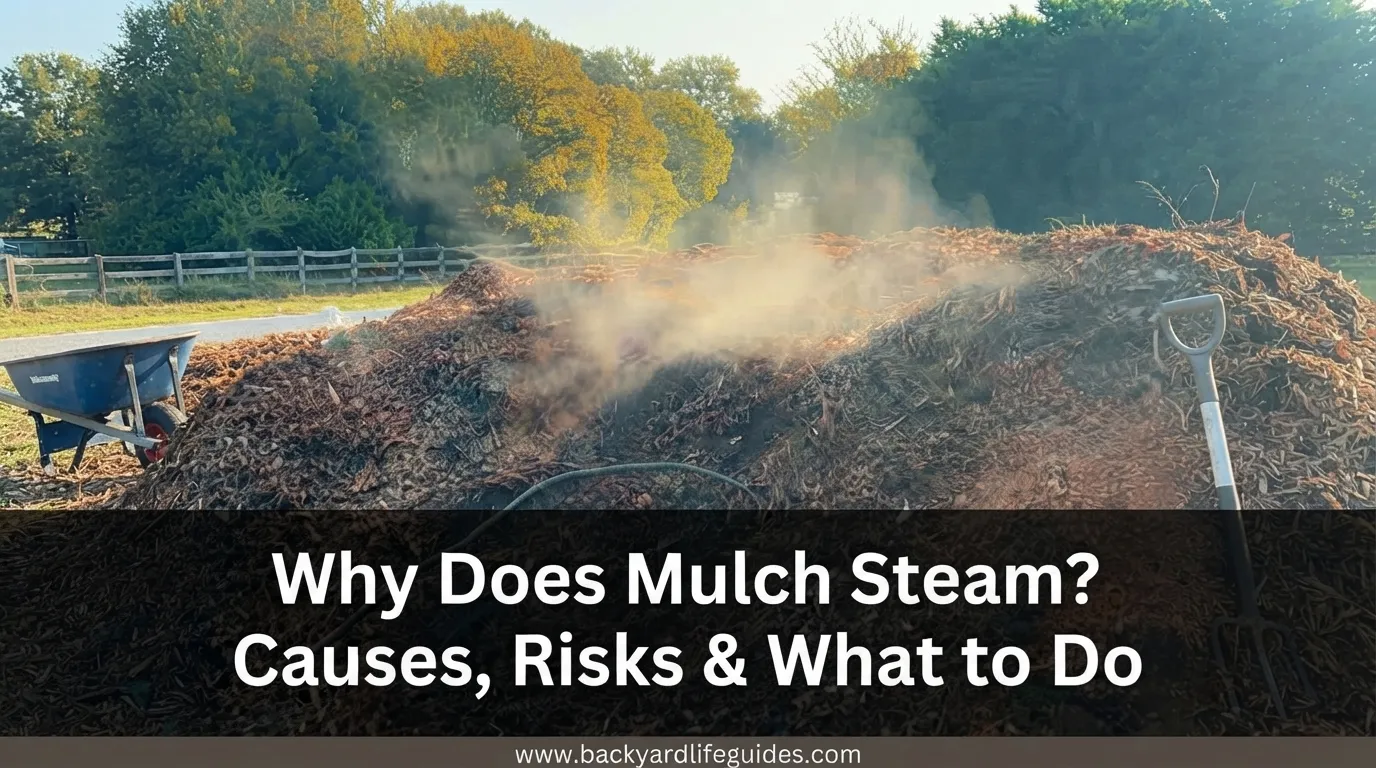
Why Does Mulch Steam? Causes, Risks & What to Do
- Disclosure: This post may include affiliate links. If you click a link and complete a purchase, I may earn a commission. Additionally, as an Amazon Associate, I earn from eligible purchases.
Seeing white vapor rising from mulch can be surprising, especially when there is no visible fire or smoke. In many cases, what looks like smoke is actually water vapor produced as organic material breaks down and heat builds inside the mulch.
Mulch steaming is commonly associated with organic decomposition, microorganisms, moisture, temperature, and humidity. Fresh wood chips, bark, and other organic materials can contain enough moisture and biological activity to become noticeably warm.
However, steaming should not always be dismissed as harmless. Large or poorly managed mulch piles can accumulate substantial heat, and dry mulch can also become a fire hazard. Understanding the difference between ordinary steaming and a potentially dangerous situation is the key to responding appropriately.
What Actually Causes Mulch to Steam?
There is no single cause in every situation. Several conditions can work together.
1. Organic matter is breaking down
Wood chips, bark, and leaves contain organic material. Once these materials begin decomposing, microorganisms such as bacteria, fungi, and protozoa help break them down.
That biological activity produces heat and releases moisture and gases as part of the decomposition process.
This is why steaming can be particularly noticeable with fresh organic mulch.
2. Microorganisms generate heat
Microorganisms are an important part of the process.
As bacteria and fungi consume organic material, their activity can generate heat. A sufficiently warm and moist mulch pile can therefore become noticeably hotter toward its center.
The effect is similar in principle to what happens during decomposition in a compost pile.
3. Moisture becomes visible vapor
The “steam” you see is generally water vapor, not necessarily smoke.
Moisture held inside the mulch can warm up as decomposition generates heat. When the warm, moisture-laden air reaches cooler outdoor air, condensation makes the vapor visible.
This explains why steaming can be especially obvious during cooler weather.
4. Temperature and humidity matter
Temperature and humidity influence microbial activity and the amount of visible vapor.
One identifies 60°F–80°F (15°C–27°C) as an optimal range for the microbial activity associated with mulch steaming.
That does not mean every pile will steam within exactly this range. Mulch type, moisture, pile size, airflow, and local weather can all change what you observe.
Is Steaming Mulch Normal?
Usually, some steaming from fresh organic mulch can be a natural part of decomposition.
For example, you may notice a light white vapor shortly after:
- Applying fresh wood-chip mulch
- Watering mulch
- Turning over a mulch pile
- Experiencing warm, humid weather
- Experiencing a sharp temperature difference between mulch and outdoor air
The important question is not simply whether mulch is steaming. You should also consider how hot it feels, how large the pile is, whether it is dry, and whether there are signs of fire or smoldering.
When Should Steaming Mulch Concern You?
A small amount of vapor from garden-bed mulch is different from a large pile producing intense heat.
Extra caution is appropriate when you have:
- A large, dense mulch pile
- Very hot material at the center
- Dry weather and low humidity
- Little airflow through the pile
- Visible smoke rather than ordinary vapor
- Burning or smoky odors
- Darkened or charred material
- Flames or glowing material
Large mulch piles can retain heat because the material in the center is insulated by the surrounding layers.
My Backyard Life specifically warns that mulch piles can become a fire concern and recommends taking steaming piles seriously. Its article was last updated May 17, 2024, and discusses mulch fires including a Houston incident in August 2023 that reportedly burned for 2 days.
Can Mulch Spontaneously Combust?
Yes, under certain conditions, although this is not the same thing as saying every steaming garden bed is about to catch fire.
Heat can accumulate inside a sufficiently large pile when decomposition, moisture conditions, limited airflow, and insulation work together. If the internal temperature becomes high enough, combustion can become possible without an obvious external flame.
My Backyard Life cites 86°F internal temperature together with 45% moisture in its FAQ when discussing spontaneous combustion.
Because temperature and moisture figures can vary considerably with material and conditions, homeowners should not treat one number as a universal ignition threshold.
The practical lesson is more important: unusually hot, steaming mulch—especially in a large pile—deserves attention.
Why Does a Large Mulch Pile Get Hotter?
Pile size can make a major difference.
A thin layer of mulch can release heat relatively easily. A large pile has much more material surrounding its center, creating an insulating effect.
The basic process
Organic material → microbial activity → heat generation → moisture warms → vapor rises → visible steam
If heat is produced faster than it can escape, the center becomes progressively warmer.
This is why turning and aerating stored mulch can be useful. It exposes hotter interior material to air and allows accumulated heat to dissipate.
Does Wet Mulch Steam More?
It can.
Moisture supports microbial decomposition, while the heat generated during decomposition can turn some of that moisture into visible vapor.
GardenerBible explains that organic mulch can absorb and retain water and that microorganisms use the organic material during decomposition. It identifies temperature and humidity as important influences on the process.
However, more water is not automatically better.
Extremely wet conditions can reduce airflow and change the decomposition process, while very dry mulch can become more vulnerable to ignition from an external spark.
The goal is therefore not to keep mulch constantly soaked. Instead, focus on appropriate moisture, airflow, and reasonable mulch depth.
Which Types of Mulch Are More Likely to Steam?
Organic mulch is more likely to steam because it contains material that microorganisms can decompose.
| Mulch type | Decomposes? | Steaming potential |
|---|---|---|
| Wood chips | Yes | Higher |
| Bark | Yes | Higher |
| Leaves | Yes | Higher |
| Gravel | No | Very low |
| Plastic | No | Very low |
The distinction is simple: organic mulch provides food for decomposition, while inorganic materials such as gravel and plastic do not break down in the same biological way.
How to Tell Steam From Smoke
It can be difficult to distinguish vapor from smoke at first glance.
Signs that suggest ordinary steam
- White, light vapor
- Vapor becomes more visible in cool air
- No burning smell
- Mulch is warm but not scorching
- No blackened or charred material
- Vapor decreases as temperatures equalize
Signs that suggest a possible fire
- Gray or dark smoke
- Strong burning smell
- Charred material
- Glowing areas
- Flames
- A rapidly heating pile
- Smoke continuing even without watering or turning
If you see actual smoke, flames, or signs of combustion, move away from the pile and contact your local fire service rather than attempting to investigate a potentially dangerous pile yourself.
What Should You Do if Your Mulch Is Steaming?
The right response depends on the size and condition of the mulch.
For a normal garden bed
If you see a small amount of white vapor from a thin layer of fresh mulch:
- Check the mulch visually.
- Look for smoke, flames, or charred areas.
- Check whether the mulch is excessively thick.
- Make sure water can reach the surrounding soil.
- Improve airflow if the mulch has become tightly packed.
- Monitor the area over the next few days.
A little vapor by itself does not necessarily mean something is wrong.
For a large mulch pile
Large stored piles deserve more caution.
Keep them:
- Away from buildings
- Away from fences and other combustible materials
- Properly separated
- Aerated when appropriate
- Free from cigarette butts and hot coals
- Monitored during hot, dry weather
My Backyard Life cites a University of Nevada recommendation of 5–30 feet of separation between mulch piles and structures.
How to Prevent Excessive Mulch Heat
Keep piles away from structures
Do not store a large pile directly against your house, shed, fence, or other combustible structure.
The cited recommendation is 5–30 feet, depending on the situation.
Keep mulch piles manageable
Avoid creating unnecessarily large piles.
My Backyard Life specifically discusses a 300-cubic-yard threshold and recommends keeping mulch layers no higher than 4 feet in the context of fire prevention.
These figures should not be treated as a universal storage code for every location. Local fire and landscaping requirements can differ.
Turn stored mulch
Turning helps expose the warmer interior material to air.
It can also help you detect unusually hot areas before they become a more serious problem.
Avoid combustible contamination
Keep the mulch area clear of:
- Cigarettes
- Hot coals
- Ash
- Open flames
- Flammable debris
A dry mulch bed can ignite from an external spark even when decomposition is not causing the heat.
Watch hot, dry weather
My Backyard Life specifically highlights summer, low humidity, hot sun, and strong winds as conditions that can increase fire concerns.
How Deep Should Mulch Be?
Mulch depth matters because thicker layers can retain more moisture and heat.
For the fire-prevention context, My Backyard Life recommends layers no higher than 4 feet when discussing large mulch piles.
For ordinary garden beds, avoid creating unnecessarily thick layers around plants. Keep mulch away from direct contact with plant stems and trunks, and follow the requirements appropriate for your particular plants and landscape.
The goal is a protective layer, not a deep mound.
Can Steaming Mulch Hurt Plants?
Steaming itself is not automatically harmful.
The greater concern is poorly decomposed or excessively hot mulch.
My Backyard Life describes “sour mulch” as decomposing material that can contain compounds such as alcohol, methane, and ammonia and says it can injure plants. It recommends spreading affected mulch into a thin layer for about 1 week to allow it to air out before use.
If mulch smells unusually sour or chemical-like, feels excessively hot, or appears poorly decomposed, don’t pile it directly around sensitive plants.
What Are the Benefits of Normal Mulch Decomposition?
Decomposition is not inherently bad.
In fact, organic mulch eventually contributes organic material to the soil.
GardenerBible identifies several potential benefits associated with the mulch environment:
- Moisture retention
- Soil-temperature regulation
- Weed suppression
- Support for microbial activity
The objective is therefore not to stop all decomposition. It is to manage mulch correctly so decomposition occurs without creating unnecessary heat or fire hazards.
A Simple Mulch-Steaming Safety Checklist
Use this quick checklist whenever you notice vapor coming from mulch.
| What you notice | What it may mean | What to do |
|---|---|---|
| Light white vapor | Normal moisture/decomposition | Monitor it |
| Fresh mulch steaming after watering | Warm moisture becoming visible | Check the mulch condition |
| Warm center of a large pile | Heat accumulation | Improve management and airflow |
| Strong unusual odor | Poor decomposition may be occurring | Spread and aerate affected material |
| Dark smoke | Possible combustion | Keep away and seek fire-service help |
| Charred mulch | Possible fire | Treat as a fire hazard |
| Flames or glowing material | Active fire | Leave the area and call emergency services |
7 Practical Ways to Manage Steaming Mulch
1. Use the right mulch
Organic materials such as wood chips, bark, and leaves can decompose and steam. Inorganic options such as gravel do not undergo the same decomposition process.
2. Don’t create unnecessarily thick piles
Large, dense piles retain more heat than thin layers.
3. Maintain airflow
Loosening or turning stored mulch can help release accumulated heat and improve oxygen availability.
4. Monitor moisture
Avoid allowing mulch to become extremely dry, but don’t assume that soaking it continuously is the solution.
5. Keep ignition sources away
Cigarettes, hot coals, sparks, and open flames should never be allowed near dry mulch.
6. Inspect during hot weather
Summer heat, low humidity, and strong winds can increase fire concerns.
7. Act quickly if you see smoke or fire
Don’t confuse a normal white vapor with actual smoke. If combustion appears possible, prioritize personal safety and contact the appropriate local emergency service.
Frequently Asked Questions
Why does mulch steam after it rains?
Moisture inside organic mulch can become warm as decomposition occurs. When warm, moisture-rich air meets cooler outdoor air, visible vapor can form.
Is steaming mulch dangerous?
Not necessarily. Light white vapor can be a normal result of decomposition. However, a large, unusually hot pile or one producing actual smoke can present a fire concern.
Why does fresh mulch get hot?
Microorganisms such as bacteria and fungi break down organic material and release heat during decomposition. This heat can accumulate inside dense piles.
What temperature makes mulch dangerous?
There is no single universal temperature that applies to every mulch pile. One cites 86°F in its discussion of spontaneous combustion, but actual risk depends on material, moisture, pile size, airflow, and other conditions.
Does watering stop mulch from steaming?
Water may reduce heat or change the appearance of vapor, but watering is not a universal solution. Excessive moisture can also affect airflow and decomposition.
Should I remove steaming mulch from my garden?
Not automatically. If it is simply producing a small amount of white vapor and shows no signs of overheating or combustion, monitor it. If the material is excessively hot, smells abnormal, smokes, or shows signs of fire, take appropriate safety precautions.
Can mulch catch fire from a cigarette?
Yes. Dry mulch can ignite from an external ignition source such as a discarded cigarette or hot coal.
How can I stop mulch from getting too hot?
Keep large piles manageable, provide appropriate airflow, avoid unnecessary pile depth, keep ignition sources away, and monitor mulch during hot and dry weather.
Is mulch steaming good for plants?
The steaming itself is not a plant benefit. However, normal decomposition can contribute organic material while mulch can help with moisture retention, soil-temperature regulation, and weed suppression.
When should I call the fire department?
If a large mulch pile is producing actual smoke, flames, glowing material, or other clear signs of combustion, move to a safe location and contact your local fire service. Do not put yourself at risk trying to inspect or extinguish a dangerous pile.
Final Thoughts
Mulch steams because heat, moisture, and decomposition can work together inside organic material. Bacteria and fungi break down wood, bark, and other organic matter, generating heat while moisture becomes visible as vapor.
For a normal garden bed, a little white vapor is often simply part of the decomposition process. The situation deserves more attention when mulch is very hot, densely piled, unusually dry, producing smoke, or showing signs of combustion.
The safest approach is simple: use reasonable mulch depths, avoid huge unmanaged piles, maintain airflow, keep ignition sources away, and pay particular attention during hot, dry, windy weather.
If the vapor turns into smoke or you see signs of fire, treat it as a safety issue rather than a gardening curiosity.