How to Stop Water Runoff From a Neighbor’s Yard: 9 Ways
- Disclosure: This post may include affiliate links. If you click a link and complete a purchase, I may earn a commission. Additionally, as an Amazon Associate, I earn from eligible purchases.
Water coming from a neighbor’s yard can turn an otherwise healthy lawn into a soggy, eroded mess. The problem may appear after heavy rain, irrigation, landscaping changes, or when a property sits lower than the home next door.
The right solution depends on where the water comes from, how fast it moves, how much water reaches your property, and whether the problem is surface runoff or subsurface moisture.
Some situations can be improved with simple landscaping. Others need a French drain, catch basin, swale, berm, dry well, or professional drainage design.
Before digging, identify the flow path and make sure your solution will move water to a safe and lawful drainage location rather than simply pushing the problem toward another property.
Why Is Water From a Neighbor’s Yard Draining Into Yours?
Several conditions can cause water to cross a property line.
A neighbor’s home may sit on higher ground, allowing gravity to carry water downhill. Poor grading can also direct runoff toward your property instead of toward an appropriate drainage area.
Other common causes include:
- Driveways and patios that prevent water from soaking into the ground
- New pools or concrete surfaces
- Changes to landscaping
- Improperly positioned downspouts
- Clogged gutters
- French drains that discharge too close to a property line
- New construction or additions
- Compacted or clay-rich soil
- Natural differences in elevation
If your yard remains wet long after rainfall has stopped, the issue may involve subsurface drainage rather than ordinary surface runoff.
What Problems Can Runoff Cause?
Repeated runoff should not be treated as merely a muddy-lawn problem.
Continuous water movement can cause:
- Soil erosion
- Mud and sediment accumulation
- Compacted soil
- Damaged grass and plants
- Landscape deterioration
- Driveway and patio problems
- Standing water
- Basement or crawlspace flooding
- Foundation concerns
- Mold-related problems
- Mosquito-friendly standing water
Runoff can also carry sediment and pollutants across the property.
The longer the problem continues, the more difficult and expensive it may become to restore damaged landscaping or drainage areas.
Start by Finding Where the Water Comes From
Do not immediately start digging a trench.
The first useful step is to watch the water during or immediately after a heavy rain event. This makes it easier to identify the actual entry point and distinguish between different types of flow.
Look for:
- Water coming over the property line in a broad sheet
- A concentrated stream from a downspout
- Water emerging from a low area
- Pooling around a patio or sidewalk
- Water collecting near the foundation
- Soil that stays saturated after rain has ended
Also record the direction of flow, pooling depth, affected areas, and distance from the property line.
Photos and videos taken during the problem can be especially useful when discussing the issue with your neighbor or a drainage professional.
Test Whether Your Soil Can Absorb the Water
If the water appears to be soaking slowly into your yard, a simple percolation test can provide useful information.
Engineer Fix describes a test using a 1-foot-deep hole:
- Dig a hole approximately 1 foot deep.
- Fill the hole with water.
- Allow the water to drain.
- Refill the hole.
- Measure the water-level drop over 1 hour.
If the level falls by less than 1 inch per hour, the soil may be heavily compacted or clay-rich. In that situation, simply reshaping the surface may not solve a serious drainage problem.
9 Ways to Stop Water Runoff From a Neighbor’s Yard
There is no single drainage method that works for every property. Choose a solution according to the water’s path, volume, soil conditions, and available space.
1. Build a Berm
A berm is a raised mound of soil designed to intercept or redirect surface water.
It can be useful when runoff arrives as a broad sheet rather than through a concentrated pipe or channel.
For better performance:
- Start with a small mound.
- Plan the direction where the water will go.
- Use suitable filler material for the base.
- Add clay soil for stability where appropriate.
- Finish with topsoil.
- Use gradual slopes.
- Consider a crescent shape rather than a circular mound.
- Place stones or heavy rocks around vulnerable edges.
- Plant vegetation to stabilize the soil.
Engineer Fix describes a typical berm at about 5 inches tall, while My Backyard Life emphasizes gradual slopes and vegetation to reduce erosion.
Do not build a berm simply to trap water against your neighbor’s property. The objective is to manage and safely redirect the flow, not create a new drainage dispute.
2. Improve the Grade of Your Yard
Grading means reshaping the land so water naturally moves toward a suitable drainage point.
It can be particularly useful when the runoff continues across your property toward:
- A house
- Patio
- Basement
- Crawlspace
- Shed
- Barn
- Other vulnerable structures
Engineer Fix recommends positive grading away from a foundation. One stated target is approximately 6 inches of fall over the first 10 feet, equivalent to a 5% slope; a minimum 2% slope is also discussed for effective drainage.
Grading can be one of the more permanent approaches, but significant earthmoving may require equipment or professional excavation.
3. Install a Swale
A swale is a shallow, broad channel that guides surface water while slowing its movement.
Unlike a steep ditch designed primarily to move water quickly, a properly designed swale can:
- Intercept sheet flow
- Slow runoff
- Spread water
- Encourage infiltration
- Reduce erosion
- Guide water toward an appropriate outlet
A swale should have a gentle profile and stable vegetation.
Deep-rooted native plants can help hold the soil in place while improving the appearance of the drainage feature.
4. Install a French Drain
A French drain is one of the most useful choices when water is moving through saturated soil or collecting in a persistent wet area.
A typical system contains:
- A trench
- Permeable landscape fabric
- Gravel
- A perforated drainage pipe
- Additional gravel
- Soil or another finished surface
Engineer Fix gives typical residential dimensions of approximately 9–12 inches wide and 18–24 inches deep. Another Engineer Fix drainage article specifies a minimum 1% slope, equal to approximately 1 inch of fall per 10 feet.
My Backyard Life provides additional installation details:
- Extend landscape fabric about 1 foot beyond the trench walls.
- Add approximately 2–3 inches of gravel to the bottom.
- Position the perforated pipe with its holes facing downward.
- Cover the pipe with another 2–3 inches of gravel.
- Fold the remaining fabric over the gravel before adding soil.
The exact design should be adapted to the property rather than treating these dimensions as universal requirements.
5. Add a Catch Basin or Drain Box
A catch basin is useful where water collects at a specific low point.
It normally consists of a box with a grate that receives surface water and connects to buried drainage piping.
This can work particularly well around:
- Patios
- Sidewalks
- Low spots
- Driveways
- Concentrated runoff areas
The important distinction is that a catch basin collects surface water, while a French drain can intercept water moving through saturated soil.
Using both systems can provide broader protection when a property has both surface pooling and subsurface moisture.
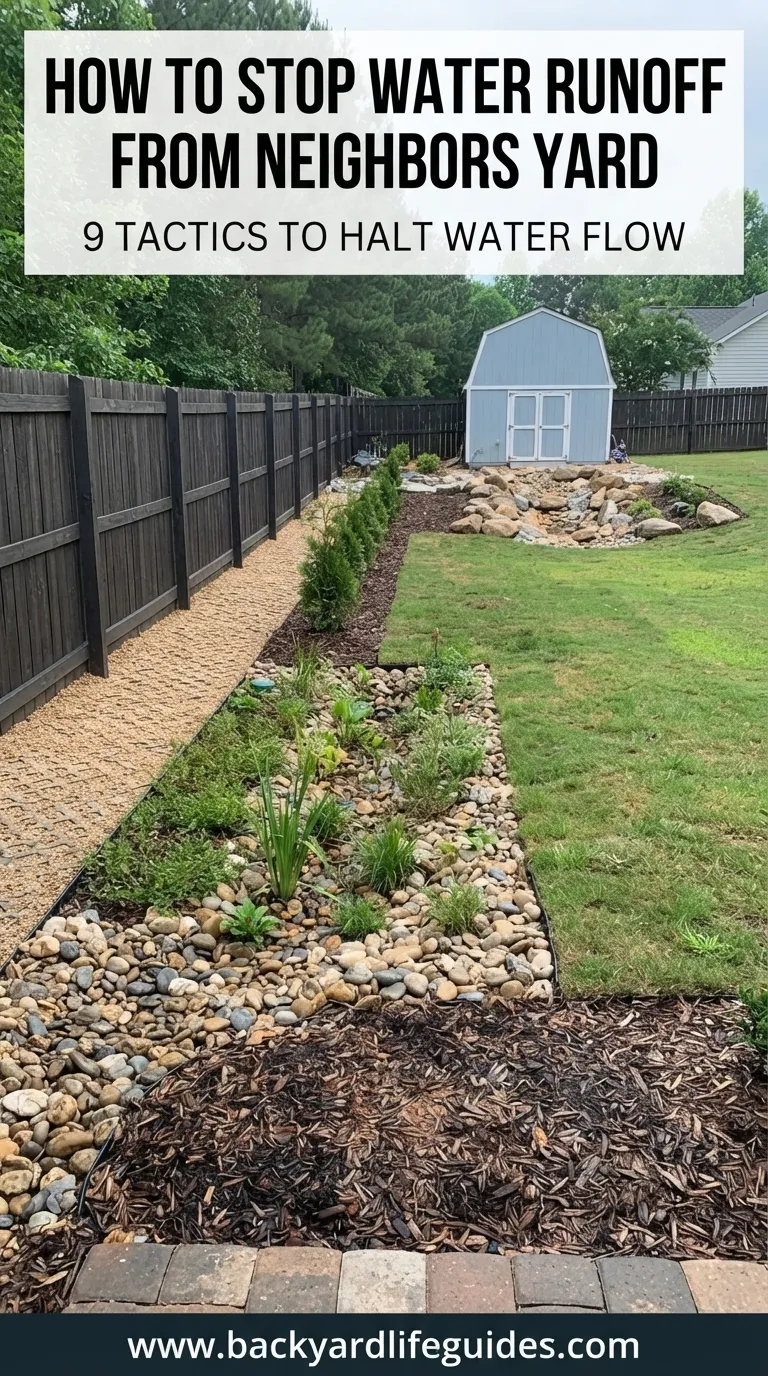
6. Create a Dry Creek Bed
A dry creek bed can turn a runoff path into a landscape feature.
It generally uses:
- River rocks
- Gravel
- Larger stones or boulders
- A shallow channel
The channel guides water through a controlled route while adding a decorative element to the yard.
It can be especially useful when you want drainage infrastructure to blend with the landscape instead of looking like a conventional trench.
7. Use a Dry Well or Rain Garden
A dry well provides underground storage and infiltration for collected water.
My Backyard Life specifically discusses the Flo-Well, which has a stated capacity of 50 gallons. Multiple units can be used where appropriate to increase capacity.
A rain garden provides a different approach. It is a planted depression that temporarily holds runoff before the water filters into the soil.
Engineer Fix states that a properly positioned rain garden can allow runoff to filter into the soil within 24 hours.
Place it where water naturally collects rather than creating a low point beside a foundation.
8. Extend or Bury Downspouts
Sometimes the drainage problem is surprisingly concentrated.
A neighbor’s downspout may discharge close to the property boundary, creating a large amount of water in one small area.
Where cooperation is possible, discuss:
- Moving the downspout outlet
- Extending the discharge point
- Clearing clogged gutters
- Directing water toward an approved drainage location
Razor Sharp Lawns specifically identifies downspouts and French-drain discharge points near property lines as potential causes of runoff problems.
If you modify your own downspouts, make sure the new discharge location does not create another drainage problem.
9. Consider a Retaining Wall or Structural Drainage
If the neighboring property is significantly higher, ordinary landscaping may not be enough.
A retaining wall can help hold back soil and manage differences in elevation. Drainage components such as perforated pipes, gravel, and weep holes may be necessary behind the structure.
For deeper groundwater movement, a curtain drain or other engineered solution may be more appropriate.
These are not ideal projects for guesswork. Structural and drainage requirements can depend heavily on soil, elevation, water volume, and local regulations.
Which Runoff Solution Should You Choose?
Use the following comparison as a starting point rather than a substitute for a site assessment.
| Problem | Useful Solution | Main Purpose |
|---|---|---|
| Broad surface flow | Berm | Intercept and redirect |
| Poor yard slope | Grading | Establish positive drainage |
| Shallow surface runoff | Swale | Slow and guide water |
| Saturated soil | French drain | Collect subsurface water |
| Localized pooling | Catch basin | Collect surface water |
| Decorative drainage path | Dry creek bed | Channel runoff |
| Collected water needing infiltration | Dry well | Store and infiltrate |
| Natural low area | Rain garden | Temporarily hold and absorb |
| Major elevation difference | Retaining wall | Stabilize soil and manage elevation |
The volume and type of water should determine the system, not simply the fact that water is crossing the property line.
Talk to Your Neighbor Before Starting Major Work
A drainage problem can sometimes be solved without excavation.
Your neighbor may not know that their:
- Downspout is discharging toward your property
- Gutter is clogged
- Landscaping redirects water
- Recent patio or driveway changed the flow
- French drain outlet is creating concentrated runoff
A calm conversation may result in a simple adjustment or a shared drainage project.
If a solution benefits both properties, sharing the work or cost may be more practical than immediately starting a dispute. Engineer Fix describes neighbor communication as an important first step before more expensive intervention.
Document the Problem Before Making Changes
If the runoff causes repeated damage, keep a simple record.
Document:
- Dates when flooding occurs
- Times when water begins flowing
- Photos
- Videos
- Pooling locations
- Approximate water depth
- Damage to grass or landscaping
- Foundation or basement concerns
- Repair expenses
- Changes made to either property
This evidence can help you explain the problem clearly to your neighbor, drainage professional, municipality, or attorney.
Check Local Drainage Rules Before Digging
Drainage laws can vary significantly between locations.
The discuss several legal approaches, including:
- Reasonable Use Rule
- Common Enemy Rule
- Civil Law Rule
- Natural-flow principles
- Local ordinances
- Drainage easements
The rules can determine whether a property owner is allowed to alter surface water and what responsibility exists when modifications cause damage.
Most importantly, do not assume that you can simply block the water and send it somewhere else.
Razor Sharp Lawns specifically warns against creating a drainage solution that sends water back toward another property or causes damage elsewhere.
Before major excavation, check applicable local requirements, permits, HOA rules, and drainage regulations.
Stay Safe Before Digging
Drainage projects often require excavation, which means underground utilities must be considered.
Before digging a French drain, dry well, swale, or other buried drainage system:
- Contact the appropriate local utility-marking service.
- Confirm where underground utilities are located.
- Plan the drainage route before excavation.
- Avoid digging close to structures without understanding the risks.
- Get professional help when the project involves major grading, structural walls, or complicated drainage.
My Backyard Life specifically recommends contacting the local utility company before digging and warns about hazards such as service disruption and electric shock.
What Not to Do With Neighbor Runoff
Trying to solve runoff too quickly can make the situation worse.
Avoid:
- Damaging your neighbor’s property
- Building a barrier that simply pushes water back
- Sending water toward another neighbor
- Digging without checking utilities
- Creating steep, erosion-prone channels
- Placing drainage outlets beside a foundation
- Assuming one drainage method works for every soil type
- Ignoring local regulations
- Waiting until repeated flooding causes major damage
The goal is not to make the water disappear. The goal is to control, redirect, slow, or safely infiltrate it.
A Practical Runoff Management Plan
For many homeowners, the following sequence is a sensible starting point:
Step 1: Observe the water during heavy rain.
Step 2: Identify whether it is sheet flow, concentrated flow, or subsurface saturation.
Step 3: Photograph and document the problem.
Step 4: Speak with your neighbor about the likely source.
Step 5: Check local drainage requirements and underground utilities.
Step 6: Choose the least complicated solution that can safely handle the water.
Step 7: Use a berm, swale, grading, or landscaping for manageable surface flow.
Step 8: Consider a French drain or catch basin for persistent or concentrated water.
Step 9: Use a dry well, rain garden, or approved outlet when collected water needs somewhere to go.
Step 10: Call a drainage professional when the volume, elevation, soil conditions, or structural risk exceeds a simple DIY project.
Frequently Asked Questions
Can I completely block water from my neighbor’s yard?
Not necessarily. A physical barrier that simply forces water back onto the neighbor’s property can create additional drainage and legal problems. A safer objective is to manage and redirect water responsibly within applicable property and drainage rules.
What is the best drainage solution for a constantly wet yard?
It depends on the source. A French drain can be useful for subsurface moisture, while a swale, grading, or berm may be more appropriate for surface runoff. A catch basin can help with concentrated surface pooling.
How deep should a residential French drain be?
Engineer Fix gives a typical range of approximately 18–24 inches deep and 9–12 inches wide. Actual dimensions should depend on the site’s drainage requirements and conditions.
What slope should a French drain have?
Engineer Fix specifies a minimum 1% slope, which equals approximately 1 inch of fall for every 10 feet. Other site-specific designs may require different slopes.
How much gravel goes in a French drain?
My Backyard Life recommends approximately 2–3 inches of gravel below the pipe and at least 2–3 inches above it in its installation guidance.
How far should landscape fabric extend?
The My Backyard Life installation guidance recommends allowing approximately 1 foot of fabric to extend beyond the top of the trench walls before folding it over the gravel.
Can a berm stop water runoff?
A berm can intercept and redirect surface runoff, particularly sheet flow. It should be shaped carefully and stabilized with soil and vegetation so it does not erode or create a new drainage problem.
When should I consider professional drainage help?
Professional help is worth considering when water threatens a foundation, the property has a major elevation difference, soil remains saturated, significant excavation is required, or a retaining wall or engineered drainage system is needed.
Should I talk to my neighbor first?
Yes. A conversation is often the simplest starting point. The neighbor may be unaware of the problem and may be able to correct a downspout, gutter, or landscaping issue without major construction.
Can I install drainage without checking local rules?
You should not assume that you can. Drainage modifications can affect neighboring properties, public stormwater systems, easements, and local regulations. Check the applicable requirements before major work.
Final Takeaway
The best way to stop water runoff from a neighbor’s yard is to diagnose the water first instead of immediately building a barrier.
For shallow surface flow, a berm, swale, grading, or landscape solution may be enough. Persistent subsurface water may call for a French drain, while concentrated pooling can benefit from a catch basin. A dry well or rain garden can help manage collected water where infiltration is appropriate.
Remember the key measurements discussed above: French drains may be around 9–12 inches wide and 18–24 inches deep, with a 1% slope; My Backyard Life specifies 2–3 inches of gravel beneath and above its pipe and 1 foot of extra fabric; Engineer Fix describes a 5-inch berm, a 1-foot soil test, a 1-hour infiltration measurement, and a 24-hour rain-garden filtration period.
Most importantly, do not simply push the water onto someone else’s property. A successful drainage solution protects your yard while directing water toward a safe, stable, and legally appropriate destination.