
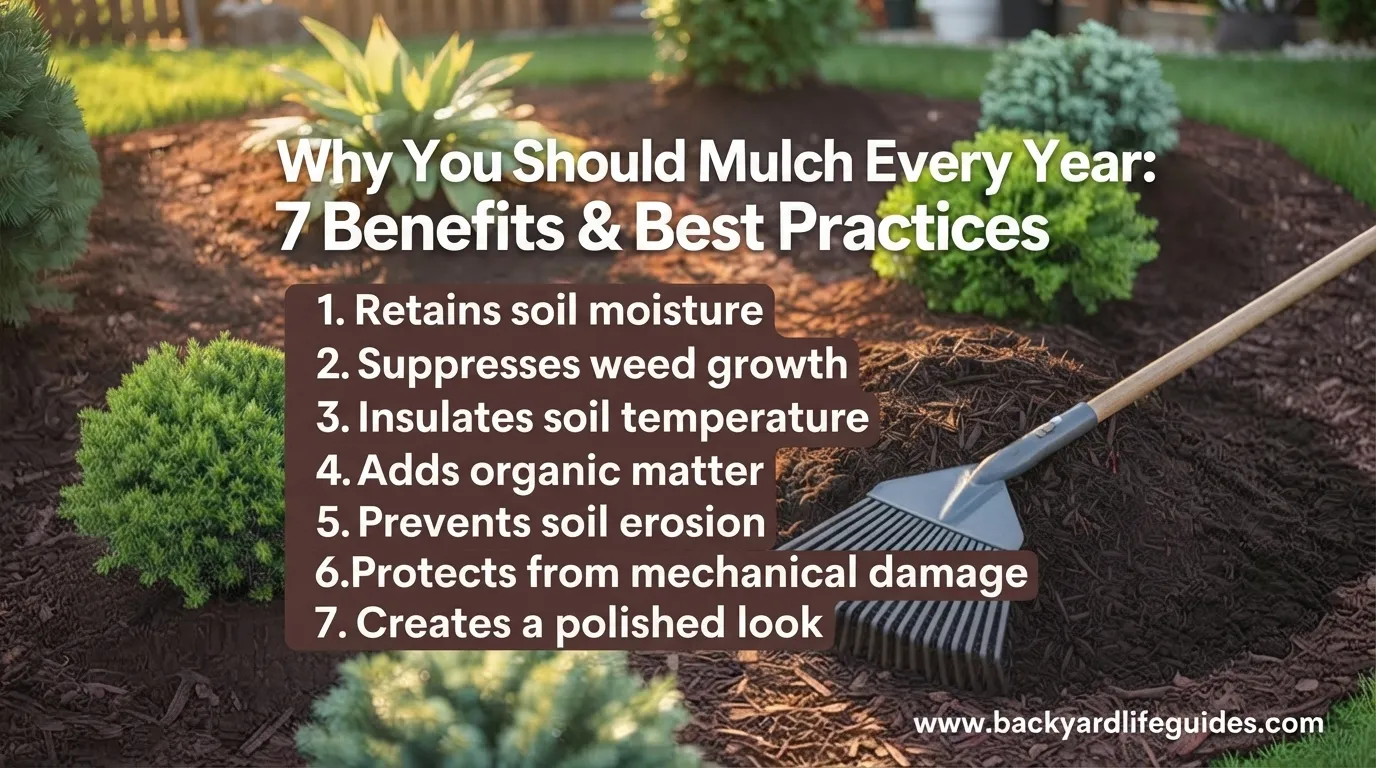
Why You Should Mulch Every Year: 7 Benefits & Best Practices
- Disclosure: This post may include affiliate links. If you click a link and complete a purchase, I may earn a commission. Additionally, as an Amazon Associate, I earn from eligible purchases.
Mulch is more than a finishing touch that makes garden beds look neat. A properly maintained layer can help reduce weeds, conserve moisture, protect soil temperatures, improve soil condition, and support healthier plants.
But “mulch every year” does not necessarily mean removing every piece of old mulch and starting again from bare soil. In many gardens, the better approach is to inspect what is already there, remove problematic material, and refresh the layer only where necessary.
Organic mulch gradually decomposes, becomes compacted, gets displaced by rain and wind, and can lose its protective thickness. Pests, weeds, and plant debris can also make an old mulch layer less desirable.
The right approach depends on the type of mulch, climate, soil, and plant requirements.
7 Reasons to Mulch Every Year
1. Mulch Helps Control Weeds
One of the most noticeable benefits of a maintained mulch layer is weed suppression.
Mulch covers part of the soil surface and reduces the amount of sunlight reaching weed seeds. This makes it harder for many weeds to germinate and establish.
As mulch becomes thin, however, more bare soil can become exposed. Once sunlight reaches the soil surface, weeds have a better opportunity to appear.
Refreshing mulch can therefore provide more consistent coverage throughout the growing season.
Helpful tip: Remove visible weeds before adding fresh mulch. Otherwise, you may simply cover an existing problem instead of dealing with it.
2. It Helps the Soil Hold Moisture
Bare soil loses water through evaporation, particularly during periods of hot or dry weather.
A mulch layer provides a protective covering over the soil. This can reduce direct exposure to sunlight and help slow moisture loss.
That means garden soil can remain moist for longer between watering sessions.
This is particularly useful when plants need consistent moisture, although mulch should still be used according to the needs of the plants growing in the bed.
3. Mulch Helps Regulate Soil Temperature
Garden soil can experience significant temperature changes.
During summer, exposed soil can become excessively hot. During winter, the same soil can be exposed to freezing conditions.
Mulch acts as an insulating layer. It helps moderate these changes by reducing the direct impact of heat and cold on the soil.
This creates a more stable environment around plant roots.
The goal is not to make soil permanently warm or cool. Instead, mulch helps reduce extreme temperature fluctuations.
4. Organic Mulch Adds Nutrients as It Breaks Down
Organic materials such as leaves, twigs, wood chips, bark, and similar materials gradually decompose.
As decomposition occurs, organic material becomes incorporated into the soil and can contribute nutrients and organic matter.
This is one reason old mulch should not automatically be considered waste.
If the existing material is healthy, relatively clean, and still functioning as a mulch layer, it may simply need to be topped up rather than completely removed.
However, decomposition also means the mulch layer becomes thinner over time.
5. It Can Improve Soil Structure
Organic mulch can contribute to healthier soil as it breaks down.
Decomposing organic material can improve soil structure and help create conditions that support better water retention and soil porosity.
The benefit develops gradually rather than immediately after applying fresh mulch.
This makes regular maintenance useful: each season’s mulch can contribute to the longer-term condition of the soil while continuing to provide surface protection.
6. Fresh Mulch Improves the Appearance of Garden Beds
There is also a visual benefit.
Fresh mulch can make garden beds look cleaner, more organized, and better maintained.
The color of mulch can also change how plants and surrounding landscape features appear. Dark mulch can provide stronger contrast with plants and structures, while lighter mulch can create a more natural-looking appearance.
For homeowners who care about both plant health and curb appeal, a yearly inspection and refresh can address both needs.
7. Regular Mulching Can Reduce Weeding and Soil Erosion
Mulch does more than block sunlight from weeds.
It can also help protect exposed soil from being displaced by rainfall and water movement.
A maintained layer can therefore contribute to better soil protection while reducing the amount of manual weeding needed in landscape beds.
Annual or biennial maintenance can be enough for many landscapes, depending on how quickly the mulch breaks down and how much coverage has been lost.
Does Mulch Really Need to Be Replaced Every Year?
Not always.
This is one of the most important points to understand.
The condition of the existing mulch matters more than simply following a calendar.
Highly compostable materials such as leaves, twigs, and grass-based mulch can break down relatively quickly and may need attention once a year.
Wood and rubber mulch can last considerably longer. The guidance you provided places wood and rubber mulch at approximately 3 years, while another source gives 1–2 years as a typical replenishment period for organic wood or bark mulch.
These figures are best treated as maintenance ranges rather than strict rules.
A Simple Inspection Before Replacing Mulch
Before buying another load of mulch, check:
- Has the mulch become noticeably thin?
- Is bare soil visible?
- Has rain or wind displaced large sections?
- Are weeds becoming difficult to control?
- Has the mulch become heavily compacted?
- Is there evidence of pests?
- Does the material appear healthy and usable?
- Have plants previously suffered from disease in that mulch?
If the layer is still healthy and sufficiently thick, you may only need to rake and refresh it.
How Deep Should Mulch Be?
The commonly cited mulch depth in the material is 2–4 inches.
Another specifically recommends refreshing an existing bed to approximately 2–3 inches.
For practical maintenance, think of 2–4 inches as the general range, while adjusting the amount according to the plants and existing conditions.
| Mulch situation | Practical approach |
|---|---|
| Thin mulch | Add enough to restore coverage |
| Healthy existing mulch | Top-dress rather than remove everything |
| Fresh seasonal refresh | About 2–3 inches is commonly recommended |
| General mulch depth guidance | 2–4 inches |
| Excessively thick layer | Avoid continuously piling more material on top |
The objective is an effective protective layer—not the deepest possible layer.
Why You Shouldn’t Keep Adding New Mulch on Top
One common mistake is treating every year as an automatic opportunity to add another layer.
If you continually add fresh mulch without checking the old material, the total depth can become excessive.
Old mulch may also become compacted underneath the new material.
A better process is to inspect first, remove what is necessary, and then restore the desired depth.
This approach also helps you notice weeds, pests, disease-related material, and other problems before they become hidden beneath a new layer.
When Is the Best Time to Refresh Mulch?
The material consistently emphasizes spring as the main refresh period.
One source recommends removing old mulch in February or around the middle of spring, while another recommends spring refreshing and specifically mentions March or April as useful early-ordering months in Connecticut.
Spring makes practical sense because it comes before or around the beginning of the main growing season.
A fresh layer at this time can help with:
- Weed suppression
- Moisture retention
- Soil protection
- Garden appearance
- Seasonal maintenance
In Connecticut, Nature’s Harvest Mulch identifies Memorial Day weekend as a peak period for mulch demand, so homeowners wanting earlier service may benefit from planning ahead.
Should You Remove Old Mulch Before Adding New Mulch?
Sometimes—but not automatically.
This is where mulch maintenance becomes more practical than simply following an annual replacement rule.
You should consider removing old mulch when it is:
- Heavily decomposed
- Diseased
- Infested with pests
- Severely compacted
- No longer providing useful coverage
- Associated with previous plant disease problems
If the old mulch is healthy and simply has become thinner, completely removing it may be unnecessary.
Instead:
- Remove dead plant material.
- Pull visible weeds.
- Inspect the existing mulch.
- Loosen compacted areas when necessary.
- Add fresh mulch where the layer is too thin.
- Restore the bed to an appropriate depth.
- Keep mulch away from plant stems and tree trunks.
This method avoids unnecessary work and makes better use of usable organic material.
What Happens When Mulch Gets Old?
Old mulch does not simply “stop working” overnight.
It gradually changes.
Decomposition
Organic mulch breaks down naturally. This can benefit the soil, but it also reduces the thickness of the protective layer.
Displacement
Wind and water can move mulch away from garden beds. Over time, this can leave some areas uncovered while other areas become thicker.
Compaction
Repeated rain and weather exposure can cause mulch to settle and become compacted.
A compacted layer may need to be loosened so air can move through it more effectively.
Pest Activity
Old mulch can become an environment where pests may lay eggs or remain active.
Regular inspection gives you an opportunity to identify problems before adding more material.
Souring
Poorly aerated, wet mulch can develop anaerobic conditions.
The material describes this process as producing compounds such as ammonia and alcohol, which can be harmful to plants. It also associates heavily affected mulch with increased flammability.
This is one reason regularly checking and raking mulch is preferable to simply building layer after layer.
How Often Should You Rake Mulch?
One recommends raking new mulch every 3–4 months.
The purpose is to introduce air into the layer and help prevent excessive compaction or souring.
Raking can also redistribute mulch that has been moved by rain, foot traffic, wind, or other disturbances.
You do not need to treat the calendar as an absolute rule. Instead, inspect the bed periodically and rake when the material appears compacted or uneven.
What Type of Mulch Needs the Most Frequent Replacement?
Not all mulch behaves the same way.
| Mulch type | General maintenance expectation |
|---|---|
| Leaves, twigs, grass-type organic mulch | Can require annual attention |
| Wood chips | Often replenished as they break down |
| Bark mulch | Commonly replenished around every 1–2 years |
| Rubber mulch | Can remain useful for several years |
| Synthetic mulch | Generally lasts longer than organic materials |
The exact lifespan depends on weather, climate, material quality, soil conditions, and the location of the garden bed.
Warm and humid conditions can accelerate decomposition, while different soil types can also influence how quickly organic materials change.
How Climate and Soil Affect Mulching Frequency
A single replacement schedule cannot work perfectly for every garden.
Warm and Humid Conditions
Higher warmth and moisture can accelerate decomposition of organic mulch.
This may mean more frequent replenishment is necessary.
Sandy Soil
Sandy soil drains quickly. This can affect moisture management and the condition of the mulch layer.
Clay Soil
Clay soil generally retains moisture more effectively, which can influence decomposition and mulch conditions.
Plant Requirements
Different plants have different preferences.
For example, plants that prefer drier conditions may not benefit from the same mulch approach as moisture-loving vegetables.
Inspect the plants and soil first instead of applying a universal depth or schedule everywhere.
What Are the Alternatives to Annual Mulching?
Annual refreshing is not the only approach.
Top-Dressing With Compost
Instead of replacing the entire mulch layer, you can add compost where appropriate and maintain the existing surface material.
This approach focuses on improving the soil while avoiding unnecessary removal.
Sheet Mulching
Sheet mulching uses materials such as cardboard, newspaper, and compost to create a layered covering.
It can be useful when the objective is broader soil and weed-management work rather than simply refreshing an existing decorative mulch bed.
Living Mulch
Living mulch uses low-growing plants or groundcovers to provide living soil coverage.
This is a different strategy from applying loose mulch, but it can reduce exposed soil and provide continuous ground coverage.
What Should You Do With Old Mulch?
Old mulch does not necessarily need to go straight into the trash.
If it is healthy and free from pests and disease, several options may be available.
Compost It
Compostable organic material can become part of a composting system.
Work It Into the Soil
Healthy, disease-free and pest-free organic material can potentially be incorporated into the soil as organic matter.
Use Compostable Waste Disposal
Material that cannot be reused can be disposed of through an appropriate compostable waste system where available.
Burning
One mentions burning as a disposal option, but this should only be considered where it is legally permitted and safely managed. Local restrictions and fire conditions should always take priority.
How to Refresh Mulch Correctly
A simple refresh can be completed in several steps.
Step 1: Inspect the Existing Layer
Look at the depth, condition, moisture, weeds, pests, and signs of disease.
Step 2: Remove Dead Plant Material
Clear away dead leaves, dead plants, and winter debris.
Step 3: Remove Weeds
Pull visible weeds before adding fresh mulch.
Step 4: Deal With Compaction
If the existing material has become compacted, rake or loosen it as appropriate.
Step 5: Add Fresh Mulch
Add enough new material to restore the bed to an appropriate 2–4 inch range, taking plant requirements into account.
Step 6: Keep Mulch Away From Plant Bases
Do not pile mulch directly against stems or tree trunks.
Leave a small gap so excessive moisture does not remain trapped around the plant base.
Step 7: Water the Plants
After refreshing mulch, water the plants appropriately.
Fresh mulch can be dry, and replacing mulch can expose previously covered soil.
4 Common Mulching Mistakes to Avoid
1. Adding New Mulch Without Inspecting the Old Layer
This can create excessive depth and hide problems underneath.
2. Leaving Weeds Under Fresh Mulch
Mulch is much more useful when weeds are removed first.
3. Piling Mulch Against Stems and Trunks
Keeping mulch away from plant bases helps reduce excessive moisture around sensitive areas.
4. Ignoring Compacted Mulch
A thick, compacted layer should not simply receive another layer on top. Rake and inspect it first.
Annual Mulching: Quick Decision Guide
Use this simple checklist before deciding what to do.
| If your mulch is… | What to consider |
|---|---|
| Thin and uneven | Refresh the low areas |
| Healthy but slightly decomposed | Top-dress with fresh mulch |
| Full of weeds | Remove weeds before refreshing |
| Pest-affected | Consider removal and replacement |
| Associated with diseased plants | Replace affected material |
| Compacted | Rake and loosen before adding more |
| Still thick and healthy | Full replacement may not be necessary |
This approach is more useful than assuming every garden needs a complete mulch replacement every 1 year.
How Much Mulch Do You Need?
The amount required depends primarily on:
- Total square footage
- Existing mulch depth
- Desired new depth
- Amount of material that needs to be removed
Nature’s Harvest Mulch also provides a mulch calculator and states a 2-yard minimum order for its service area.
For any mulch supplier, calculate the area first so you do not order significantly more material than needed.
Annual Mulching vs. Mulch Refreshing
The terms can sound interchangeable, but they are not always the same.
Annual replacement suggests removing the old material and installing completely new mulch.
Annual refreshing means inspecting the existing mulch, correcting problems, and adding enough material to restore the desired coverage.
For many established beds, refreshing is the more practical approach.
It reduces unnecessary removal while still maintaining the benefits of mulch.
A Practical Yearly Mulch Schedule
You can use the following routine as a simple maintenance framework:
Late winter: Inspect the beds and remove unwanted debris.
February–April: Prepare for the growing season and refresh mulch where necessary.
Spring: Add fresh material to areas where the layer has become thin.
Every 3–4 months: Check for compaction and redistribute mulch when necessary.
Throughout the growing season: Watch for weeds, pests, excessive moisture, and exposed soil.
Before the next refresh: Evaluate whether the existing material should be reused, topped up, or removed.
This turns mulch maintenance into an inspection-based routine rather than an automatic yearly replacement.
Final Thought
Mulching every year can be beneficial, but the goal should not be to replace mulch simply because another year has passed.
The better strategy is to inspect, clean, correct, and refresh.
A maintained layer of approximately 2–4 inches can help suppress weeds, conserve moisture, moderate soil temperature, protect soil from erosion, improve soil condition, and enhance the appearance of garden beds.
Organic mulch may require attention every 1 year, while wood, bark, rubber, and synthetic materials can last longer. Some organic wood and bark mulch may be replenished every 1–2 years, while wood and rubber mulch may remain useful for up to around 3 years, depending on conditions.
Spring—particularly February through April for early seasonal preparation—is a practical time to evaluate the mulch layer.
Most importantly, do not automatically remove healthy old mulch. If it is clean, disease-free, pest-free, and still providing adequate coverage, refreshing rather than completely replacing it can be the smarter choice.
Frequently Asked Questions
Is it necessary to replace mulch every year?
No. Inspect the existing mulch first. Healthy mulch that remains sufficiently thick may only need raking or topping up rather than complete replacement.
What is the ideal mulch depth?
The guidance gives a general range of 2–4 inches, while fresh seasonal refreshes are commonly described around 2–3 inches.
What month is best for replacing mulch?
Spring is the main recommended period. The supplied material mentions February, March, and April as useful timing depending on the situation and location.
How often should wood mulch be replaced?
Wood mulch generally lasts longer than highly compostable materials. The supplied information gives approximately 1–2 years for organic wood or bark replenishment and up to around 3 years for wood and rubber mulch.
Should I remove old mulch before adding new mulch?
Not necessarily. Remove old mulch when it is diseased, pest-affected, severely compacted, or no longer useful. Otherwise, you can often refresh the existing layer.
Can old mulch be mixed into soil?
Healthy, disease-free and pest-free organic mulch can potentially be worked into the soil as organic matter.
How often should mulch be raked?
One recommends raking every 3–4 months to introduce air and help prevent compaction and souring. Adjust this according to the actual condition of the mulch.
Can mulch cause plant problems?
Yes. Poorly maintained or heavily compacted mulch can contribute to pest, disease, moisture, or souring problems. Avoid piling mulch directly against stems and tree trunks.
Does mulch improve soil?
Organic mulch can contribute organic matter and nutrients as it decomposes. It can also support improved soil structure, moisture retention, and temperature regulation.
Is yearly mulching better than every two years?
Not automatically. The best schedule depends on mulch type, decomposition, weather, soil, plant needs, and the condition of the existing layer. Some landscapes may need yearly attention, while others can go longer.
One Comment