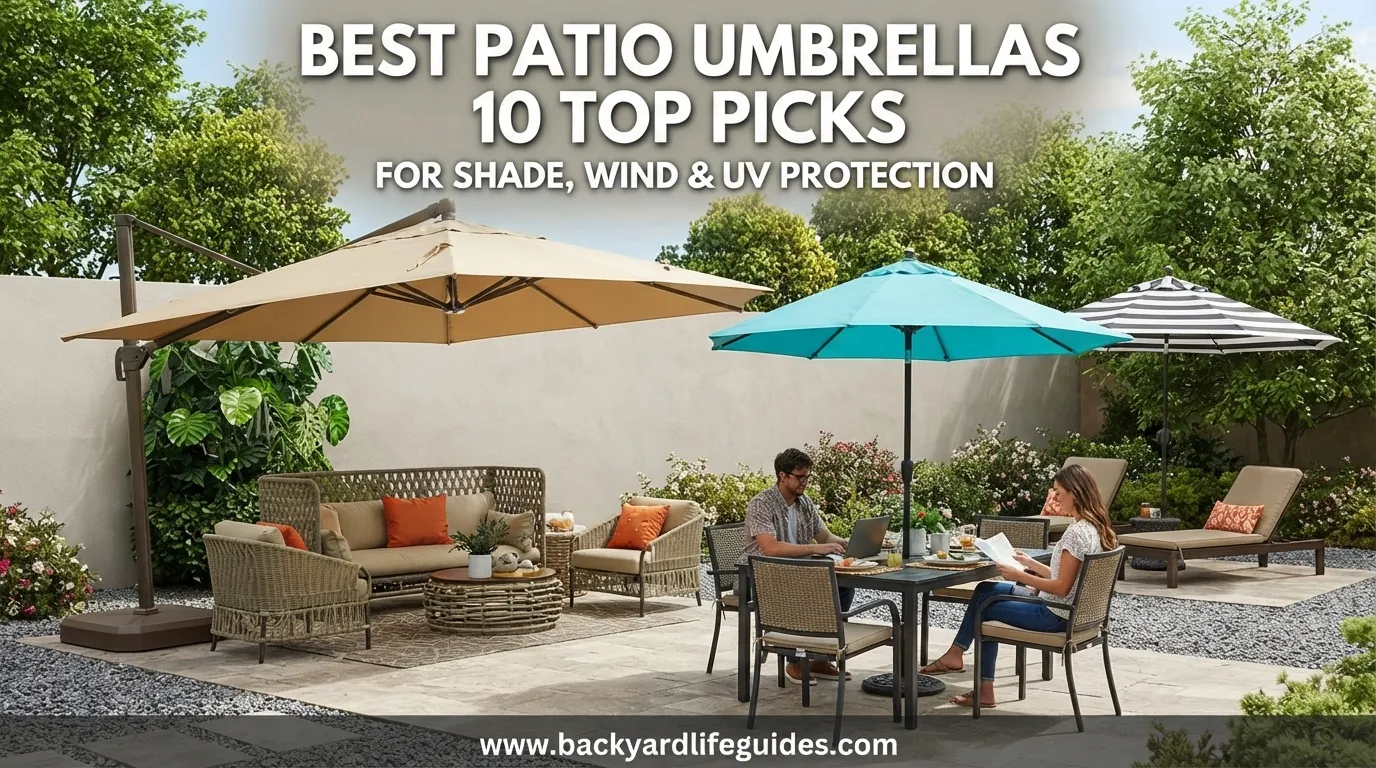
Best Patio Umbrellas: 10 Top Picks for Shade, Wind & UV Protection
- Disclosure: This post may include affiliate links. If you click a link and complete a purchase, I may earn a commission. Additionally, as an Amazon Associate, I earn from eligible purchases.
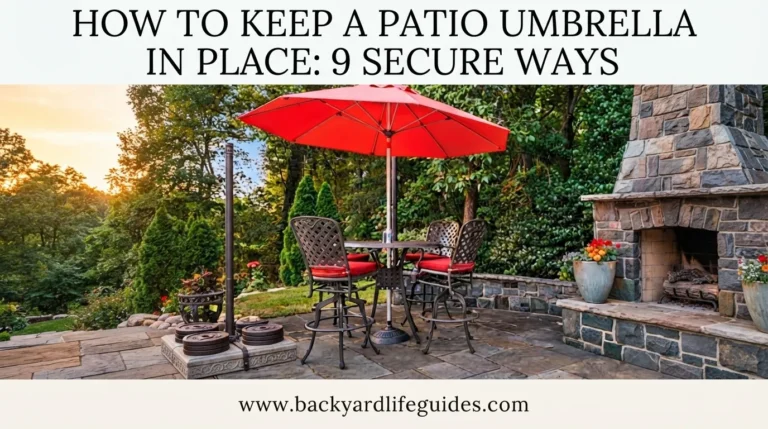
A good patio umbrella does more than provide shade. The right model should match your patio size, table dimensions, weather conditions, preferred coverage, fabric needs, and available base space.
The five major buying factors that repeatedly matter when comparing patio umbrellas are canopy size, stability, UV protection, fabric durability, and base weight. Features such as tilt mechanisms, 360-degree rotation, solar LEDs, cantilever frames, and fade-resistant fabric can also make a noticeable difference in everyday use.
There is no single umbrella that is perfect for every patio. A 7-foot umbrella can work well for a compact seating area, while an 11- to 15-foot model can provide substantially more coverage for larger dining sets or outdoor sectionals.
This guide brings those considerations together so you can compare the most useful patio umbrella styles without having to sort through specifications one by one.
How to Choose the Right Patio Umbrella
Choosing by appearance alone can lead to an umbrella that is either too small, difficult to stabilize, or poorly suited to your patio.
Instead, compare the following specifications.
Start With Canopy Size
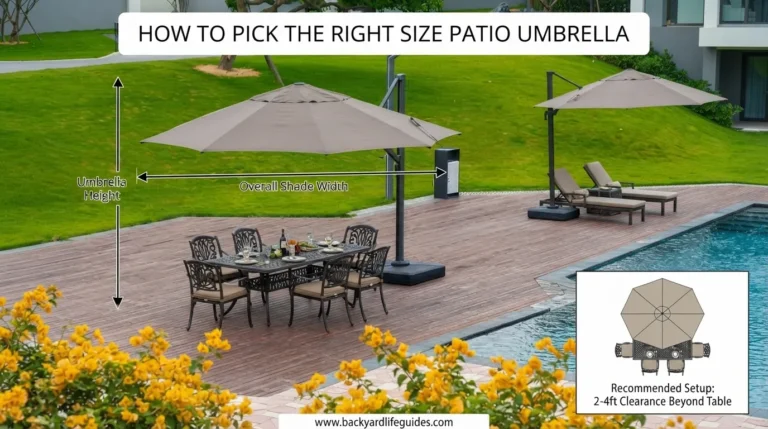
Canopy size is one of the easiest ways to narrow your options.
A 7- to 7.5-foot umbrella is useful for smaller spaces, compact seating arrangements, or smaller tables. A 9-foot canopy is a common choice for standard outdoor dining tables and everyday patio seating.
For larger areas, consider an 11-foot model. Extra-large umbrellas can extend to 13 or 15 feet when you need substantially wider shade.
The PHI VILLA double-sided design, for example, reaches 15 × 9 feet and provides approximately 135 square feet of coverage.
Match the Umbrella to Your Table
The canopy should extend beyond the seating area rather than simply covering the center of the table.
A 9-foot umbrella can work well with many tables in the 42- to 54-inch range. Larger dining sets may benefit from an 11-foot or larger canopy.
Before buying, measure:
- Table width
- Table length
- Chair position
- Total seating area
- Available clearance around the umbrella
- Table umbrella-hole diameter
A large canopy is not automatically better if your patio does not have enough room to accommodate it.
Consider Wind Before Choosing an Umbrella
Wind resistance is one of the most important practical considerations.
A large canopy catches more wind, which means the frame, ribs, pole, and base all become important.
Several of the reviewed models were evaluated against substantial wind conditions. The figures reported across the products include approximately 30 MPH, 35 MPH, 40 MPH, and 43 MPH.
These numbers should not be interpreted as a universal guarantee for every umbrella. Wind performance depends on the installation, base, canopy position, surface, and surrounding environment.
Look for Vented Canopies
A vent allows air to move through the umbrella rather than forcing all of the pressure against a solid canopy.
Useful designs include:
- Single vents
- Double vents
- Three-tier vents
- Two-tier cantilever vents
The EliteShade 3-Tier design and several other reviewed models use vented canopies specifically as part of their stability and airflow design.
Use Enough Base Weight
A strong canopy still needs a suitable base.
Base requirements can vary dramatically. Examples from the reviewed products include approximately 50 lb, 100 lb, 135 lb, 200 lb, 220 lb, 265 lb, and even 432 lb when using a heavy paver configuration.
For example, the Forbes-tested Frontgate 11-foot umbrella calls for at least 50 lb with a small table and approximately 100 lb when used freestanding with a larger table.
The Purple Leaf system can reach approximately 220 lb when fully weighted.
The Frontgate Altura system can use 12 concrete pavers weighing 36 lb each, giving a combined paver weight of approximately 432 lb.
The important lesson is simple: never judge stability by canopy size alone.
UV Protection Matters
A patio umbrella is primarily a shade product, so UV protection should be high on your checklist.
Some reviewed umbrellas use specifications such as:
- UPF 50+
- 99.9% UV blocking
- UV-resistant polyester
- Solution-dyed acrylic
- Fade-resistant fabrics
The Abba Patio Lyon, for example, is listed with UPF 50+ protection and a claim of blocking 99.9% of UV rays.
The Bluu Banyan model is also described with 99.9% UV blocking.
These specifications can help compare products, but remember that UV protection does not mean the entire outdoor area is completely protected from sunlight.
Choose the Right Fabric
Fabric affects appearance, durability, water resistance, and fade resistance.
Polyester
Polyester appears frequently in affordable and mid-range patio umbrellas.
It can offer a useful balance between:
- Cost
- Weight
- Outdoor performance
- Color choices
- Water resistance
Some reviewed products use 180G or 240G polyester, providing a useful specification for comparison.
Acrylic
Solution-dyed acrylic appears in several premium-oriented options.
The EliteShade and Sunbrella-related recommendations emphasize fade resistance and long-term outdoor appearance.
Some products are associated with claims of approximately 5 years of fade resistance, while other products in the comparison carry 10-year no-fade or fade-resistance claims.
Sunbrella
Sunbrella fabric appears in premium patio umbrella recommendations because of its emphasis on outdoor durability and resistance to fading.
If appearance retention is a priority, fabric construction can be more important than choosing the cheapest umbrella.
Best Patio Umbrella Styles
Different umbrella designs solve different patio problems.
Market Umbrellas
A market umbrella is the familiar center-pole design used with outdoor tables.
It is usually the easiest style to understand and can be an excellent choice for:
- Dining tables
- Smaller seating areas
- Everyday shade
- Traditional patio layouts
A 9-foot market umbrella is one of the most common sizes represented among the reviewed products.
Cantilever Umbrellas
Cantilever umbrellas move the pole away from the center of the shaded area.
That makes them particularly useful when you want shade over furniture without placing a pole through the center of a table.
Many cantilever models include:
- Adjustable angles
- Rotating mechanisms
- Side-mounted frames
- Large canopies
- Heavy bases
The Purple Leaf model, for example, provides 360-degree rotation and multiple height or angle combinations.
Offset Umbrellas
Offset umbrellas use a similar side-support concept and can cover seating areas without requiring the center pole to occupy the middle of the furniture arrangement.
They are particularly useful when furniture placement is more important than having a traditional center-mounted umbrella.
Wall-Mounted Umbrellas
Wall-mounted models can be useful where floor space is limited.
Instead of relying entirely on a traditional freestanding base, the umbrella attaches to a wall or vertical structure.
This can make the design practical for compact outdoor spaces.
Best Patio Umbrellas With Solar Lights
Solar lighting is useful when you want to keep using the patio after sunset.
Several reviewed models include integrated LED lighting.
The Best Choice Products solar umbrella uses 24 LEDs and is reported with approximately 6 to 7 hours of lighting runtime.
The SUPERJARE model goes much further with:
- 120 LEDs
- 13 lighting modes
- Approximately 4 hours of USB-C charging
- A 13-foot canopy
- 12 ribs
Solar lighting adds convenience, but it should not be the only reason to choose a particular umbrella. The canopy, frame, base, and fabric remain more important for daytime outdoor use.
Best Patio Umbrella for Small Spaces
A smaller patio does not necessarily need a complicated cantilever system.
A 7- to 7.5-foot umbrella can provide useful shade without overwhelming a compact seating arrangement.
The Abba Patio 7.5-foot market umbrella and the Ammsun 7-foot model are examples of smaller options in the reviewed products.
A smaller canopy can also be easier to:
- Position
- Store
- Stabilize
- Fit around furniture
Measure your patio before choosing a larger model simply because it offers more shade.
Best Large Patio Umbrellas
If you have a large dining table, sectional, or outdoor entertainment area, consider an 11- to 15-foot umbrella.
The major large-size examples include:
- 11 ft market umbrellas
- 11.5 ft heavy-duty cantilever designs
- 13 ft solar umbrellas
- 15 ft double-sided umbrellas
The PHI VILLA 15-foot design provides approximately 135 square feet of coverage, making it one of the largest configurations represented in the reviewed products.
Large umbrellas need particularly careful attention to the base and installation surface because a larger canopy can create greater wind pressure.
Best Patio Umbrella for Windy Conditions
For windy locations, focus on the complete system rather than one specification.
Look for:
Fiberglass ribs: They can flex rather than behaving like completely rigid components.
Vented canopies: Vents help air pass through the canopy.
Strong frames: Aluminum and steel appear frequently in the reviewed designs.
Heavy bases: More canopy requires an appropriate counterweight.
Secure positioning: Even a strong umbrella should be closed during unsuitable weather.
The Ayge 9-foot umbrella, for example, uses 8 fiberglass ribs, while several cantilever designs use reinforced aluminum structures.
One reviewed Midtown Umbrellas model carries a stated 43 MPH wind rating, while other tested products were exposed to gusts around 30–40 MPH.
These figures are useful for comparison, but they should not replace safe-weather practices.
Best Patio Umbrella for UV and Fade Resistance
If your patio receives strong sunlight for long periods, prioritize fabric quality.
A good comparison should include:
| Feature | Why It Matters |
|---|---|
| UPF 50+ | Indicates strong fabric-level UV protection |
| UV-resistant fabric | Helps protect the material from sunlight |
| Solution-dyed acrylic | Useful for long-term color retention |
| Fade warranty | Provides additional information about expected performance |
| Ventilation | Helps airflow and can support canopy stability |
The reviewed products include fade-related claims ranging from approximately 5 years to 10 years, depending on the manufacturer and fabric.
Patio Umbrella Base: What Weight Do You Need?
The base is easy to overlook when shopping for an umbrella.
However, it can be one of the most important components of the complete setup.
| Umbrella Situation | Example Base Weight Mentioned |
|---|---|
| Standard umbrella | 50 lb |
| Larger freestanding setup | 100 lb |
| Large umbrella sand requirement | 135 lb |
| Heavy cantilever setup | 200–220 lb |
| Large reinforced system | 265 lb |
| Heavy paver configuration | 432 lb |
These figures come from the specific products reviewed and should not be treated as a universal base-weight chart.
Always follow the manufacturer’s installation requirements for the exact umbrella.
Important Features Worth Paying For
Not every feature is necessary, but some can significantly improve everyday usability.
Tilt Mechanism
A tilt function lets you redirect shade as the sun moves.
Some reviewed umbrellas provide approximately 45 degrees of tilt, while the Bluu Banyan model is listed with a 90- to 180-degree adjustment range.
360-Degree Rotation
Cantilever umbrellas can benefit greatly from rotation.
The ability to rotate the canopy lets you follow changing sunlight without moving the entire base.
Several reviewed cantilever products offer 360-degree rotation.
Crank Lift
A crank mechanism makes opening and closing easier than manually lifting a large canopy.
This is especially useful for 9- to 13-foot umbrellas.
Solar LEDs
Solar lighting can turn a daytime shade product into an evening patio feature.
The reviewed products range from 24 LEDs to 120 LEDs, depending on the model.
How the Testing and Evaluation Should Be Understood
The reviewed sources use different approaches to evaluating patio umbrellas.
Forbes reports testing 11 models, with 9 winners, and began with approximately 2 weeks of testing before longer-term evaluation.
The Spruce reports testing 50+ styles, shapes, and sizes, with some products tested for more than 6 months.
Sarah Lee & Johnny describes testing umbrellas across three patio seasons on a 12 × 20-foot concrete slab.
Bob Vila evaluates categories including:
- Durability
- Stability
- Water resistance
- Design
Products receive scores on a 5-point scale in its testing framework.
These approaches demonstrate why a useful patio umbrella comparison should consider more than appearance or price.
Patio Umbrella Materials Compared
| Material | Main Advantage | What to Consider |
|---|---|---|
| Aluminum | Lightweight and corrosion-resistant | Frame quality varies |
| Steel | Strong structural option | Can be heavier |
| Fiberglass | Flexible ribs | Useful for wind-oriented designs |
| Polyester | Affordable and widely used | Quality and weight vary |
| Acrylic | Strong fade-resistance potential | Usually positioned as a premium fabric |
| Sunbrella | Premium outdoor fabric | Higher-end option |
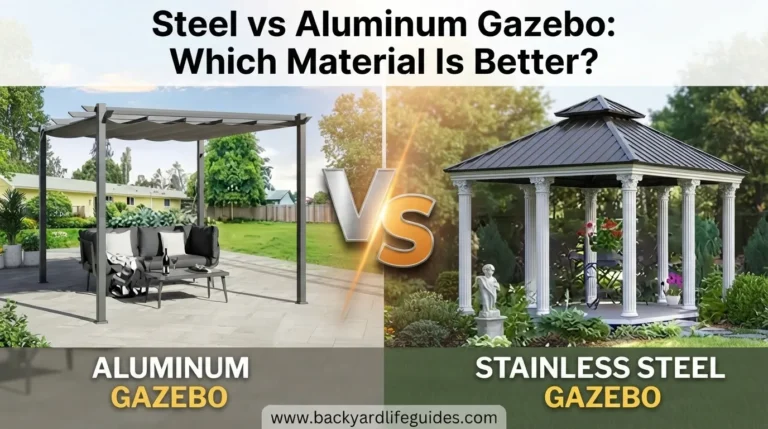
The best material depends on how you intend to use the umbrella.
For windy areas, the frame and rib construction deserve particular attention. For sunny patios, fabric quality and fade resistance may matter more.
10 Practical Checks Before You Buy
Before ordering a patio umbrella, work through this checklist:
- Measure your table and seating area.
- Decide whether a 7, 9, 10, 11, 13, or 15-foot canopy makes sense.
- Check the umbrella’s base requirement.
- Consider your area’s typical wind conditions.
- Look for a vented canopy.
- Compare UV protection.
- Check the fabric type and fade-resistance information.
- Decide whether you need tilt or 360-degree rotation.
- Consider solar LEDs if you use the patio after dark.
- Confirm that the pole and base will fit your existing patio furniture.
Common Patio Umbrella Mistakes
Buying Too Small
A canopy that barely covers the table may leave the people sitting around it exposed to direct sun.
Ignoring the Base
A beautiful umbrella can still become unstable if the base is insufficient for its size and design.
Choosing Only by Price
Lower-priced umbrellas can be useful, but fabric, frame, ribs, base requirements, and warranty information should also be considered.
Forgetting the Wind
A patio umbrella should be closed and secured during unsuitable weather, even when the product has wind-resistant features.
Choosing a Large Umbrella for a Small Patio
A 13- or 15-foot canopy may provide excellent shade but can make a compact patio feel crowded.
Frequently Asked Questions
What is the best patio umbrella size?
A 9-foot umbrella is a versatile choice for many standard patio tables. Smaller 7- to 7.5-foot models suit compact spaces, while 11- to 15-foot umbrellas are better for larger seating areas.
Is a 9-foot patio umbrella big enough?
For many standard outdoor tables, yes. A 9-foot canopy appears frequently among the reviewed products and can provide practical coverage without requiring the large base and clearance of an extra-large umbrella.
What size patio umbrella is best for a large table?
An 11-foot or larger umbrella can be a better choice for large dining tables and sectionals. For especially large outdoor areas, 13- or 15-foot models provide substantially more coverage.
Are cantilever umbrellas better than regular umbrellas?
Neither style is universally better. A cantilever umbrella is useful when you want the pole positioned beside the furniture, while a traditional market umbrella works naturally through a table’s center.
How much does a patio umbrella base need to weigh?
The reviewed products show requirements ranging from around 50 lb to several hundred pounds depending on umbrella size and design. Always follow the manufacturer’s specific base recommendation.
What is the best fabric for a patio umbrella?
Acrylic and premium outdoor fabrics are attractive choices when fade resistance is important. Polyester can offer a practical balance between cost and outdoor performance.
Are solar patio umbrellas worth it?
Solar umbrellas can be worthwhile if you regularly use your patio after sunset. The reviewed products include models with 24 LEDs and others with as many as 120 LEDs.
How long do patio umbrella lights last?
The reviewed solar models include lighting runtimes around 6–7 hours, although actual performance depends on sunlight, charging conditions, battery condition, and usage.
What patio umbrella is best for windy areas?
Look for a combination of a strong frame, flexible ribs, vented canopy, secure base, and appropriate installation. Wind figures from reviewed products range from roughly 30 to 43 MPH, but those numbers are product-specific.
Is UPF 50+ good for a patio umbrella?
UPF 50+ represents a high level of fabric-level UV protection. It is a useful specification when comparing umbrellas intended for sunny outdoor areas.
Final Buying Advice
The best patio umbrella is not necessarily the biggest, most expensive, or most feature-packed model.
For a typical patio, start with a 9-foot market umbrella if you need straightforward table coverage. Move toward an 11-foot cantilever or market design when you need more shade. Choose a 13- or 15-foot option only when your patio and base can safely accommodate the larger canopy.
If wind is your main concern, prioritize the complete system—frame, ribs, vents, base, and installation—not just a manufacturer’s wind number.
If sunlight and fading are your biggest concerns, prioritize UV protection, UPF ratings, acrylic or premium outdoor fabrics, and fade warranties.
And if evening entertaining matters, solar umbrellas with 24 to 120 LEDs can add useful illumination without requiring a separate lighting installation.
Ultimately, the strongest choice is the umbrella that fits your space, furniture, weather conditions, shade requirements, and everyday habits. A correctly sized canopy with an appropriate base will usually provide more practical value than simply choosing the largest model available.