How to Pick the Right Size Patio Umbrella
- Disclosure: This post may include affiliate links. If you click a link and complete a purchase, I may earn a commission. Additionally, as an Amazon Associate, I earn from eligible purchases.
Choosing a patio umbrella is not simply about buying the largest canopy that fits your budget. The right size should provide enough shade, leave comfortable space around your furniture, and remain proportional to your patio.
A canopy that is too small can leave people sitting in direct sunlight, while an oversized umbrella may dominate a compact patio and place additional demands on the pole and base.
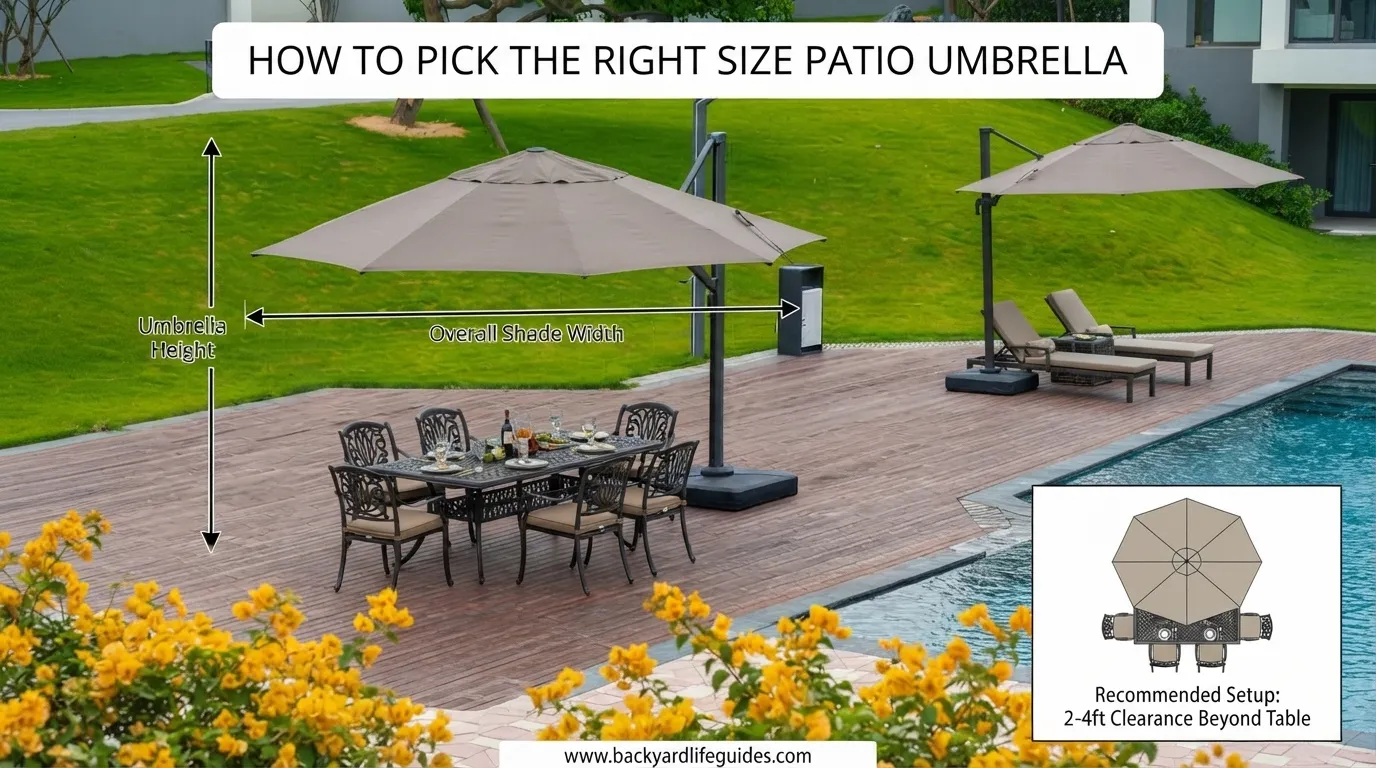
The easiest starting point is the 2-foot rule: aim for the canopy to extend about 2 feet beyond the table or seating area on each side. For a table that is 4 feet wide, this points toward an umbrella around 8 feet in diameter.
For many standard residential dining setups, a 9-foot umbrella is a practical middle ground. It is commonly matched with tables around 42–54 inches and seating for approximately 4–6 people.
Start With Your Table or Seating Area
Before looking at umbrella colors, materials, or decorative features, measure the area you actually want to shade.
For a dining table, measure the tabletop rather than the entire patio. Remember that people sit outside the table itself, so the umbrella needs additional coverage around the edges.
For a lounge arrangement, measure the complete use zone containing the chairs, sofa, or other furniture you want beneath the canopy. This approach is especially useful when your furniture does not form a simple rectangle.
The 2-Foot Rule
A simple starting calculation is:
Table width + 4 feet = approximate umbrella diameter
That provides approximately 2 feet of additional canopy on each side.
For example:
| Table Width | Starting Umbrella Size |
|---|---|
| 30 inches | 6–6.5 ft |
| 36 inches | 7–7.5 ft |
| 42 inches | 8–9 ft |
| 48 inches | 9 ft |
| 54 inches | 9–10 ft |
| 60 inches | 10–11 ft |
| 72 inches | 11 ft+ |
This is a starting point rather than an absolute rule. Patio layout, chair position, sun direction, and available clearance can all change the final choice.
Patio Umbrella Size Chart
The following chart combines the most useful sizing relationships from the into one quick reference.
| Umbrella Size | Approx. Shade | Typical Table | Seating |
|---|---|---|---|
| 6 ft | 28 sq ft | 24–30 in | 2 |
| 7 ft | 38 sq ft | 30–36 in | 2–3 |
| 7.5 ft | 44 sq ft | 36–40 in | 3–4 |
| 9 ft | 64 sq ft | 42–54 in | 4–6 |
| 10 ft | 78 sq ft | 48–60 in | 5–6 |
| 11 ft | 95 sq ft | 54–72 in | 6–8 |
| 13 ft | 133 sq ft | 72 in+ | 8+ |
These coverage figures represent approximate canopy area and should not be interpreted as guaranteed all-day shade. The sun’s position changes the effective shaded area during the morning and afternoon.
What Size Patio Umbrella Do You Need for a 2-Person Table?
For a small 2-person bistro or café-style table, a 6-foot umbrella is usually a practical starting point.
A 6-foot canopy provides approximately 28 square feet of coverage and works well where space is limited.
If the table is around 30 inches wide or smaller, a 6–6.5 ft umbrella can provide useful coverage without overwhelming a balcony, small patio, or compact seating area.
What Size Patio Umbrella Do You Need for 4 People?
For most 4-person dining arrangements, consider approximately 7.5–9 feet.
A 42-inch round table is a particularly useful example. A 9-foot umbrella gives roughly 64 square feet of canopy coverage and provides additional shade beyond the tabletop.
If the table is closer to 36 inches, a 7.5-foot umbrella may be enough. For a larger 48-inch table, moving toward a 9-foot umbrella makes more sense.
Quick 4-Person Guide
- 36-inch table: 7–7.5 ft
- 42-inch table: 7.5–9 ft
- 48-inch table: 9 ft
What Size Patio Umbrella Do You Need for 6 People?
For 6 people, look at approximately 9–11 feet, depending on the table dimensions.
A table around 48–54 inches can generally work with a 9–10 ft umbrella.
For a table approaching 60 inches, an umbrella around 10–11 ft provides more generous coverage.
The goal is to shade the people sitting around the table, not merely the center of the tabletop.
What Size Patio Umbrella Do You Need for 8 People?
An 11-foot umbrella is a strong starting point for a table seating approximately 6–8 people.
For larger tables, especially those around 72 inches, consider an 11–13 ft solution or another arrangement capable of covering the complete seating zone.
For particularly long dining areas, using two smaller umbrellas can sometimes provide more practical coverage than trying to place one enormous canopy over the entire table.
Choosing an Umbrella for a Rectangular Table
Rectangular tables require a little more planning because the table has two different dimensions.
Measure both the length and width, then pay particular attention to the longest dimension.
For example:
| Rectangular Table | Suggested Umbrella |
|---|---|
| 48 × 30 in | 7.5–9 ft |
| 60 × 36 in | 9–10 ft |
| 72 × 42 in | 10–11 ft |
| 84 × 42 in | 11–13 ft |
For a long table, a rectangular canopy may distribute shade more efficiently than a round canopy.
Choosing an Umbrella for a Round Table
Round tables are easier to size because both the table and canopy can be compared using diameter.
Measure straight across the table through its widest point.
Then use the additional-coverage principle:
Table diameter + approximately 4–5 feet = target umbrella diameter
For example, a 48-inch table is 4 feet across. Adding 4–5 feet gives a target of approximately 8–9 feet, making a 9-foot umbrella a practical standard choice.
Choosing an Umbrella for a Square Table
Square tables can work particularly well with square canopies because the shapes align naturally.
For example, an 8 × 8 ft square umbrella provides approximately 64 square feet of canopy area, similar to the approximate coverage of a 9-foot round umbrella. A 10 × 10 ft square canopy provides approximately 100 square feet.
This does not mean the two shapes will provide identical shade throughout the day. Their geometry and the sun’s position still affect the usable shade.
Round vs. Square vs. Rectangular Umbrellas
The best shape depends on your furniture arrangement.
Round or Octagonal
A round or octagonal umbrella is a natural choice for:
- Round dining tables
- Small square tables
- Bistro sets
- Compact seating areas
Common sizes include 6, 7.5, 9, 11, and 13 feet.
Square
Square canopies are useful when:
- The table is square.
- The furniture is arranged in a straight layout.
- You want shade reaching closer to corners.
- You have a sectional arrangement.
An 8 × 8 ft canopy provides about 64 sq ft, while a 10 × 10 ft canopy provides approximately 100 sq ft.
Rectangular
Rectangular umbrellas make sense for:
- Long dining tables
- Outdoor dining areas
- Long sectionals
- Larger seating zones
An 8 × 12 ft rectangular canopy provides approximately 96 sq ft of coverage.
For particularly large arrangements, a 15 ft rectangular twin canopy can provide approximately 135 sq ft of coverage and can serve longer dining or adjacent seating zones.
Don’t Forget the Chairs
One of the easiest mistakes is measuring only the tabletop.
A chair extends beyond the table, particularly when someone is sitting comfortably or when the chair is pulled backward.
For practical planning, allow approximately 24 inches behind a chair when checking whether an open umbrella will fit comfortably within the patio footprint.
This matters especially on:
- Small patios
- Balconies
- Narrow decks
- Areas beside walls
- Spaces near walkways
An umbrella may be the correct size for your table but still be too large for the actual space.
Check Your Patio’s Available Space
Measure the patio or deck in both directions before purchasing.
Look for obstacles such as:
- Walls
- Railings
- Pergola beams
- Roof edges
- Hanging lights
- Ceiling fans
- Tree branches
- Walkways
The canopy should fit comfortably within the usable footprint when fully opened.
For comfortable movement underneath the canopy, approximately 7.5 feet of vertical clearance from the ground to the underside of the open canopy is a useful planning figure.
How Sun Direction Changes Your Choice
A patio umbrella does not create the same shade throughout the day.
When the sun is nearly overhead, the canopy’s coverage may closely resemble its calculated footprint. In the morning and late afternoon, however, the lower sun angle can move the effective shade away from the table.
That is why a canopy with some extra coverage can be more comfortable than one that exactly matches the tabletop.
The 2-foot overhang approach helps compensate for this movement.
Morning and Afternoon Shade
If your patio receives strong low-angle sunlight, consider:
- A slightly larger canopy
- A tilt mechanism
- A layout that allows the umbrella to be repositioned
- A shape that better matches your seating zone
The objective is not simply maximum canopy size. It is usable shade where people actually sit.
When a Larger Umbrella Makes Sense
A larger umbrella can be useful when you need to shade:
- A large dining table
- A sectional
- Several lounge chairs
- A pool deck
- Multiple adjacent seating areas
The research shows examples ranging from 13 ft round/octagonal canopies at approximately 133 sq ft to a 15 ft rectangular twin at approximately 135 sq ft.
However, bigger is not automatically better.
A large canopy needs adequate room, an appropriate support system, and a suitable base. It can also become visually overpowering on a small patio.
When a Smaller Umbrella Is Better
A smaller canopy may be the smarter choice when your outdoor area is limited.
A 6–7.5 ft umbrella can work well for:
- Bistro tables
- Small balconies
- Two-person seating
- Compact patios
- One or two lounge chairs
Choosing a smaller umbrella can preserve walking space and make the overall patio feel less crowded.
Market Umbrella vs. Cantilever Umbrella
A standard market umbrella has a center pole, so the canopy generally sits directly over the table or seating area.
A cantilever umbrella has an offset support, allowing the canopy to sit beside its base.
This makes a cantilever design particularly useful when a center pole would interfere with seating.
Choose a Market Umbrella When:
- Your table has an umbrella hole.
- You want the simplest setup.
- The canopy can sit in the center.
- You have a conventional dining arrangement.
Choose a Cantilever Umbrella When:
- You need unobstructed seating.
- You want the shade positioned beside the base.
- You are covering lounge furniture.
- You need greater positioning flexibility.
Cantilever umbrellas can require substantially heavier bases because the offset canopy creates greater leverage. The exact base requirement depends on the design and manufacturer specifications.
Don’t Ignore the Base
Umbrella diameter and base stability should be considered together.
A commonly cited planning rule is approximately 10 pounds of base weight per foot of canopy diameter for standard center-pole umbrellas.
That would produce these starting figures:
| Canopy | Basic Weight Rule |
|---|---|
| 6 ft | 60 lb |
| 7 ft | 70 lb |
| 7.5 ft | 75 lb |
| 9 ft | 90 lb |
| 10 ft | 100 lb |
| 11 ft | 110 lb |
| 13 ft | 130 lb |
These are planning figures, not universal safety specifications. Wind exposure, mounting method, table design, and the umbrella manufacturer’s instructions can require a heavier base.
For example, a 9-foot umbrella should not automatically be paired with a lightweight base simply because the canopy fits your table.
What About Wind?
Wind is an important part of choosing umbrella size.
A larger canopy catches more air, so increasing umbrella size without considering stability can create problems.
Look for:
- A properly weighted base
- A secure pole
- Strong ribs
- A vented canopy
- A mechanism designed for the umbrella’s size
- Manufacturer-specific wind guidance
If the manufacturer says to close the umbrella during certain wind conditions, follow that instruction rather than relying on the base alone.
Measure an Existing Umbrella Correctly
If you are replacing an umbrella, measure it while it is fully open.
For canopy diameter, measure straight from one edge to the opposite edge through the center.
Do not rely on the folded length because the closed umbrella does not accurately represent its open canopy diameter.
Check the Pole Too
The pole matters because it needs to fit the:
- Umbrella base
- Table umbrella hole
- Mounting hardware
Common residential pole diameters identified in the sizing research include approximately 1.5 inches and 1.89 inches, while commercial poles can be around 2–3 inches.
Always verify the actual dimensions of the umbrella and base before purchasing.
A Simple Patio Umbrella Sizing Process
You can make the decision much easier by following these steps.
Step 1: Measure the Table
Record its width, diameter, length, and width, depending on the table shape.
Step 2: Count the Seats
Determine whether you need shade for 2, 4, 6, 8, or more people.
Step 3: Add Overhang
Start with approximately 2 feet per side, or about 4–5 feet total added to the table’s widest measurement.
Step 4: Select the Closest Standard Size
Choose the next practical umbrella size rather than forcing an unusual exact measurement.
Step 5: Check the Patio
Make sure the fully opened canopy does not hit walls, railings, branches, lights, or walkways.
Step 6: Check Height
Aim for comfortable head clearance and approximately 7.5 feet of vertical space where appropriate.
Step 7: Match the Base
Consider canopy diameter, mounting style, and wind exposure when selecting the base.
Step 8: Think About the Sun
If your patio receives strong morning or afternoon sunlight, consider additional coverage or a tilting canopy.
Common Patio Umbrella Sizing Mistakes
Choosing Based Only on Table Size
A table is only part of the equation. Chairs and the surrounding movement area also need to fit underneath or around the canopy.
Buying the Largest Umbrella Available
A larger umbrella can provide more shade, but it can also take up valuable patio space and create greater stability requirements.
Ignoring the Sun’s Movement
A canopy that looks large enough at noon may leave people exposed in the morning or afternoon.
Forgetting Vertical Clearance
Measure overhead obstacles before opening the umbrella.
Using the Wrong Base
A properly sized canopy still needs appropriate support.
Measuring a Closed Umbrella
Always use the open canopy dimensions when comparing umbrella sizes.
FAQs
What is the most common patio umbrella size?
A 9-foot umbrella is a practical standard for many residential dining setups, particularly tables around 42–54 inches serving approximately 4–6 people.
Is a 7-foot umbrella big enough for a 4-person table?
It can work for a compact table, but 7.5–9 feet generally provides more useful coverage for four people. The final choice depends on table dimensions and available patio space.
Is a 9-foot umbrella too big for a 42-inch table?
Usually not. A 9-foot canopy provides approximately 64 sq ft of coverage and gives useful overhang around a 42-inch table.
What size umbrella do I need for a 48-inch table?
A 9-foot umbrella is a practical starting point. A 48-inch table is 4 feet wide, so adding approximately 4–5 feet produces an 8–9 ft target, making the standard 9-foot size a convenient choice.
What size umbrella do I need for a 60-inch table?
A 10–11 ft umbrella is a useful starting range for a 60-inch table, particularly when seating approximately 6 people.
What size umbrella do I need for 8 people?
Start around 11 feet for many 8-person arrangements. Larger tables or broad seating areas may justify a 13-foot canopy or a different multi-umbrella arrangement.
Is a square umbrella better than a round umbrella?
Neither is universally better. A square canopy can align efficiently with square furniture and certain seating layouts, while round/octagonal umbrellas work naturally with round tables. An 8 × 8 ft square and a 9 ft round canopy can both provide approximately 64 sq ft of coverage.
How much bigger should a patio umbrella be than the table?
A useful starting point is approximately 2 feet beyond each side, equivalent to roughly 4 feet of additional total diameter. Some situations benefit from 4–5 feet of total added diameter.
How much base weight does a 9-foot umbrella need?
A common planning formula is 10 lb per foot of canopy diameter, which gives approximately 90 lb for a 9-foot center-pole umbrella in calm conditions. Wind exposure can require more.
How much vertical clearance does a patio umbrella need?
A practical planning figure is approximately 7.5 feet from the ground to the underside of the open canopy, while the exact requirement depends on the umbrella design and installation.
Should I buy a 13-foot patio umbrella?
A 13-foot umbrella makes sense when you genuinely need its additional coverage and have enough patio space for it. It can provide approximately 133 sq ft of canopy area, but it is excessive for many small residential dining tables.
Final Patio Umbrella Sizing Checklist
Before ordering, confirm these 7 things:
- Table dimensions
- Number of seats
- Desired shade area
- Umbrella diameter
- Canopy shape
- Available vertical and horizontal space
- Base and mounting requirements
For most shoppers, the decision can be simplified to one starting question:
How wide is the area you actually need to shade?
Measure that space, add roughly 2 feet of coverage on each side, compare the result with standard sizes, and then check the patio’s clearance and support requirements.
That approach gives you a much better chance of choosing an umbrella that is comfortable, proportional, and genuinely useful—not simply the biggest canopy that fits the product listing.