
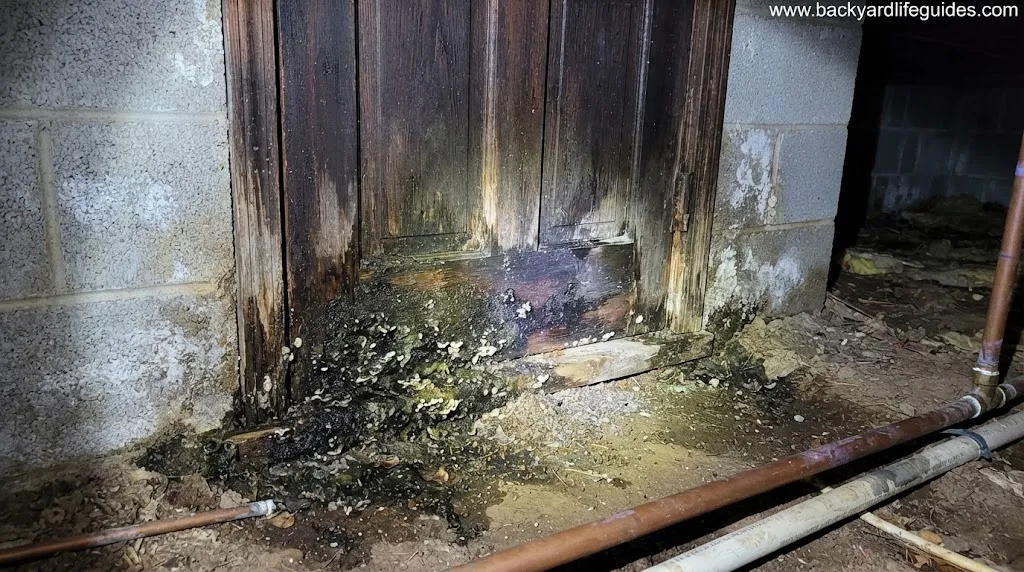
Dark Substance on Crawl Space Door: What It Means and What to Do
- Disclosure: This post may include affiliate links. If you click a link and complete a purchase, I may earn a commission. Additionally, as an Amazon Associate, I earn from eligible purchases.
What Is That Dark Stain on Your Crawl Space Door? Causes and Solutions Explained
Finding a dark substance on a crawl space door can be concerning, especially when it appears as black spots, fuzzy patches, stains, or powdery growth. In many cases, dark growth is associated with mold or mildew, but color alone cannot tell you exactly what type of mold it is or how hazardous it may be.
The more useful question is: Why is the crawl space staying damp?
Moisture from leaks, ground water, humidity, condensation, poor drainage, or damaged vapor barriers can create conditions where mold grows. Cleaning the visible substance without correcting the moisture problem can allow the growth to return.
This guide explains what the dark substance may be, what causes it, how large an affected area matters, when DIY cleanup may be appropriate, and when professional remediation makes more sense.
What Is the Dark Substance on a Crawl Space Door?
A dark substance on a crawl space door may be mold, mildew, dirt, staining, or another type of buildup. The six sources reviewed for this topic consistently emphasize that appearance alone is not enough to identify a particular mold species.
Dark growth may appear:
- Black
- Dark green
- Gray
- Brown
- Fuzzy
- Powdery
- Stringy
- Slimy
Some growth can blend into wooden surfaces and become difficult to notice.
The most important clue is usually the moisture condition around it. If the crawl space has a musty odor, wet insulation, condensation, standing water, leaks, or persistently high humidity, moisture-related mold growth becomes a stronger possibility.
Does Black Mean Toxic Mold?
Not necessarily.
One of the most important points from the is that “black mold” is primarily a visual description, not a reliable species identification.
A dark patch could be black, dark green, brown, or gray. You should not determine the species or hazard level simply by looking at its color.
Instead of focusing only on whether the substance is black, look at the larger situation:
- Is the area damp?
- Is there a musty odor?
- Is wood wet or deteriorating?
- Is insulation wet?
- Is there standing water?
- Is there a plumbing leak?
- Is humidity staying high?
- Is the growth spreading?
These clues can help identify the underlying problem that needs attention.
Why Does Mold Grow on a Crawl Space Door?
Mold needs suitable environmental conditions to establish and continue growing. Across the sources reviewed, the recurring factors are moisture, a food source, and enough time. Another source also describes spores and temperature as important conditions.
The 4 Conditions Associated With Mold Growth
One summarizes mold growth around 4 requirements:
| Requirement | What it means |
|---|---|
| Spores | Mold spores are present in the environment |
| Moisture | Water or persistent dampness supports growth |
| Food | Organic materials can provide a food source |
| Temperature | Suitable temperatures can encourage growth |
Another source simplifies the process to 3 basic requirements:
- Moisture
- Food source
- Enough time
The practical takeaway is simple: moisture is the condition you should investigate first.
Common Moisture Sources Behind a Dark Crawl Space Door
A dark substance may be a visible symptom of a larger crawl-space moisture problem.
The reviewed sources identify several possible sources.
Plumbing Leaks
Leaking pipes can continuously introduce moisture into the crawl space. If dark growth is concentrated around a pipe or plumbing component, the location may provide an important clue.
Ground Moisture
Dirt floors can allow moisture from the ground to enter the crawl space. Bare soil, poor ground protection, and inadequate moisture control can contribute to damp conditions.
Rain and Snowmelt
Heavy rain and snowmelt can saturate soil around a foundation. Water may enter through drainage problems, foundation seepage, or other openings.
Poor Drainage
Blocked gutters, poorly directed downspouts, incorrect grading, and drainage problems can send water toward the foundation rather than away from it.
Damaged Vapor Barriers
A damaged or inadequate vapor barrier can allow moisture from the ground to contribute to crawl-space humidity.
Condensation and Humidity
A crawl space can also become damp because of condensation and high humidity. Poor ventilation and temperature differences can make moisture control more difficult.
What Does a Dark Crawl Space Door Tell You?
The substance itself is only part of the problem.
If the door has dark staining while the surrounding crawl space is damp, the door may be showing evidence of a broader moisture condition.
Look beyond the door and check for:
- Musty odors
- Dark staining
- Fuzzy growth
- Wet insulation
- Standing water
- Rusted metal
- Damaged ground cover
- Soft or deteriorating wood
- Condensation
- Peeling paint
- Cracks or leaks
- Warped or soft flooring above the crawl space
A single dark spot does not necessarily mean the entire crawl space has extensive contamination. However, visible growth plus ongoing moisture deserves investigation.
How to Tell Mold From White Efflorescence
Not every unusual substance in a crawl space is mold.
| Feature | White Mold | Efflorescence |
|---|---|---|
| Nature | Biological growth | Mineral salt deposit |
| Common surface | Organic materials such as wood | Concrete or brick |
| Appearance | Fuzzy, stringy, or cottony | Crystalline or flat |
| Odor | May have a musty smell | Typically no smell |
| Growth | Can spread over time | Mineral deposit rather than biological growth |
This distinction is useful when investigating white material, but a dark substance on a crawl space door is more likely to require attention to moisture and possible biological growth.
Can You Clean a Dark Substance Yourself?
The answer depends largely on the size, surface, and condition of the affected area.
The repeatedly use approximately 10 square feet as an important threshold.
One source considers DIY removal reasonable when the affected area is 10 square feet or less, roughly equivalent to a 3 × 3 ft patch.
Another source recommends professional remediation for areas larger than approximately 10 square feet.
RestoreNearMe provides a more detailed classification:
| Affected Area | General Recommendation |
|---|---|
| Under 10 sq ft | Small isolated area; DIY may be possible |
| 10–100 sq ft | Moderate contamination; professional remediation typically recommended |
| Over 100 sq ft | Extensive contamination; professional remediation required |
| Structural components affected | Professional structural assessment |
These figures should be treated as practical decision points rather than a substitute for an on-site assessment.
Why the 10-Square-Foot Number Matters
The 10 sq ft threshold appears in multiple sources, making it one of the strongest numerical points.
For example:
3 ft × 3 ft = 9 sq ft
So a small patch around this size falls below the commonly cited 10-square-foot threshold.
If the growth covers a much larger area, continues into multiple surfaces, or affects structural materials, professional help becomes increasingly appropriate.
How to Approach a Small Affected Area
For a small, isolated area on a suitable hard surface, the sources mention protective equipment and basic cleaning materials.
Recommended protective equipment includes:
- N-95 respirator
- Gloves
- Goggles
- Long sleeves
- Disposable work clothing when appropriate
Cleaning materials mentioned include:
- Hot water
- Soap
- Stiff brush
- Sponge
- Wet vacuum
- Household chlorine bleach and water for disinfection
The area should be thoroughly dried after cleaning.
The important point is that cleaning should not be treated as the complete solution.
What You Should NOT Do
One of the strongest practical sections in the research is the list of activities that can spread contaminated material.
Avoid:
- Dry brushing
- Sanding
- Pressure washing
- Using a household fan to blow air through the crawl space
Aggressive cleaning or uncontrolled airflow can disturb material and spread spores or particulate matter to nearby surfaces.
The goal should be controlled cleaning, not simply making the visible stain disappear as quickly as possible.
Why Cleaning Alone May Not Solve the Problem
Imagine this sequence:
Visible mold → cleaning → moisture remains → growth returns
That is why moisture control is the central theme across.
If a plumbing leak remains active, if rainwater continues entering the crawl space, or if humidity remains high, cleaning the door may only address the visible symptom.
The better approach is:
Find the moisture source → correct it → address the contamination → dry the area → prevent recurrence.
When Should You Call a Professional?
Professional remediation becomes more appropriate when the contamination is extensive, recurring, difficult to access, or connected to structural materials.
Consider professional assistance when:
- The affected area is over 10 sq ft
- The contamination approaches 10–100 sq ft
- The affected area exceeds 100 sq ft
- Structural wood is involved
- Porous materials are heavily contaminated
- Insulation is soaked or heavily affected
- Mold keeps returning
- The moisture source is difficult to locate
- There is significant standing water
- The crawl space has widespread moisture damage
RestoreNearMe also reports a professional mold-assessment range of approximately $200–$500, depending on the assessment and conditions.
What Does Professional Mold Assessment Involve?
The assessment information in the focuses on determining the extent and cause of the problem.
A proper assessment should answer 4 key questions:
- Where is the moisture coming from?
- How far does the contamination extend?
- Which materials can be cleaned?
- Which materials need to be removed or repaired?
This approach is more useful than simply asking what color the mold is.
What Does Crawl Space Remediation Involve?
The professional remediation process described by the sources can be summarized into 5 stages:
| Stage | Purpose |
|---|---|
| 1. Containment | Control the affected area |
| 2. Controlled removal | Remove contaminated materials where necessary |
| 3. Cleaning | Clean remaining affected surfaces |
| 4. Verification | Check that the work addressed the contamination |
| 5. Restoration | Repair and restore the crawl space |
The exact work depends on the size and condition of the crawl space.
How to Stop the Dark Substance From Coming Back
Once the visible growth has been addressed, the next priority is moisture control.
The sources recommend several preventive measures.
Fix Plumbing Leaks
Inspect pipes and plumbing connections for leaks or signs of water damage.
Improve Drainage
Maintain gutters and direct downspouts away from the foundation. Correct grading and drainage problems that allow water to collect near the crawl space.
Control Ground Moisture
A vapor barrier can help control moisture coming from the ground.
One specifies:
- 6-mil polyethylene as a minimum vapor-barrier thickness
- 10–20 mil as a preferred range for greater durability
Control Humidity
RestoreNearMe recommends keeping crawl-space humidity below approximately 50–60% with appropriate dehumidification.
Monitoring humidity can help identify whether the crawl space is staying too damp.
Consider Encapsulation
For severe or recurring moisture problems, crawl-space encapsulation may be considered.
The reviewed source gives an estimated encapsulation range of:
$5,000–$30,000
The actual cost depends on the size and condition of the crawl space.
Inspect After Major Weather Events
After heavy rain or snowmelt, check for:
- Standing water
- New odors
- Wet insulation
- Condensation
- Damaged ground covers
- Foundation seepage
Annual crawl-space inspections are also recommended.
How Temperature and Humidity Affect Mold Growth
One source gives a mold-friendly temperature range of approximately 77°F–86°F, particularly when humidity is present.
However, temperature is only one part of the equation.
A crawl space with suitable temperatures can still avoid continued mold growth if moisture is controlled. Conversely, persistent moisture can create problems even when temperatures vary.
That is why the most useful strategy is to focus on moisture management rather than temperature alone.
Can Crawl Space Mold Affect the Rest of the Home?
Yes, identifies a potential connection between crawl-space conditions and indoor air.
The stack effect can cause air to move upward through a home. If crawl-space air contains odors or mold spores, that air can potentially enter living areas.
This makes crawl-space moisture control relevant beyond the crawl space itself.
The sources also associate crawl-space mold exposure with symptoms such as:
- Stuffy or runny nose
- Sneezing
- Sore throat
- Coughing
- Burning or red eyes
- Skin irritation or rash
People with asthma or mold allergies may experience stronger reactions, while the reviewed sources also identify people with chronic lung disease or weakened immune systems as potentially more vulnerable.
Some Questions
Is a dark substance on a crawl space door always mold?
No. A dark substance can have different causes, and color alone cannot identify a mold species. However, dark or fuzzy growth combined with moisture, musty odors, or water damage can indicate a mold-related problem.
Is black mold more dangerous than other mold colors?
You cannot determine the hazard level simply from color. The research specifically emphasizes that “black mold” is a visual description rather than a reliable species identification.
What is the 10-square-foot mold rule?
Several sources use 10 sq ft as an important practical threshold. Areas at or below this size may potentially be suitable for limited DIY cleaning when conditions are appropriate, while larger contamination generally warrants professional evaluation.
Is 3 × 3 feet considered a small mold area?
A 3 × 3 ft area equals 9 sq ft, which is below the commonly cited 10 sq ft threshold.
What if the mold covers 100 square feet?
The reviewed guidance classifies over 100 sq ft as extensive contamination and recommends professional remediation. Structural components also warrant professional assessment.
What humidity should a crawl space have?
One recommends maintaining crawl-space humidity below approximately 50–60% using appropriate dehumidification.
How thick should a crawl-space vapor barrier be?
The reviewed source specifies a minimum of 6-mil polyethylene, with 10–20 mil preferred for greater durability.
How much does a professional mold assessment cost?
One reports an assessment range of approximately $200–$500. The actual cost can vary according to the crawl space and the scope of the assessment.
How much can crawl-space encapsulation cost?
The reviewed source gives a range of approximately $5,000–$30,000 for severe or recurring moisture problems. The final cost depends on the crawl-space size and existing conditions.
Should I pressure-wash mold from the crawl space door?
The research specifically advises against pressure washing because aggressive methods can spread contaminated material or spores.
What is the most important thing to do after finding dark growth?
Find the moisture source. Repair leaks, address drainage problems, control humidity, protect the ground from moisture, and then deal with the visible contamination.
Final Word
A dark substance on a crawl space door should not automatically be labeled as toxic black mold based on appearance alone. The more important clue is whether the crawl space has persistent moisture.
Check for plumbing leaks, ground moisture, rainwater, poor drainage, condensation, damaged vapor barriers, wet insulation, and high humidity. For a small area of around 10 sq ft or less, limited DIY cleaning may be possible when the surface and conditions are suitable. Larger contamination—especially 10–100 sq ft, areas over 100 sq ft, or growth involving structural materials—calls for professional attention.
Most importantly, do not stop at cleaning the stain. Fix the moisture problem, or the dark growth may return.
2 Comments