
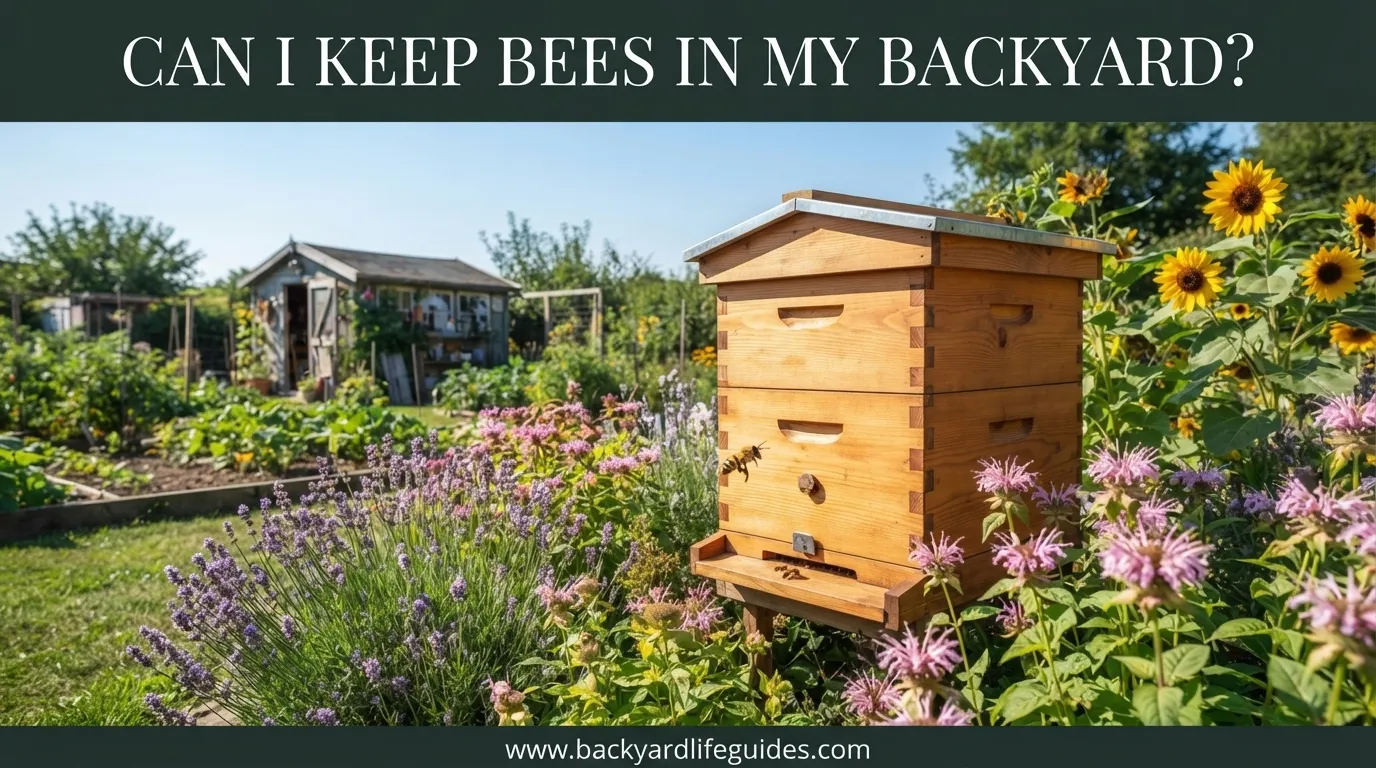
Can I Keep Bees in My Backyard? Space, Cost, Laws & Beginner Guide
Can I Keep Bees in My Backyard?
- Disclosure: This post may include affiliate links. If you click a link and complete a purchase, I may earn a commission. Additionally, as an Amazon Associate, I earn from eligible purchases.
Yes, backyard beekeeping can be possible, but keeping bees is more than simply putting a hive in your garden. Before bringing home a colony, you need to consider local rules, available space, hive placement, neighbors, water, food sources, equipment, seasonal care, and the amount of time you can commit.
For many beginners, a backyard can provide a suitable environment for one or two hives. However, the exact requirements depend on where you live. Some locations require registration, permits, or inspections, while cities, counties, HOAs, or other local authorities may restrict the number of hives you can keep.
A good starting point is to think about three things first: legality, space, and responsibility.
Is Backyard Beekeeping Legal?
In many areas, keeping honeybees in a backyard is permitted, but there is no single rule that applies everywhere.
The six guides reviewed for this topic repeatedly emphasize checking your local regulations before purchasing bees or equipment. State laws may allow beekeeping while a city or county has additional requirements.
Why Local Rules Matter
A property may appear large enough for a hive but still fail to meet local setback or registration requirements.
Some of the reviewed guides mention typical property-line setbacks of 10–25 feet, while other recommendations focus on creating several feet of clear space around the hive.
So, don’t buy bees first and investigate regulations later.
Check first. Set up second.
How Much Space Do You Need for Bees?
You don’t necessarily need a huge property to keep bees.
One recommends a minimum backyard area of approximately 10 × 10 feet, while another recommends around 200–300 square feet for a properly arranged backyard setup.
The physical hive itself can be surprisingly compact.
One guide gives an approximate hive footprint of:
20 × 20 inches
or about:
50 × 50 cm
However, the hive isn’t the only thing that needs space.
You also need room for:
- Inspecting the hive
- Standing safely while working
- Moving equipment
- Bees entering and leaving
- Creating a suitable flight path
- Keeping people away from the hive
- Maintaining the surrounding area
How Much Clearance Should You Leave?
The recommendations across the reviewed articles vary depending on what the measurement refers to.
| Space consideration | Recommended figure |
| Hive footprint | About 20 × 20 inches |
| Clear space around hive | About 3 feet on each side |
| Hive clearance mentioned by another guide | 6–8 feet |
| Clear flight path | 10–15 feet |
| Typical property setback | 10–25 feet |
| Suggested backyard area | 10 × 10 feet minimum |
| Suggested area for 1–2 hives | 200–300 sq. ft. |
These numbers aren’t contradictory because they describe different parts of the setup.
A small hive can fit in a compact area, but the beekeeper still needs enough surrounding space to safely manage it.
Where Should You Put a Beehive?
Hive placement can make backyard beekeeping much easier—or much more difficult.
The reviewed guides consistently emphasize sunlight, shade, protection, water, and safe bee flight paths.
A good general arrangement includes:
- Morning sunlight
- Some afternoon shade
- Protection from strong wind
- A stable and level surface
- A nearby water source
- Distance from patios and play areas
- Distance from heavy foot traffic
- An entrance directed away from people and neighbors
Which Direction Should the Hive Face?
Different recommendations appear across the articles.
One guide recommends a south-facing entrance, while another suggests east-facing placement. Another allows east, south, or southeast.
The common idea is to provide the bees with good morning sunlight and position the entrance so bee traffic doesn’t interfere with people.
Rather than treating one compass direction as a universal rule, focus on the practical goal:
Give the colony useful sunlight while directing bee traffic away from people.
Can a Fence Help?
Yes.
A fence, hedge, or lattice barrier can encourage bees to rise above people’s head height as they leave the hive.
One guide recommends a barrier around 6 feet tall, while another discusses placing a lattice barrier approximately 1–2 feet in front of the hive.
The purpose is not simply decoration. The barrier can help change the bees’ flight path.
Do Bees Need Water?
Yes, the reviewed guides emphasize providing a dependable water source.
A simple water station can be a birdbath, tub, saucer, or another suitable container.
One guide specifically recommends replenishing a water saucer every other day.
The reason for providing water near the hive is simple: if you don’t give bees a deliberate water source, they may find their own.
That could mean visiting:
- Neighboring yards
- Birdbaths
- Pools
- Outdoor containers
- Other sources of standing water
A consistent water source can therefore become part of good neighbor management.
How Far Do Bees Travel for Food?
Honeybees don’t need all of their food inside your backyard.
One comprehensive guide states that bees can travel up to 2 miles while foraging.
That means the surrounding neighborhood can contribute to the colony’s food supply.
Still, making your own property bee-friendly can help.
Consider growing or maintaining plants that provide:
- Nectar
- Pollen
- Flowering resources throughout the season
One ‘s low-intervention approach particularly emphasizes that beekeepers should also think like gardeners, because a healthy colony needs access to abundant food.
Which Bees Are Best for a Backyard?
The articles discuss several honeybee types and approaches rather than recommending one universal choice.
The types specifically mentioned include:
- European honeybee
- Carniolan honey bee
- Italian honeybee
- Himalayan honey bee
The guides also discuss obtaining local bees and catching a swarm instead of relying entirely on shipped package bees.
Carniolan Honey Bees
One describes Carniolan bees as a beginner-friendly option because of their mild nature.
However, it also notes a potential concern: their population can increase quickly in spring, which can increase the risk of swarming.
Italian Honey Bees
Another guide specifically recommends Italian honeybees for urban settings because they are described as calmer and less defensive.
Local Bees
The low-intervention approach strongly favors local bees, arguing that locally sourced colonies are better suited to the weather and forage conditions of the area.
The broader lesson is that beginners should consider temperament, local conditions, availability, and swarm management, rather than choosing bees based on appearance or one characteristic alone.
What Type of Hive Should a Beginner Choose?
The Langstroth hive appears repeatedly throughout the reviewed material and is presented as a common beginner-friendly choice.
Another guide discusses the Top-bar hive, while the low-intervention approach prefers the Warre hive.
Langstroth Hive
The Langstroth design has been used for more than 150 years and commonly begins with a brood box.
Starter boxes are commonly built around 8 or 10 frames.
Its major advantage for beginners is familiarity and the availability of established equipment and practices.
Warre Hive
One favors the Warre hive for beginners and says a 3-box Warre hive is as large as a backyard beekeeper will need.
Its approach is more focused on allowing the colony to develop with minimal interference.
Top-Bar Hive
The Top-bar hive is also discussed as an alternative and is described as the oldest hive design among the types covered by the .
There isn’t necessarily one perfect hive for everyone.
Your choice can depend on your preferred management style, available equipment, and how hands-on you want to be.
What Equipment Do You Need?
Starting a hive requires more than the wooden box itself.
The guides mention the following equipment:
| Equipment | Purpose |
| Hive | Provides the colony’s home |
| Hive stand | Keeps the hive elevated and stable |
| Bottom board | Forms the base |
| Brood box | Holds developing brood |
| Frames | Provide structure inside the hive |
| Foundation | Supports comb construction |
| Honey super | Provides space for honey storage |
| Inner cover | Part of the hive cover system |
| Outer cover | Protects the hive from weather |
| Hive tool | Helps separate and manipulate hive components |
| Smoker | Helps manage bees during inspections |
| Bee suit | Protective clothing |
| Veil | Protects the face and head |
| Gloves | Protect the hands |
| Closed-toe boots | Additional foot protection |
| Honey extractor | Used to remove honey from comb |
| Uncapping scratcher | Helps with honey harvesting |
| Refractometer | Used to measure honey moisture |
You don’t need to buy every possible beekeeping gadget immediately.
A sensible beginner setup should focus on essential hive equipment, protective gear, and basic management tools.
How Much Does It Cost to Start Backyard Beekeeping?
The startup cost varies considerably depending on how many hives you want and what equipment you purchase.
One estimates approximately $500–$800 for one hive setup.
Another gives a first-year estimate of approximately $620–$1,310.
A separate beginner guide says a 2-hive setup can cost $1,000+ during the first year.
Example Cost Breakdown
The most detailed breakdown gives these figures:
| Item | Approximate Cost |
| Hive system | $300–$700 |
| Nucleus colony | $150–$200 |
| Protective suit + gloves | $80–$150 |
| Smoker | $30–$60 |
| Hive tool | $10–$20 |
| Beginner course | $50–$150 |
| Hive registration | $0–$30 |
| Estimated Year 1 total | $620–$1,310 |
| Ongoing annual cost | $55–$170 per hive |
These are reported figures, so actual prices can differ depending on your location and setup.
If you’re completely new, budgeting for education and protective equipment is just as important as budgeting for the hive.
How Much Time Does Beekeeping Take?
Backyard beekeeping isn’t completely hands-off.
One comprehensive guide recommends inspections approximately every 7–14 days during peak spring and summer.
Another seasonal recommendation uses 7–10 day inspection intervals during spring.
The same guide estimates:
- 10–20 hours for initial study
- 2–4 hours for legal and neighbor research
- 20–40 hours during the first year
- Approximately 1–2 hours every 7–14 days during active periods
These figures help illustrate the commitment.
You don’t necessarily spend hours every day with the hive, but you do need to pay attention consistently.
What Happens During a Hive Inspection?
A hive inspection is an opportunity to understand what is happening inside the colony.
Depending on the season and management approach, a beekeeper may look for signs related to:
- Queen activity
- Brood
- Food stores
- Colony growth
- Swarming
- Pests
- Diseases
- Honey storage
The article also stresses that excessive intervention isn’t always desirable.
Opening a hive unnecessarily can potentially lead to problems such as:
- Damaging the queen
- Crushing bees
- Losing honey
- Chilling the hive interior
- Disturbing propolis seals
The practical balance is regular observation without unnecessary disturbance.
What Happens During Spring?
Spring is one of the most active periods for a honeybee colony.
The reviewed material gives several useful numbers.
A queen can lay well over 1,500 eggs per day, and a colony can potentially double in a matter of weeks.
That rapid growth makes spring an important period for monitoring the hive.
One guide recommends inspections every 7–10 days during spring.
When the first brood box reaches approximately 70–80% full, the guide recommends considering adding a second brood box.
Why Is Swarming a Concern?
Rapid spring population growth can increase swarming pressure.
This is particularly relevant to the discussion of Carniolan bees, which one ys can build population quickly during spring.
Regular observation can help a beekeeper recognize changes before the colony becomes difficult to manage.
What Happens During Summer?
Summer generally brings increased foraging activity and plenty of attention to colony health.
The reviewed guides connect summer management with:
- Regular inspections
- Nectar collection
- Pollen availability
- Varroa mite monitoring
- Water availability
- Hive ventilation and positioning
Your colony’s needs can change as weather and available forage change.
This is why a fixed calendar isn’t enough. Observe the colony and respond to what you see.
What Happens During Fall?
Fall is a preparation period.
The colony needs to enter winter with adequate food stores and a healthy population.
The material emphasizes watching:
- Honey stores
- Colony health
- Pests
- Winter preparation
A beekeeper shouldn’t assume that a strong summer colony automatically means a successful winter.
How Much Honey Does a Colony Need for Winter?
One comprehensive estimate estimates that a colony may need approximately:
60–80 pounds of honey
to survive a cold winter.
The same guide describes the winter cluster as maintaining an internal temperature around:
95°F / 35°C
This illustrates why honey harvesting should not be based simply on how much honey you can remove.
The colony’s own stores are essential.
When Is Honey Ready to Harvest?
Honey isn’t necessarily ready just because the comb looks full.
One recommends harvesting when frames are at least:
80% capped on both sides
Another beginner guide gives a more conservative traditional harvesting point of:
90% capped honeycomb cells
A refractometer can also be used to check moisture.
One gives a target of:
18.6% moisture
Another guide describes finished honey as approximately 17–18% water, compared with nectar at roughly 80% water.
If the frames aren’t ready, one recommendation is to wait another:
1–2 weeks
The key idea is to check the honey’s readiness rather than harvesting simply because the colony has produced visible honey.
How Do You Handle Bees Around Neighbors?
Neighbor relationships are one of the most important practical considerations for backyard beekeeping.
Even if beekeeping is legal, people living nearby may not understand the difference between honeybees and more aggressive insects such as wasps.
Before installing a hive, consider talking with nearby neighbors.
Simple Ways to Be a Good Beekeeping Neighbor
You can:
- Explain that you’re keeping honeybees
- Explain where the hive will be located
- Keep bee flight paths away from common activity areas
- Use a fence or hedge to redirect flight
- Maintain a reliable water source
- Prevent swarming through appropriate management
- Choose calmer bees when possible
- Share some honey with interested neighbors
One specifically recommends a 6-foot flyover barrier.
Another discusses a 1–2-foot lattice barrier placed in front of the hive.
The exact arrangement can vary, but the objective is the same:
Encourage bees to fly upward and away from people.
How Do You Keep Bees Away From Patios and Play Areas?
Hive placement should separate bee activity from the places where people spend time.
Avoid positioning a hive directly beside:
- Patios
- Children’s play equipment
- Frequently used walkways
- High-traffic areas
- Neighbor-facing activity zones
The hive entrance should ideally direct bees toward an area where their normal flight doesn’t conflict with household activity.
A fence or hedge can further redirect their initial flight.
What About Bee Stings?
Bee stings are an unavoidable consideration when working with a living bee colony.
Protective equipment mentioned by the guides includes:
- Bee suit
- Veil
- Gloves
- Closed-toe boots
A smoker is also repeatedly listed as a basic beekeeping tool.
Beginners should learn how to approach and handle a hive calmly rather than treating every inspection like a quick backyard chore.
If someone in your household has a serious concern about bee stings, that should be part of your decision before establishing a colony.
What Are Common Bee Pests and Diseases?
The material repeatedly identifies Varroa mites as an important pest to monitor.
The broader guides also emphasize checking colonies for pests and diseases during inspections.
This is one reason backyard beekeeping shouldn’t be treated as simply installing a box and waiting for honey.
A colony requires ongoing observation.
Can You Keep Bees With Limited Backyard Space?
Possibly.
A small yard doesn’t automatically rule out beekeeping.
The key questions are:
- Is beekeeping legal where you live?
- Can you meet the required setbacks?
- Do you have safe hive access?
- Can you provide a suitable flight path?
- Can you keep bees away from high-traffic areas?
- Can you provide water?
- Can you provide or access sufficient forage?
- Can you safely inspect and maintain the hive?
A backyard of 10 × 10 feet is mentioned as a minimum recommendationby onee, while another suggests 200–300 square feet for a more comfortable 1–2-hive arrangement.
So, don’t judge suitability by yard size alone.
Can You Keep More Than One Hive?
Yes, multiple hives are discussed throughout the material.
However, the appropriate number depends on:
- Local regulations
- Available space
- Your experience
- Time commitment
- Budget
- Neighbor considerations
Some urban ordinances are described as limiting backyard beekeepers to approximately 2–4 hives.
California is discussed separately with a hobbyist threshold of 10 or fewer hives in one ‘s legal overview.
Always verify the rules that apply specifically to your location.
A Simple Beginner Plan for Starting Your First Hive
If you’re seriously considering backyard beekeeping, don’t rush into buying bees.
Use this sequence.
1. Check Your Local Rules
Research:
- City regulations
- County regulations
- State requirements
- Registration
- Permits
- Hive limits
- Property setbacks
- HOA rules
2. Study Before Buying
One recommends spending approximately 10–20 hours studying before getting started.
Learn the basics of:
- Hive structure
- Bee behavior
- Queen, worker, and drone roles
- Seasonal management
- Hive inspections
- Pests and diseases
- Honey harvesting
3. Talk to Your Neighbors
Don’t wait until your first swarm or your first inspection.
Tell neighbors what you’re planning and explain where the hive will be located.
4. Choose Your Hive
Compare:
- Langstroth
- Warre
- Top-bar
For many beginners, the Langstroth is presented as the most familiar and beginner-friendly option in the reviewed material.
5. Prepare the Location
Set up the hive location before the bees arrive.
One commends preparing the site at least 1 week before bee delivery.
Make sure the area has:
- Morning sun
- Suitable shade
- Wind protection
- Stable ground
- Water
- Safe access
- Appropriate flight direction
6. Order or Source Your Bees
The guides discuss nucleus colonies, package bees, local bees, and swarms.
The local-bee-focused approach favors bees adapted to the surrounding environment.
7. Install the Colony
Once everything is ready, install the bees and begin observing.
Don’t immediately turn every day into a hive inspection.
8. Build a Regular Observation Routine
During active periods, inspections may occur every 7–14 days, with one spring recommendation using 7–10 days.
Keep notes so you can recognize changes in colony development.
First-Year Backyard Beekeeping Checklist
Use this quick checklist before committing.
| Question | Ready? |
| Have you checked local beekeeping laws? | ☐ |
| Have you checked HOA restrictions? | ☐ |
| Do you know the hive limit in your area? | ☐ |
| Do you have enough space? | ☐ |
| Can you meet setback requirements? | ☐ |
| Is there a safe flight path? | ☐ |
| Can you provide water? | ☐ |
| Do you have access to bee forage? | ☐ |
| Have you spoken with neighbors? | ☐ |
| Do you have protective equipment? | ☐ |
| Do you have a smoker and hive tool? | ☐ |
| Have you learned basic hive inspection? | ☐ |
| Have you planned for seasonal management? | ☐ |
| Have you budgeted for first-year costs? | ☐ |
FAQs
Can I keep bees in my backyard?
In many locations, yes, but local laws determine whether you can keep bees and how many hives you’re allowed to have. Registration, permits, inspections, setbacks, and HOA restrictions may apply.
How much space do I need for one beehive?
The reviewed guides give several measurements. A hive itself may occupy roughly 20 × 20 inches, but you need additional working and flight space. One recommendation is a 10 × 10-foot minimum backyard area, while another suggests 200–300 square feet for 1–2 hives.
How far should a beehive be from a property line?
One gives a typical range of 10–25 feet, but requirements vary by location. Check your local regulations before installing a hive.
How many beehives can I have in my backyard?
Some urban ordinances discussed in the material limit backyard beekeepers to approximately 2–4 hives. Other locations may allow more. The legal limit depends on your local regulations.
Do backyard bees need water?
Yes. The guides recommend providing a dependable water source such as a birdbath, tub, or water container. One recommendation says to replenish a water saucer every other day.
How far will honeybees travel?
One of the reviewed guides states that bees can travel up to 2 miles for food.
Which hive is best for beginners?
The Langstroth hive is repeatedly presented as a common and beginner-friendly option. They also discuss Warre and Top-bar hives, so your choice can depend on your preferred beekeeping style.
How much does it cost to start beekeeping?
The estimates range from approximately $500–$800 for one hive setup to $620–$1,310 for the first year. A two-hive setup is described as potentially costing $1,000+.
How often should I inspect my hive?
The reviewed guides recommend approximately every 7–14 days during peak spring and summer activity. One spring recommendation is every 7–10 days.
How much honey does a colony need for winter?
One study estimates approximately 60–80 pounds of honey for a colony to survive a cold winter.
When should I harvest honey?
The reviewed recommendations include harvesting when frames are at least 80% capped on both sides, while another guide gives 90% capped as a traditional harvesting point. A refractometer can also be used to check moisture, with one guide giving 18.6% as its figure.
Are backyard bees dangerous?
Honeybees can sting, so beekeepers should use appropriate protective equipment and manage colonies responsibly. Proper hive placement, calm handling, barriers, and consideration for neighbors are important parts of backyard beekeeping.
Do I need to talk to my neighbors?
It is strongly recommended by the reviewed guides. Explaining your plans, positioning the hive responsibly, providing water, and managing flight paths can help reduce potential conflicts.
Final Thoughts
Keeping bees in a backyard can be rewarding, but the best setup starts before the bees arrive.
First, confirm that backyard beekeeping is legal in your area. Then evaluate your available space, property setbacks, hive position, water supply, forage, budget, and relationship with neighbors.
For a beginner, the numbers provide a useful reality check: you may need around 10 × 10 feet or more of suitable space, $500–$1,310+ for initial setup depending on your approach, and regular inspections roughly every 7–14 days during active periods.
If you’re prepared to learn, observe your colony, protect your bees, and manage the hive responsibly, a backyard can potentially become a productive home for a small honeybee colony.


4 Comments