The Science of Combustion: How Different Fuels Impact Cooking
- Disclosure: This post may include affiliate links. If you click a link and complete a purchase, I may earn a commission. Additionally, as an Amazon Associate, I earn from eligible purchases.
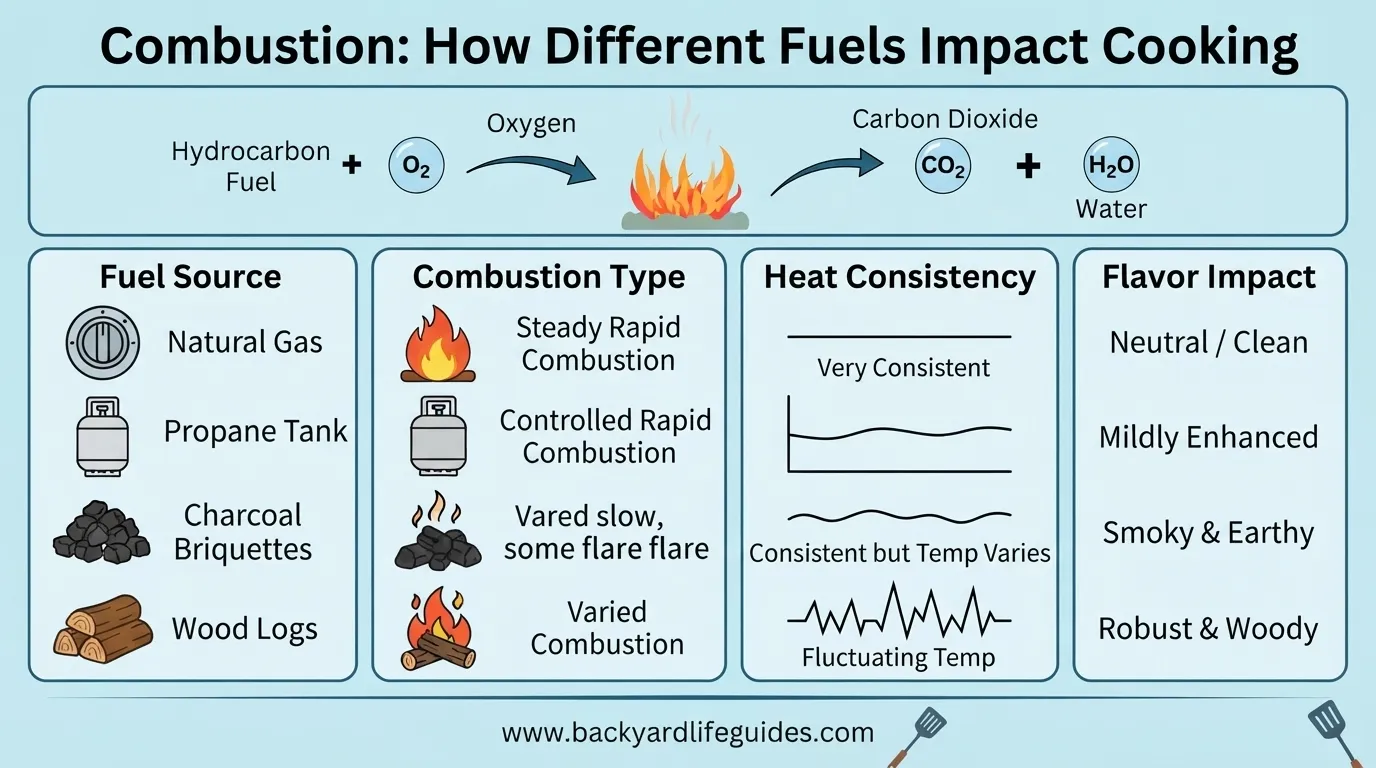
Choosing a cooking fuel is about more than simply producing enough heat. The fuel you use can influence flavor, temperature control, cooking time, convenience, cleanup, cost, and overall cooking performance.
Wood, charcoal, propane, natural gas, electricity, and wood pellets all produce heat in different ways. Some are better suited to creating strong smoky flavors, while others prioritize speed, consistency, portability, or easy cleanup.
There is also no single fuel that works best for every household or cooking situation. Fuel choices can depend on accessibility, affordability, convenience, household circumstances, technical options, and cultural preferences.
Understanding these differences makes it easier to select the right fuel for the cooking you actually do.
What Determines Which Cooking Fuel Is Best?
The best cooking fuel depends on what you value most when preparing food.
For outdoor cooking, flavor and heat intensity may be the biggest considerations. For everyday household cooking, convenience, availability, safety, and controllability may matter more.
Fuel selection can be influenced by:
- Accessibility — whether the fuel is readily available where you live.
- Affordability — the purchase price and ongoing fuel costs.
- Convenience — how quickly the fuel can be started and controlled.
- Cooking requirements — whether you are frying, simmering, stirring, searing, or grilling.
- Energy efficiency — how effectively the fuel provides usable cooking heat.
- Health and environmental considerations — factors that can influence household choices.
- Cultural preferences — familiar cooking methods can remain important even when alternatives are available.
This is one reason households do not always completely replace one fuel with another.
Why Households May Use More Than One Fuel
A household does not necessarily have to choose one fuel exclusively.
Energypedia describes this practice as fuel stacking, also referred to as an energy shelf. A household may keep multiple fuels available and select between them depending on the cooking task, price, supply, or convenience.
For example, one fuel might be preferred for frying while another is more convenient for simmering or other cooking tasks.
Fuel stacking can also provide greater energy security. If supply becomes unreliable or prices change, having another cooking option can provide flexibility.
This means the idea that households always move from one traditional fuel to one modern fuel is too simple. Actual fuel choices can be more complicated and depend on everyday needs.
Wood: Strong Heat and Natural Flavor
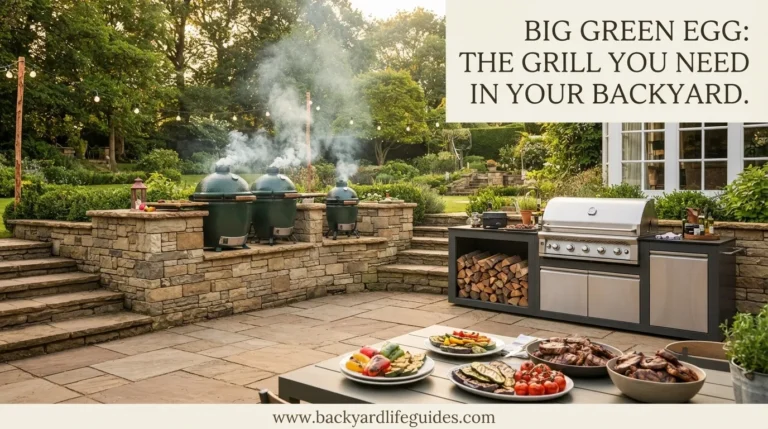
Wood is one of the oldest cooking fuels and remains particularly important for outdoor cooking.
One of its biggest advantages is flavor. Burning different hardwoods can produce different characteristics, giving food a depth of flavor that other fuel sources cannot completely reproduce.
Wood can also reach high temperatures, and the article from My Backyard Life notes that wood logs or splits can burn hotter and longer than the other fuels discussed.
That can reduce the need for frequent fuel replenishment during a cooking session.
Hardwood Choices Affect Flavor
The type of wood matters because different hardwoods contribute different flavor characteristics.
Common examples discussed include:
- Hickory
- Oak
- Apple wood
- Mesquite
This makes wood particularly attractive when flavor is a major part of the cooking experience.
The trade-off is convenience. Wood requires more preparation and attention than fuels that can be turned on immediately. It can involve chopping or handling logs and requires more active management while cooking.
For someone who enjoys the process of outdoor cooking and wants pronounced natural flavor, however, wood offers something that convenience-focused fuels cannot fully replicate.
Charcoal: A Balance of Heat, Flavor, and Practicality
Charcoal occupies an important middle ground between traditional wood cooking and more convenient fuel sources.
The charcoal-making process is connected to pyrolysis, where wood and other organic materials are heated to temperatures above 750°F / 400°C.
The process can take days, while volatile compounds such as water, hydrogen, methane, and tar are burned off.
The resulting charcoal provides a concentrated fuel that can deliver substantial heat while still retaining characteristics associated with wood.
Briquettes
Briquettes are manufactured from materials such as:
- Wood chips
- Peat
- Sawdust
- Other combustible biomass
- Sodium nitrate
- Borax
- Starch or clay binders
Their major strengths are consistency, affordability, and accessibility.
They are generally cheaper and can provide a longer, consistent burn. For people who want predictable cooking performance without spending as much on fuel, briquettes can be a practical option.
Hardwood Lump Charcoal
Hardwood lump charcoal is described as 100% natural hardwood.
Compared with briquettes, its main advantages include:
- Faster lighting
- Higher burning temperatures
- Cleaner smoke
- More concentrated natural wood flavor
This makes lump charcoal particularly appealing when the goal is a stronger connection between charcoal cooking and the flavor of hardwood.
In simple terms, briquettes prioritize cost and consistency, while hardwood lump charcoal emphasizes natural composition, heat, and wood character.
Propane and Natural Gas: Fast and Controllable Heat
Gas fuels approach cooking differently from wood and charcoal.
Instead of managing burning wood or charcoal, gas provides heat that can be started and adjusted quickly. This makes propane and natural gas especially attractive for people who value speed and control.
My Backyard Life notes that more than 40 million U.S. households use gas stoves, representing more than 30% of homes.
The major benefits include:
- Instant heat
- Precise heat control
- No wood chopping
- Less active tending
- Easier cleanup
- Convenient everyday operation
Gas is particularly useful when you want to adjust cooking temperature quickly without waiting for solid fuel to heat up or cool down.
Natural Gas
Natural gas is primarily composed of methane (CH₄) and is commonly delivered through pipelines.
Its main strengths include cost-effectiveness, immediate heat, consistent cooking performance, and precise temperature control.
However, pipeline infrastructure limits where natural gas can be used. It is more commonly available in areas with established gas networks.
Natural gas also does not naturally provide the characteristic smoky flavor associated with wood and charcoal.
That is not necessarily a disadvantage for every type of food. If smoky flavor is not an important part of the dish, the convenience of natural gas may be more valuable.
LPG
LPG is described as a mixture of propane and butane.
Unlike piped natural gas, LPG can be stored in pressurized cylinders or tanks. This makes it more portable and useful in places where pipeline infrastructure is unavailable.
LPG can be particularly useful for outdoor cooking and locations where natural gas is not readily accessible.
Its disadvantages include periodic refilling and dependence on tanks or cylinders. Costs can also vary depending on location and delivery requirements.
Natural Gas vs. LPG
The choice between natural gas and LPG often comes down to availability, cost, and cooking requirements.
Natural gas can be a strong option where pipeline infrastructure already exists. It provides immediate and controllable heat without requiring fuel cylinders to be refilled.
LPG provides greater portability and flexibility. It can be especially useful for outdoor cooking or locations without access to natural gas pipelines.
Before choosing between them, it is useful to consider local availability, fuel rates, delivery or refill costs, and how you normally cook.
Butane: Compact and Useful for Outdoor Cooking
Butane is described as a type of LPG and is particularly associated with camping, travel, and outdoor cooking.
Its main practical advantages are its compact size, light weight, quick ignition, and low residue.
Butane performs best in moderate temperatures. In low temperatures, its performance can become less reliable.
Because of this, it is generally presented as less practical for everyday household cooking and more suitable for situations where portability matters.
For a camping trip or compact outdoor cooking setup, that portability can be a significant advantage.
Electricity: Convenient and Easy to Clean
Electric cooking provides a very different experience from combustion-based fuels.
More than 60% of U.S. households own at least one electric stove.
Electric cooking is highlighted for:
- Easy cleaning
- Responsive cooking
- Powerful cooking performance
- Reduced concerns associated with gas combustion
The flavor difference between gas and electric cooking is described as minimal.
The main difference becomes more noticeable when high-heat cooking techniques are involved.
Gas vs. Electric for Searing
Gas has an advantage for searing, browning, and the Maillard reaction because it can provide strong direct heat.
Electric cooking can achieve the same type of reaction, but it may require more time and greater control.
For everyday cooking where easy cleanup and responsive heat are priorities, electricity can be highly convenient. For certain high-heat cooking techniques, gas may provide a more immediate experience.
Wood Pellets: Consistent Smoke With Less Intensity
Wood pellets are another option for people who want wood-based smoke without relying on larger pieces of wood.
They may be made from 100% softwood or from a hardwood and softwood blend.
One of their biggest advantages is how quickly they become ready. The material states that pellets can ignite and become ready in approximately 10–15 minutes.
They also ignite faster than traditional charcoal and wood while producing clean, consistent smoke.
Pellet Flavor and Cost
Pellets generally provide a more subtle flavor than charcoal.
That can be useful when you want smoke without an especially strong smoky character.
Charcoal is presented as the stronger choice when bold smoky flavor is the main objective.
The trade-off is price. Wood pellets are generally more expensive than charcoal, so their value depends on whether you prioritize convenience and consistent smoke over fuel cost.
The supplied material also gives a specific mixing guideline of 1 cup of pellets for every 1 pound of charcoal.
How Fuel Changes Flavor
Flavor is one of the clearest differences between cooking fuels.
Wood and charcoal can provide the strongest connection to smoky, natural wood flavor. Different hardwoods can further change the flavor characteristics.
Gas and electricity do not naturally provide the same smoky character.
This does not mean gas or electricity produces inferior food. It means the fuel is less involved in the flavor profile.
If smoky flavor is essential, wood or charcoal may be more attractive. If the goal is simply to cook food efficiently with precise temperature control, gas or electricity may be more practical.
Wood pellets sit between these approaches by providing consistent, comparatively subtle smoke.
How Fuel Changes Heat and Cooking Performance
Heat is another major difference.
Wood can reach high temperatures and, according to the supplied My Backyard Life content, wood logs or splits can burn hotter and longer than the other fuels discussed.
Charcoal also provides strong cooking heat, with hardwood lump charcoal specifically highlighted for burning hotter and lighting faster than briquettes.
Gas provides instant and controllable heat, which makes it convenient for changing temperatures quickly.
Electric cooking can also provide powerful and responsive performance, although gas may have an advantage during certain high-heat techniques such as searing.
Pellets emphasize consistency and smoke rather than the strongest possible wood-fired flavor.
Efficiency Is Not the Only Consideration
It can be tempting to decide that the most efficient fuel is automatically the best fuel.
In practice, fuel choice involves several factors at once.
A fuel can be convenient but expensive. Another can provide excellent flavor but require more preparation. A third can be portable but less practical for everyday cooking.
Energypedia’s discussion of household fuel choice shows why accessibility, affordability, convenience, energy efficiency, health, environmental considerations, and household circumstances all matter.
This is also why fuel stacking can make practical sense.
Safety and Ventilation Matter With Gas Cooking
Gas fuels provide significant convenience, but safe use remains important.
The supplied CookingUpdate material emphasizes:
- Regular maintenance
- Professional inspection
- Proper kitchen ventilation
- Exhaust fans
- Opening windows when necessary
- Carbon monoxide detectors
Carbon monoxide detectors are particularly recommended around sleeping areas.
Gas is flammable, and leaks can create safety risks. Natural gas also presents an environmental concern because methane is a potent greenhouse gas, meaning leaks can have a significant climate impact.
LPG also has environmental impacts associated with its extraction and transportation.
Environmental Considerations Across Cooking Fuels
Environmental impact varies between fuel types.
Natural gas is described as burning cleaner than coal or oil and producing less carbon dioxide and fewer pollutants in the comparison provided. However, methane leakage remains an important concern.
LPG can provide high energy density and is described in the supplied material as capable of producing fewer emissions in the discussed comparison, while still having environmental impacts connected to extraction and transportation.
Wood, charcoal, pellets, electricity, and other cooking options each have different production and usage characteristics.
The important point is that fuel choice involves more than combustion at the cooking surface. Availability, production, transportation, efficiency, and how the fuel is actually used can all influence the overall choice.
Modern and Traditional Fuels Are Not Always Simple Opposites
It is easy to divide cooking fuels into “traditional” and “modern” categories.
However, the supplied Energypedia material shows why this can be misleading.
A household may continue using wood because it is familiar, accessible, affordable, or culturally preferred. At the same time, that same household may use another fuel when it offers better convenience for a particular cooking task.
This is why real-world cooking habits do not always follow a simple progression from one fuel to another.
Instead, people often choose the fuel that best fits a specific cooking task and household situation.
Which Fuel Should You Choose?
There is no universal winner.
Choose wood when natural flavor, high heat, and the traditional outdoor cooking experience are your priorities.
Choose charcoal when you want strong smoky flavor and substantial cooking heat. Briquettes are particularly useful when affordability and consistency matter, while lump charcoal emphasizes natural hardwood character.
Choose natural gas when you have pipeline access and want fast, precise, convenient cooking.
Choose LPG when portability matters or natural gas infrastructure is unavailable.
Choose butane when compact outdoor or camping cooking is the priority, particularly in moderate temperatures.
Choose electricity when easy cleaning, responsive cooking, and convenient household use matter most.
Choose wood pellets when you want faster ignition and clean, consistent, relatively subtle smoke.
The Most Practical Approach to Fuel Selection
Instead of asking which cooking fuel is universally best, start by asking what you need the fuel to do.
Think about your cooking environment, the flavors you want, how often you cook, how much attention you want to give the fire, and which fuels are realistically available.
For outdoor cooking, flavor and heat may outweigh convenience.
For everyday cooking, instant control and easy cleanup may be more important.
For camping or travel, portability can become the deciding factor.
And for households with multiple cooking needs, using more than one fuel can be the most practical solution.
FAQs
Which cooking fuel gives the strongest natural smoky flavor?
Wood provides a rich natural flavor, while charcoal can also deliver strong smoky characteristics. Hardwood type can further influence the flavor produced during cooking.
What temperature is associated with charcoal pyrolysis?
The supplied material states that pyrolysis occurs when wood and organic materials are heated above 750°F / 400°C. The process can take days.
How long do wood pellets take to become ready?
Wood pellets are described as taking approximately 10–15 minutes to ignite and become ready.
What is the pellet-to-charcoal ratio mentioned in the article?
The supplied material gives a guideline of 1 cup of pellets for every 1 pound of charcoal.
Are charcoal briquettes and lump charcoal the same?
No. Briquettes are manufactured from materials such as wood chips, sawdust, peat, biomass, and binders. Hardwood lump charcoal is described as 100% natural hardwood.
Which is better for bold smoky flavor, pellets or charcoal?
Based on the supplied material, charcoal is the stronger choice when bold smoky flavor is the main goal. Pellets generally provide a subtler smoke.
What is natural gas mainly made of?
Natural gas is described as being primarily composed of methane (CH₄).
What is LPG made from?
LPG is described as a mixture of propane and butane.
Is butane suitable for camping?
Yes. Butane is specifically discussed as being useful for camping, outdoor cooking, and travel because it is compact, lightweight, and quick to ignite.
Why might someone choose LPG instead of natural gas?
LPG can be stored in tanks or pressurized cylinders, making it useful in locations where natural gas pipeline infrastructure is unavailable.
Does gas provide the same smoky flavor as wood?
No. Gas does not naturally provide the characteristic smoky flavor associated with wood and charcoal. However, this may not matter for foods where smoky flavor is not desired.
Is electric cooking different from gas cooking?
Both can provide responsive cooking performance, but gas has an advantage for certain high-heat techniques such as searing and browning. Electric cooking may require more time and control for the same reaction.
Why do some households use multiple cooking fuels?
Multiple fuels can provide greater flexibility and energy security. Different fuels may be selected for different cooking tasks, prices, availability, or supply conditions.
Final Thoughts
Cooking fuel affects much more than the flame beneath a pan or grill.
Wood emphasizes natural flavor and high heat. Charcoal combines strong smoky character with practical cooking performance. Gas focuses on speed and precise control. Electricity offers convenient, responsive cooking and easy cleaning. Wood pellets provide consistent smoke with relatively subtle flavor, while LPG and butane add portability where pipeline gas is unavailable.
The most useful choice is therefore not necessarily the fuel with the highest heat or lowest cost. It is the one that best matches your cooking style, available infrastructure, desired flavor, convenience, and practical needs.
Understanding these differences allows you to make a more informed decision instead of choosing a fuel simply because it is familiar or commonly used.