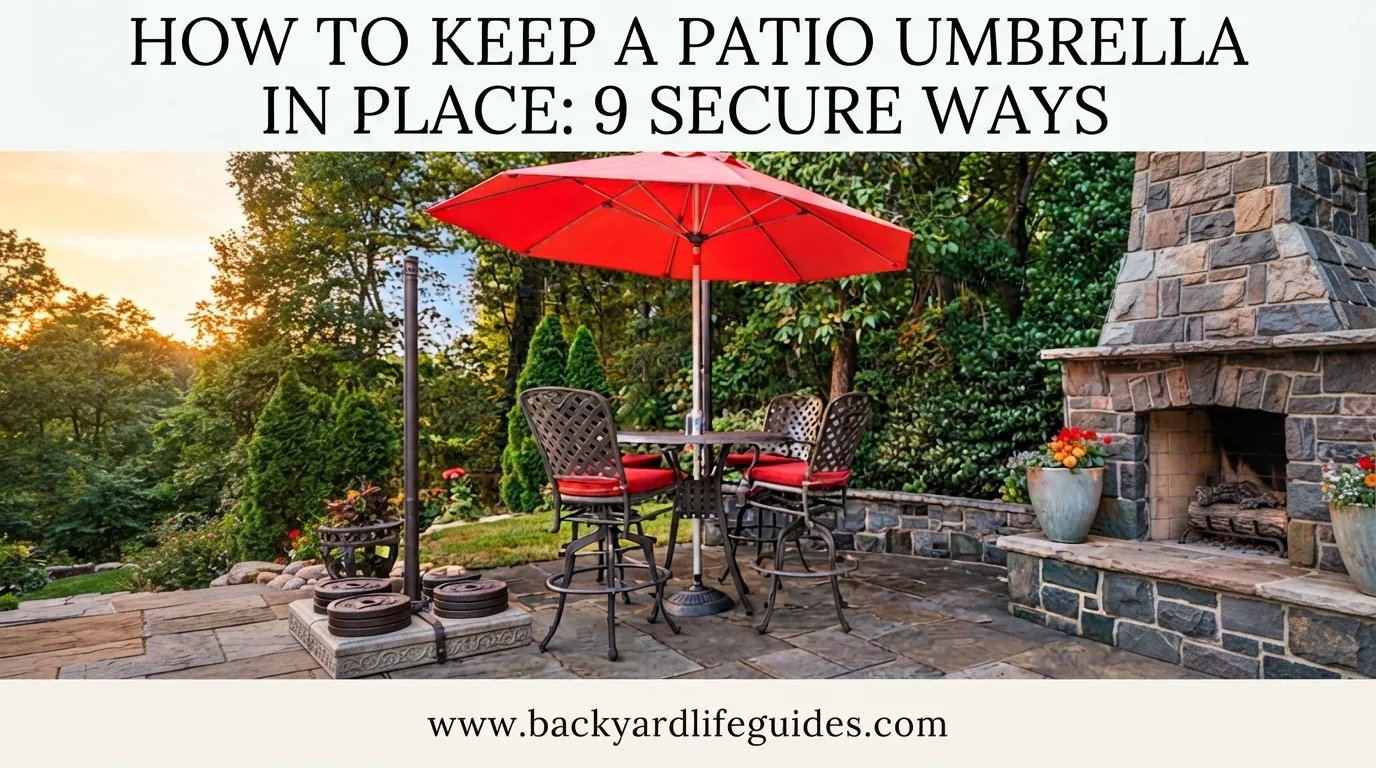
How to Keep a Patio Umbrella in Place: 9 Secure Ways
- Disclosure: This post may include affiliate links. If you click a link and complete a purchase, I may earn a commission. Additionally, as an Amazon Associate, I earn from eligible purchases.
A patio umbrella can make an outdoor space more comfortable, but wind can quickly turn a useful shade source into an unstable and potentially damaging object. The most reliable approach is to combine the right base weight, a suitable umbrella frame, good airflow, secure pole support, and sensible weather precautions.
The five sources reviewed for this guide emphasize several practical solutions: strengthening the base, using a sturdy table, choosing an umbrella with air vents, closing it when it is not being used, and adding straps or other anchors when extra support is needed.
Why Does a Patio Umbrella Fall Over?
Wind is the main problem, but the wind itself is not always the only issue.
An umbrella can become unstable when the base is too light, the pole does not fit securely, the supporting table is weak, or the canopy catches too much air. An umbrella without adequate ventilation can act much like a sail or parachute when a strong gust passes underneath it.
A loose connection between the pole and its support can also allow movement. In particular, an umbrella positioned through a table needs a properly sized hole and firm support so the pole does not move excessively.
The good news is that you usually do not need to rely on one solution alone. Several simple improvements can work together.
1. Choose the Right Umbrella Base Weight
The base is one of the most important parts of the setup because it counteracts the force created by the canopy and wind.
The appropriate weight depends on the umbrella’s diameter and whether the pole is standing independently or passing through a patio table. The recommendations reported by the vary, so they should be treated as practical reference ranges rather than one universal rule.
Base weight by umbrella size
| Umbrella diameter | Position | Suggested base weight |
|---|---|---|
| 6–7 ft | General guidance | 20–30 lb |
| 7.5–10 ft | General guidance | 40–50 lb |
| 9–13 ft | General guidance | 75–100 lb |
| 6 ft or smaller | Free-standing | 50–60 lb |
| 6 ft or smaller | Through table | 25–40 lb |
| 7 ft | Free-standing | 50–60 lb |
| 7 ft | Through table | 30–40 lb |
| 7.5 ft | Free-standing | 50–60 lb |
| 7.5 ft | Through table | 30–40 lb |
| 8 ft | Free-standing | 70–80 lb |
| 8 ft | Through table | 50–60 lb |
| 9 ft | Free-standing | 70–80 lb |
| 9 ft | Through table | 50–60 lb |
| 10 ft | Free-standing | 70–80 lb |
| 10 ft | Through table | 50–60 lb |
| 11 ft | Free-standing | 70–80 lb |
| 11 ft | Through table | 50–60 lb |
What can you use to add weight?
The mention several options:
- Sandbags
- Gravel
- Cinder blocks
- Weight bags
- Sand
- Lead bags
- Concrete
- Granite
- Fillable umbrella bases
Garden to Patio also mentions supplemental weight bags capable of adding up to 100 lb, a cantilever base capable of adding up to 125 lb, and heavy-duty bases advertised up to 200 lb.
For a cleaner appearance, a purpose-built heavy base is generally easier to live with than loose blocks or bags.
2. Use a Heavy, Stable Patio Table
If your umbrella passes through a patio table, the table becomes part of the stabilization system.
A lightweight table may move when the umbrella catches wind. A heavy and durable table provides additional support and helps keep the pole from moving. My Backyard Life specifically recommends a heavy-cast aluminum table with a center opening for the umbrella pole.
The table should:
- Have a properly positioned center hole
- Be heavy enough to remain stable
- Hold the umbrella pole firmly
- Have a sturdy construction
- Work with the umbrella and base arrangement
A strong table cannot replace appropriate base support in every situation, but it can make a noticeable difference when used as part of the complete setup.
3. Select an Umbrella With Air Vents
A canopy can catch a surprising amount of wind.
Air vents provide an escape route for moving air, reducing the amount of pressure trapped underneath the canopy. Mad Backyard compares a ventless umbrella to a parachute because the wind can push against the large surface.
Garden to Patio notes that many umbrellas use a single vent, while a dual-air-vent design can be considered for particularly windy locations.
If you are buying a new umbrella, checking the canopy ventilation before purchasing can therefore be worthwhile.
If an existing umbrella lacks vents, My Backyard Life says a professional tailor can add them.
Why vents matter
The goal is not to eliminate wind. It is to allow some of the air to move through the canopy instead of creating excessive upward or sideways force.
This can help reduce:
- Canopy movement
- Flapping
- Tipping pressure
- The chance of the umbrella behaving like a sail
4. Choose a Strong Umbrella Frame
The frame and ribs also matter when an umbrella is exposed to repeated wind.
The advise avoiding fragile plastic or wooden frames where durability is a concern. My Backyard Life recommends a heavy aluminum frame, while Mad Backyard suggests steel or aluminum with structural ribs.
Garden to Patio also discusses aluminum construction and mentions eucalyptus wood as a more durable wooden option.
What to look for
When comparing umbrellas, pay attention to:
- Frame material
- Pole strength
- Rib construction
- Pole-to-base connection
- Canopy ventilation
- Overall stability
The objective is not simply to buy the heaviest umbrella. The complete system—frame + pole + canopy + table + base—needs to work together.
5. Secure the Pole Properly
A heavy base will not help as much if the pole can move freely inside its socket or table opening.
The supplied recommend making sure the pole is held firmly and that the supporting hardware is properly tightened. Garden to Patio specifically emphasizes a solid pole and a grip that holds it securely.
If your umbrella is spinning, inspect the connection before immediately buying a heavier base.
My Backyard Life also discusses securing an umbrella in a table, while another My Backyard Life guide identifies a loose securing bolt and an incorrectly sized table opening as possible causes of spinning.
Quick inspection
Check:
- Is the pole sitting straight?
- Is the securing hardware tight?
- Is there excessive movement inside the table opening?
- Does the stand remain stable when the pole moves?
- Are any bolts or fittings loose?
Fixing a simple connection problem can sometimes be more useful than adding weight.
6. Add Straps or Other Anchors
When the normal base arrangement is not enough, additional restraints can provide another layer of stability.
The mention:
- Wind stabilizer straps
- Velcro straps
- Bungee cords
- Rope
- Tie-down straps
- Ground anchors
- Ground augers
- Heavy-duty stakes
- Deck clamps
Garden to Patio says stabilizer straps can help with rocking, twisting, and flapping and can be used with standard as well as cantilever umbrellas.
Purple Leaf’s guidance places particular emphasis on attaching a tie-down to the umbrella pole, rather than directly to the canopy ribs, to avoid damaging the ribs.
Where can an anchor attach?
Depending on your outdoor setup, the mention potential anchor points such as:
- A sturdy deck railing
- Fence post
- House-side structure
- Ground anchor
- Heavy-duty stake
The attachment should be secure without putting damaging tension on the canopy or ribs.
7. Secure a Patio Umbrella Without a Traditional Base
If you specifically want to know how to secure a patio umbrella without a base, there are several alternatives in the supplied material.
Garden to Patio recommends an umbrella cone wedge for umbrellas positioned through patio tables. It also discusses deck umbrella clamps that attach an umbrella to a deck or railing.
Other approaches discussed across the include:
- Sandbags
- Concrete blocks
- Bricks
- Bungee cords
- Rope
- Ground anchors
- Tie-down straps
- Gravel-filled containers
PatioFixes also discusses using materials such as PVC pipe, broom handles, duct tape, and zip ties as possible securing materials in DIY situations.
Best approach without a base
The priority should be creating a stable connection at the pole and adding enough distributed weight or anchoring to prevent tipping.
Avoid relying on one small or lightweight object that can easily move when the wind increases.
8. Close the Umbrella When You Are Not Using It
One of the simplest solutions is also one of the easiest to overlook:
Close the umbrella.
An open canopy presents a large surface to the wind. Closing it substantially reduces that exposed surface.
All three of the main stabilization-focused emphasize closing the umbrella when it is not being used.
Some umbrellas use:
- Built-in cords
- Velcro straps
- Hook-and-loop fasteners
- Separate protective covers
After closing the canopy, secure it so a gust cannot reopen it.
When should you close it?
Close the umbrella:
- When you leave the patio
- Between periods of use
- Before expected strong winds
- During storms
- Whenever conditions become unsuitable
This simple habit can reduce unnecessary stress on the frame, canopy, pole, and base.
9. Prepare for Strong Wind and Severe Weather
A secure umbrella is not necessarily designed to remain open in every weather condition.
My Backyard Life recommends placing an umbrella near a strong structure or fence where appropriate and bringing it indoors during powerful weather.
PatioFixes similarly recommends collapsing, covering, and storing an umbrella during extreme conditions such as strong winds, heavy rain, and snowstorms.
Better wind preparation
Before severe weather:
- Close the canopy.
- Secure the closed fabric.
- Check the base and pole connection.
- Remove unnecessary accessories.
- Move the umbrella indoors when practical.
- Use a garage or storage shed for longer-term protection.
Do not assume that adding another weight automatically makes an open umbrella safe in severe weather.
Base Weight vs. Extra Anchoring
Not every umbrella needs the same stabilization strategy.
| Situation | Useful approach |
|---|---|
| Small umbrella | Appropriate base + table support |
| Large umbrella | Heavier base + secure pole |
| Windy location | Heavy base + additional weight/straps |
| Umbrella through table | Heavy table + correct pole support |
| Cantilever umbrella | Appropriate heavy base + additional stabilization |
| No conventional base | Cone wedge, clamps, anchors, sandbags, or other secure support |
| Strong wind forecast | Close and secure the umbrella |
| Severe weather | Store indoors when practical |
The safest solution is usually a combination of appropriate support methods, rather than depending on one accessory.
A Simple Setup Checklist
Before leaving your patio umbrella outside, run through this quick checklist:
- The base is heavy enough for the umbrella.
- The pole is firmly secured.
- The table is stable if the umbrella passes through it.
- The canopy has suitable air ventilation.
- The frame and ribs are in good condition.
- Additional straps or anchors are secure where needed.
- The umbrella is closed when not being used.
- Strong weather has been considered.
- Damaged or loose components have been inspected.
This takes very little time but can prevent avoidable problems.
Common Mistakes to Avoid
Using a lightweight base
A large canopy combined with an undersized base can create an unstable setup. Match the support to the umbrella’s size rather than choosing a base simply because it fits the pole.
Leaving the umbrella open during strong wind
Even a heavy base can be challenged by a large canopy. Closing the umbrella removes much of the wind-catching surface.
Ignoring a loose pole connection
If the pole moves inside its socket or table opening, inspect the hardware and fit before adding more weight.
Depending on lightweight household objects
PatioFixes specifically warns against using lightweight objects as weights and recommends proper anchoring rather than improvised objects that can easily move.
Forgetting routine inspection
Look for:
- Loose screws
- Bent ribs
- Fabric tears
- Rusting hardware
- Damaged moving parts
- Frayed fabric
Small problems are easier to address before the umbrella is exposed to strong wind.
How to Maintain a Patio Umbrella for Better Stability
Keeping an umbrella clean and maintained can also help extend its usable life.
PatioFixes recommends cleaning the umbrella with mild soap and warm water and using a damp cloth for the frame. The umbrella should be completely dry before it is folded to help reduce the risk of mildew and mold.
During inspections, check the fabric, ribs, hardware, pole, and moving parts.
If you find:
- A loose screw, tighten it.
- A bent rib, inspect it before continued use.
- A small fabric tear, repair it with an appropriate outdoor patch.
- Rusting hardware, assess whether the component needs attention or replacement.
Regular maintenance is not just about appearance. A damaged frame or loose connection can affect overall stability.
Patio Umbrella Stabilization: Quick Comparison
| Method | Main benefit | Best use |
|---|---|---|
| Heavy base | Adds stability | Most standard setups |
| Sandbags | Easy additional weight | Windy locations |
| Gravel | Simple DIY weight | Temporary/heavier support |
| Cinder blocks | High added weight | DIY stabilization |
| Air vents | Allows air to escape | Wind-exposed canopies |
| Heavy patio table | Supports the pole | Table-mounted umbrellas |
| Stabilizer straps | Limits movement | Rocking/twisting |
| Deck clamps | Secures to railing/deck | No-base installations |
| Ground anchors | Adds restraint | Suitable ground areas |
| Closing canopy | Reduces wind exposure | When not in use |
| Indoor storage | Removes weather exposure | Severe weather |
FAQ
How heavy should a patio umbrella base be?
The supplied sources give several ranges. One guide suggests 20–30 lb for 6–7 ft, 40–50 lb for 7.5–10 ft, and 75–100 lb for 9–13 ft umbrellas. Another provides separate weights depending on whether the umbrella is free-standing or installed through a table.
Is 50 lb enough for a patio umbrella?
It can be appropriate for some setups, but it depends on umbrella size and configuration. Garden to Patio lists 50–60 lb for several smaller free-standing umbrellas, while larger umbrellas require heavier support.
How do I keep a patio umbrella from blowing away?
Use an appropriately heavy base, secure the pole, choose a vented canopy, add stabilizer straps or anchors when necessary, and close the umbrella before strong winds.
Can I secure a patio umbrella without a base?
Yes. The supplied sources mention umbrella cone wedges, deck clamps, sandbags, concrete blocks, ground anchors, tie-down straps, and other DIY stabilization methods.
Are air vents important on a patio umbrella?
They can help because they allow air to escape through the canopy instead of trapping as much wind beneath it. For especially windy locations, Garden to Patio discusses dual air vents as an option.
Should I leave my patio umbrella open overnight?
It is better to close and secure it when it is not being used, particularly when wind is expected. Closing the canopy reduces its exposure to wind.
What can I use to weigh down a patio umbrella?
The mention sandbags, gravel, cinder blocks, supplemental weight bags, sand, lead bags, concrete, and granite. Purpose-built bases are another option.
How can I stop my umbrella from spinning?
First inspect the pole connection, securing bolt, and table opening. A loose bolt or excessive space around the pole can allow unwanted movement. A more suitable heavy base can provide additional stability.
Final Takeaway
Keeping a patio umbrella in place is less about finding one magic fix and more about creating a stable setup.
Start with the correct base weight, then make sure the pole is properly supported. A sturdy table, vented canopy, strong frame, and additional straps or anchors can provide further stability. Most importantly, close the umbrella whenever it is not in use and take extra precautions when strong weather is expected.
For many patios, the best setup is simple: heavy support + secure pole + air ventilation + sensible wind management.
When conditions become severe, removing the umbrella from the wind altogether is the most straightforward way to protect both the umbrella and the surrounding patio area.