
Backyard Mushrooms: Types, Causes, Removal & Growing Guide
- Disclosure: This post may include affiliate links. If you click a link and complete a purchase, I may earn a commission. Additionally, as an Amazon Associate, I earn from eligible purchases.
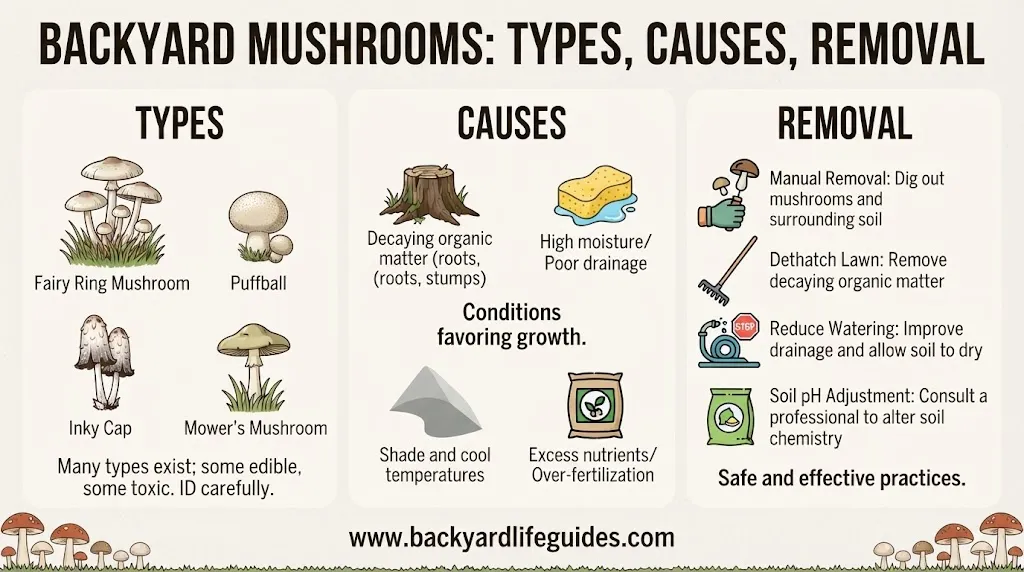
Seeing Backyard Mushrooms appear after rain can be surprising, especially when they suddenly cover a lawn, grow around a tree stump, or form circles in the grass. In most cases, mushrooms are the visible fruiting bodies of fungi living beneath the soil or inside decaying organic material.
Their appearance can tell you something about conditions in your yard. Moisture, shade, poor drainage, buried wood, old stumps, leaves, mulch, compost, pet waste, and other organic material can all provide favorable conditions for fungal growth.
Not every mushroom is dangerous, but identification matters. Some varieties are edible, some are considered non-poisonous, and others can be toxic or have poisonous look-alikes.
The good news is that you can usually manage unwanted mushrooms by addressing the conditions that support them. If your goal is cultivation instead, several edible varieties can also be deliberately grown outdoors using logs, woodchips, straw, or other substrates.
Why Do Backyard Mushrooms Grow?
Mushrooms usually appear when the environment provides enough moisture and organic material for fungi to develop.
Organic material
Fungi help break down organic matter, so areas containing decomposing material can become natural mushroom-growing locations.
Common sources include:
- Buried wood
- Old tree stumps
- Fallen logs
- Decaying leaves
- Mulch
- Compost
- Pet waste
- Other rotting organic material
A lawn may therefore develop mushrooms even when there is no obvious piece of wood on the surface. The fungal network may be using material beneath the soil.
Damp conditions
Heavy rain can trigger mushroom growth, particularly where water remains in the soil.
Poor drainage, low areas, and consistently damp ground can create favorable conditions — the same damp spots that can also attract mosquitoes to your yard.
Shade and protection
Mushrooms also commonly appear in sheltered locations.
Areas underneath trees, around mulch, among leaves, and in shaded parts of a yard can retain moisture for longer than exposed areas.
What backyard mushrooms can indicate
Their presence does not automatically mean your yard is unhealthy. Mushrooms are part of the natural process of breaking down organic material and returning nutrients to the soil, a role explained further by University of Maryland Extension.
However, a sudden or persistent appearance can point toward excess moisture, poor drainage, accumulated organic debris, or excessive thatch.
9 Common Backyard Mushrooms to Know
Different mushrooms have very different appearances, habitats, and levels of edibility.
| Mushroom | Scientific name | Typical characteristics | Edibility concern |
|---|---|---|---|
| Meadow/Field Mushroom | Agaricus campestris | White or grayish cap, pinkish/brownish gills | Edible, but look-alikes exist |
| Mower’s Mushroom | Panaeolina foenisecii | Small cap, common in frequently mowed lawns | Not edible; described as non-poisonous |
| Ringless Honey Mushroom | Desarmillaria caespitosa / Armillaria tabescens | Often around stumps and dead organic material | Can be destructive to plants |
| Common Stinkhorn | Phallus impudicus | Strong rotting-meat-like odor | Can make dogs sick |
| Fairy Ring Mushroom | Marasmius oreades | Small caps, often circular growth patterns | Edible according to the source, but look-alikes exist |
| Shaggy Ink Cap | Coprinus comatus | Included among common backyard mushrooms | Identification required |
| Fly Agaric | Amanita muscaria | Distinct wild mushroom species | Toxic |
| Giant Puffball | Calvatia gigantea | Can become extremely large | Identification required |
| Green-Spored Parasol | Chlorophyllum molybdites | Common backyard mushroom discussed in identification guides | Identification required |
Never eat a wild mushroom simply because it resembles an edible variety. Positive identification is important because poisonous look-alikes can exist.
Meadow or Field Mushroom
The Meadow Mushroom, also known as the Field Mushroom, is Agaricus campestris.
It commonly appears in early summer and has a white or grayish cap with pinkish to brownish gills. It is closely related to the common button mushroom and is described as edible.
The important caution is that edible mushrooms can have dangerous look-alikes. The article specifically highlights the destroying angel as an example of a poisonous mushroom that demonstrates why appearance alone is not enough for identification.
Size
One source gives the Field Mushroom a cap diameter of approximately 1–4 inches (3–10 cm).
Mower’s Mushroom
Mower’s Mushroom is associated with frequently mowed lawns and is commonly found during summer.
Its cap can be quite small, with the sources giving a range of approximately 0.4–1.2 inches (1–3 cm).
It is common in North America and Europe and is described as not edible but non-poisonous.
Because these mushrooms can blend into grass, regular lawn inspection can help you notice them before children or pets encounter them.
Ringless Honey Mushroom
Ringless Honey Mushroom is associated with dead organic material, including tree stumps and fallen logs.
It generally appears from late summer into fall, with one source identifying September through November as a common growing period.
This mushroom deserves particular attention around living plants. The material describes it as destructive when associated with host plants because it can interfere with the plant’s ability to receive water and nutrients.
If mushrooms repeatedly appear around the base of a tree or stump, inspect the area for decaying wood and other organic material.
Common Stinkhorn
The Common Stinkhorn, Phallus impudicus, is especially recognizable because of its powerful odor, often compared with rotting meat.
It commonly occurs around:
- Mulched gardens
- Forested yards
- Organic debris
A warning for dog owners
Stinkhorns can attract dogs because of their strong odor. The material warns that dogs may become sick after encountering them.
If you have pets that investigate everything in the yard, removing visible stinkhorns and limiting access to affected areas is particularly important.
Fairy Ring Mushroom
Fairy Ring Mushrooms, or Scotch bonnets, are associated with distinctive circular or ring-shaped growth patterns.
They have small white-to-tan umbrella-shaped caps and may appear in lawns.
The source describes them as edible but also emphasizes the existence of poisonous look-alikes. Therefore, a circular growth pattern should not be treated as proof that the mushrooms are safe to eat.
Typical size
The reported cap diameter is approximately 0.8–2 inches (2–5 cm).
Giant Puffball
Giant Puffballs are notable because of their potential size.
The information gives approximate dimensions of:
- 8–24 inches (20–60 cm) wide
- 3–12 inches (7.5–30 cm) tall
Smaller puffballs can measure around 2 inches (5 cm).
Their size makes them considerably different from the tiny mushrooms commonly appearing throughout lawns.
Are Backyard Mushrooms Poisonous?
Some are, while others are edible or described as non-poisonous.
The safest approach is to treat an unidentified mushroom as unsafe to eat.
One states that fewer than 5% of known mushrooms are poisonous or of uncertain edibility. That does not make casual identification safe, because a single poisonous mushroom can still cause serious harm.
Two toxic species specifically highlighted in the research are:
- Death Cap
- Fly Agaric
The research also warns about poisonous look-alikes for some mushrooms that are otherwise described as edible.
Use more than appearance
Reliable identification should involve several characteristics:
- Research the mushroom.
- Observe its color.
- Examine where it grows.
- Consider its other sensory characteristics.
- Consult an expert when necessary.
Do not rely on one visual characteristic alone.
How to Get Rid of Backyard Mushrooms
Removing the visible mushroom is only part of the solution. The underlying fungal network may remain in the soil or organic material.
The most useful approach is to make the yard less favorable for unwanted fungal growth, a strategy also recommended by UC Integrated Pest Management.
1. Reduce unnecessary watering
Excess irrigation can keep the soil unnecessarily wet.
One source recommends approximately 1 inch (2.5 cm) of water per week as an irrigation guideline.
Avoid adding unnecessary water when natural rainfall is already keeping the ground moist.
2. Improve drainage
Persistent wet spots can encourage mushrooms.
If water collects in certain parts of the yard, consider ways to improve drainage. One recommended option is installing French drains where appropriate. A well-drained flagstone patio can also help redirect water away from problem spots.
3. Level uneven ground
Low areas can hold water after rainfall.
Leveling uneven sections can help reduce standing moisture and create a more consistent lawn environment.
4. Remove dead organic material
Look for the material feeding fungal growth.
Remove or manage:
- Fallen logs
- Dead wood
- Old stumps where practical
- Excess leaves
- Decaying mulch
- Other decomposing organic material
5. Clean up pet waste
Pet waste is specifically identified as a potential food source for backyard fungi.
Regular cleanup can therefore reduce one source of organic material.
6. Manage lawn thatch
Excessive thatch can contribute to conditions favorable for mushrooms.
One source identifies more than 0.5 inch (1.3 cm) of thatch as excessive.
If thatch has accumulated, appropriate lawn maintenance can help improve conditions.
7. Increase sunlight and airflow
Shady, protected areas can retain moisture.
Where practical, increasing light and air circulation can make the environment less favorable for unwanted mushrooms.
8. Aerate the soil
Compacted soil can contribute to poor water movement.
Soil aeration can help improve air and water movement through the lawn.
9. Use fungicide only as a last resort
Fungicide is presented as a final option rather than the first solution.
Addressing moisture, drainage, organic material, shade, and thatch first targets the conditions that encourage mushroom growth.
A Simple Mushroom Prevention Checklist
If mushrooms keep returning, work through this checklist:
| Problem | What to do |
|---|---|
| Too much water | Reduce unnecessary irrigation |
| Standing water | Improve drainage |
| Uneven lawn | Level low areas |
| Dead wood | Remove decaying organic material |
| Old mulch | Clean or replace excessive material |
| Pet waste | Clean it regularly |
| Heavy thatch | Manage thatch above 0.5 inch |
| Excess shade | Increase light where practical |
| Poor airflow | Improve circulation |
| Persistent growth | Consider fungicide only as a last resort |
This approach focuses on the cause, rather than repeatedly removing only the mushrooms you can see.
How Big Can Backyard Mushrooms Get?
Backyard mushrooms range from tiny lawn species to very large puffballs.
Some useful size comparisons include:
| Mushroom | Approximate size |
|---|---|
| Mower’s Mushroom | 0.4–1.2 in / 1–3 cm cap |
| Fairy Ring Mushroom | 0.8–2 in / 2–5 cm cap |
| Field Mushroom | 1–4 in / 3–10 cm cap |
| Giant Puffball | 8–24 in / 20–60 cm wide |
| Giant Puffball height | 3–12 in / 7.5–30 cm |
This range shows why size alone is not enough for identification.
Can You Grow Mushrooms in Your Backyard?
Yes. Backyard mushroom growing can be approached as a deliberate form of outdoor cultivation, and it pairs well with other small garden ideas for making the most of your outdoor space.
The research identifies several suitable options, particularly:
- Oyster mushrooms
- Shiitake
- Wine caps
- Morels
- Elm mushrooms
Other cultivated species mentioned include lion’s mane, reishi, maitake, nameko, chicken of the woods, and pioppini.
Outdoor cultivation can use:
- Hardwood logs
- Woodchips
- Straw
- Compost
- Fruiting blocks
Log Cultivation
Log growing is one of the most established outdoor methods described in the research.
Shiitake can be grown on suitable hardwoods such as:
- Oak
- Hard maple
- Wild black cherry
- Black willow
- Birch
- Beech
Oyster mushrooms are associated with tulip poplar in the cited interview.
Recommended log dimensions
The interview recommends logs approximately:
- 6–8 inches in diameter
- 30–40 inches long
Another cultivation source gives a broader hardwood log diameter range of 4–8 inches.
When to start
Late winter is identified as an ideal starting period. For Zone 7 conditions, the example given is around late February.
After cutting, logs are allowed to rest for approximately 2–3 weeks before inoculation.
Inoculating the logs
Approximately 50 holes per log can be drilled for inoculation.
Mushroom-inoculated birch dowels are placed into the holes and sealed with wax.
The spawn run can take approximately 6–18 months.
During this period, logs should remain:
- Evenly moist
- In shade
- Low to the ground
Once established, outdoor mushrooms can continue producing for years. The interview specifically states that established mushrooms can fruit naturally for up to 8 years with little input beyond monitoring and harvesting.
Growing Mushrooms on Woodchips
Woodchips provide another outdoor cultivation option, particularly for wine caps.
The recommended patch described in the research is:
- 4 inches deep
- 5 × 5 feet
- Positioned beneath a deciduous tree
Woodchip beds can begin fruiting as early as the following year.
The method can also be started through approximately September.
Wine cap cultivation
Wine caps are especially suited to hardwood chips.
They can grow very large, with the interview stating that individual mushrooms can reach up to 5 pounds.
They can produce hundreds of mushrooms at a time and may fruit through summer and fall.
The recommendation is to favor hardwood chips and avoid excessive use of pine and cedar.
Straw Mushroom Cultivation
Straw can also serve as a mushroom-growing substrate.
The cultivation details include:
- Cut straw into 2–3 inch pieces.
- Pasteurize at 160–170°F.
- Pasteurize for 1–2 hours.
- Use approximately a 5:1 straw-to-spawn ratio.
These details are particularly relevant to growers who want a small-space cultivation method rather than using large logs.
Compost and Manure Substrate
Another cultivation approach uses compost and manure.
The cited mixture uses a:
60:30:5:5 ratio
The material is composted for approximately 2–3 weeks.
It is then pasteurized at:
140°F for 2 hours
After pasteurization, the substrate is cooled to approximately:
75°F
before spawn is added.
Spore Syringe Inoculation
The technical cultivation guide also describes spore syringe inoculation.
Important measurements include:
- 70% isopropyl alcohol for sterilization
- 45° injection angle
- 1–2 cc of spore solution per quart
- 3–4 injection locations
Clean handling is important because contamination can interfere with mushroom development.
Temperature and Humidity
Environmental conditions vary by mushroom species, but the cultivation research gives several useful ranges.
For oyster mushrooms:
| Stage | Temperature |
|---|---|
| Colonization | 65–75°F |
| Fruiting | 55–65°F |
A broader cultivated mushroom range is given as approximately 55–75°F (13–24°C).
Humidity is also important:
- General development: 80–95%
- Fruiting: 85–95%
The cultivation guide recommends checking humidity twice daily.
Light Requirements
Mushrooms do not require the same lighting conditions as conventional garden plants.
The cultivation information recommends approximately:
12 hours of indirect light per day
For LED grow lights, the suggested range is:
5000–6500K
The lights can be positioned approximately 3–4 feet from the growing area.
Fruiting and Troubleshooting
Environmental changes can influence fruiting.
The research notes that a temperature fluctuation of approximately 10–15°F can trigger fruiting.
For shiitake blocks, cold-water soaking for approximately 24 hours is described as a way to stimulate fruiting.
Growing conditions should therefore be monitored rather than treated as completely static.
How Quickly Can Mushrooms Grow?
Mushroom growth can be surprisingly fast once conditions are right.
The cultivation source states that mushrooms can double in size within 24 hours, which is why crops should be checked twice daily.
Outdoor log cultivation is much slower overall. Spawn runs can take 6–18 months, while woodchip beds may begin fruiting the following year.
The timeframe therefore depends heavily on the species and cultivation method.
Harvesting and Storing Mushrooms
Fresh mushrooms require relatively quick use or preservation.
The cultivation information gives these storage guidelines:
| Method | Approximate duration |
|---|---|
| Fresh, refrigerated | 5–7 days |
| Dried mushrooms | Up to 1 year |
| Frozen sautéed mushrooms | Up to 6 months |
For dehydration, the cited settings are:
- 110–120°F
- 3–6 hours
For freezing excess mushrooms, the interview recommends slicing them to approximately 1/8 inch, quickly sautéing them for a couple of minutes, and then freezing them.
Can Backyard Mushroom Growing Be Done in Small Spaces?
Yes. Small-scale systems can use logs, woodchip beds, containers, bags, or controlled growing areas.
One cultivation guide describes a growing room measuring:
6 × 8 feet
It claims that hundreds of pounds can be produced annually under suitable production conditions and that a 6-foot-tall shelf can substantially increase the usable growing area within the same footprint.
The same source suggests starting new production batches every 2–3 weeks when scaling production.
Backyard Mushrooms as a Small Business
Outdoor mushroom cultivation can also be approached as a small business.
Potential sales channels identified in the research include:
- Local restaurants
- Farmers’ markets
- Food co-ops
Starting small allows growers to learn cultivation, harvesting, storage, and demand before attempting larger production.
Environmental Benefits of Growing Mushrooms
Mushrooms are not only food-producing organisms. Their ecological role is another important part of backyard cultivation.
The research highlights their ability to:
- Break down organic material
- Return nutrients to soil
- Support soil health
- Help with water retention through mycelium networks
- Use materials such as coffee grounds and kitchen scraps as substrates
- Reduce some organic waste sent to landfills
- Support beneficial insects and microorganisms
The interview also presents an unusual ecological application for wine-cap mycelium: using it around runoff areas to help process material associated with roof runoff, driveways, cars, and downspouts.
People Asked Questions
Are backyard mushrooms poisonous?
Some can be toxic, while others are edible or described as non-poisonous. Because poisonous look-alikes exist, an unidentified backyard mushroom should not be eaten without reliable identification.
Why are mushrooms suddenly growing in my lawn?
Common contributing conditions include heavy rain, damp soil, poor drainage, shade, mulch, buried wood, decaying leaves, pet waste, and other organic material.
How do I stop mushrooms from growing in my yard?
Start by reducing unnecessary watering, improving drainage, removing dead organic material, managing excess mulch and thatch, increasing airflow and light where practical, and aerating compacted soil.
How much water should a lawn receive?
One source recommends approximately 1 inch (2.5 cm) of water per week as an irrigation guideline.
What is the smallest mushroom mentioned in these guides?
Mower’s Mushrooms can have caps approximately 0.4–1.2 inches (1–3 cm) across.
What is the largest mushroom mentioned?
The Giant Puffball can reach approximately 8–24 inches (20–60 cm) wide and 3–12 inches (7.5–30 cm) tall.
Can mushrooms be grown outdoors?
Yes. The research describes outdoor cultivation using logs, woodchips, straw, compost, and fruiting blocks.
What are good mushrooms for backyard cultivation?
The most frequently recommended beginner-friendly choices are oyster mushrooms, shiitake, and wine caps.
How long can mushroom logs produce?
The interview states that established outdoor mushrooms can naturally fruit for up to 8 years, while log spawn runs can take 6–18 months before fruiting.
How deep should a wine-cap woodchip bed be?
The cited woodchip method uses a bed approximately 4 inches deep and 5 × 5 feet in area.
How humid should a mushroom growing area be?
The cultivation guide gives 80–95% humidity for general mushroom development and 85–95% during fruiting.
How long do fresh mushrooms last?
The cultivation information gives approximately 5–7 days refrigerated for fresh mushrooms. Dried mushrooms may last up to 1 year, while frozen sautéed mushrooms can last up to 6 months.
Final Words
Backyard mushrooms can be either an unwanted lawn problem or an opportunity for outdoor cultivation. Their appearance is often connected with moisture, organic material, shade, and poor drainage, so correcting those conditions is the foundation of prevention.
For identification, remember that appearance alone is not enough to determine whether a mushroom is safe to eat. For cultivation, oyster mushrooms, shiitake, and wine caps offer practical outdoor options using logs, woodchips, straw, or other substrates.
Whether you’re trying to remove mushrooms or intentionally grow them, understanding where they come from and what conditions they need makes backyard mushroom management much easier.




3 Comments