
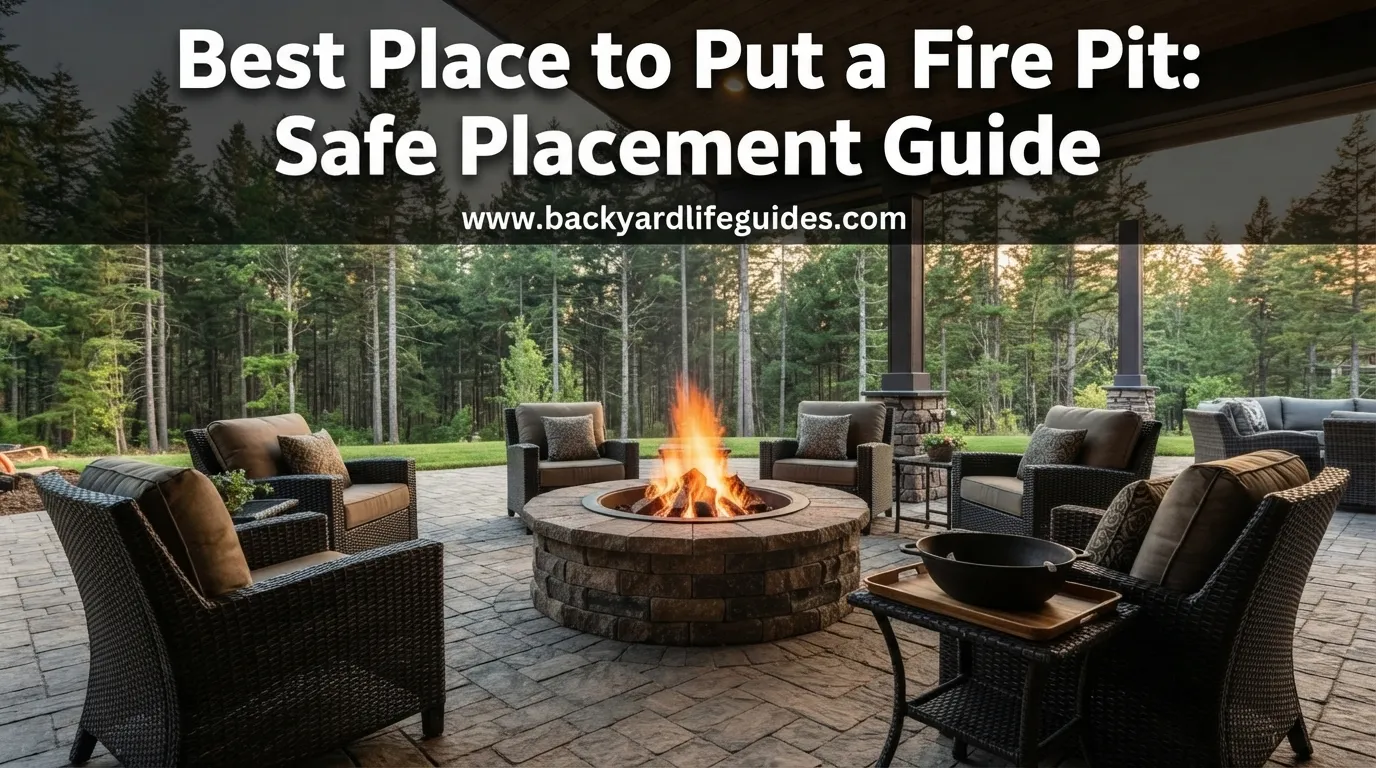
Best Place to Put a Fire Pit: Safe Placement Guide
- Disclosure: This post may include affiliate links. If you click a link and complete a purchase, I may earn a commission. Additionally, as an Amazon Associate, I earn from eligible purchases.
Choosing the best place to put a fire pit is about more than finding an empty corner of your backyard. The location affects safety, smoke, comfort, seating, accessibility, appearance, and how often you will actually enjoy the fire.
A good fire-pit location should provide enough distance from your house and other combustible objects while leaving comfortable room for people to sit and move around. You also need to think about wind direction, overhead structures, the ground surface, underground utilities, local regulations, and the way your backyard is used.
For many residential setups, a practical starting point is to keep the fire pit at least 10 feet from houses and other structures and provide approximately 7 feet of surrounding radiating space for seating and movement. However, these numbers should not replace your local fire code or the manufacturer’s installation requirements.
How Far Should a Fire Pit Be From a House?
Distance is one of the most important factors when deciding where to put a fire pit.
A useful planning benchmark is 10 feet between the fire pit and the house or other nearby structures. This helps create a buffer between flames, radiant heat, sparks, smoke, and heat-sensitive building materials.
The required clearance can vary depending on the location, fire-pit design, fuel type, and local regulations. Therefore, treat 10 feet as a planning baseline, not a universal legal requirement.
A wood-burning fire pit generally deserves extra caution because sparks, embers, and radiant heat can travel beyond the immediate flame area. Gas-burning models provide more controlled combustion, but they still need appropriate clearance and ventilation.
Keep Combustible Materials Away
When examining a proposed location, look beyond the house itself.
Check for:
- Dry leaves
- Grass and vegetation
- Wood piles
- Wooden fences
- Decking
- Outdoor furniture
- Tree branches
- Siding
- Awnings
- Other combustible structures
A fire pit should not be surrounded by clutter. Keeping the area open makes it easier to control the fire and gives people more room to move safely.
Leave 7 Feet of Space Around the Fire Pit
Distance from the house is only one part of good placement. You also need enough space around the fire pit itself.
A useful design starting point is approximately 7 feet of radiating space around the fire pit. This area can accommodate seating, movement, and the natural heat coming from the fire.
The 7-foot concept is especially helpful when planning the complete fire-pit area rather than simply placing a fire bowl somewhere in the yard.
Think of the fire pit as the center of a small outdoor room.
The surrounding space should allow people to:
- Sit comfortably
- Walk around the fire
- Enter and leave the seating area
- Maintain reasonable distance from the flames
- Avoid bumping into furniture
- Enjoy warmth without sitting directly beside the fire
A larger area may be preferable when you have a larger fire pit, more guests, children, furniture, or a wood-burning fire.
Choose Level and Stable Ground
A fire pit should sit on level, stable ground.
An uneven location can make the fire pit unstable and create problems with seating and movement. People should not have to step over roots, holes, rocks, or other obstacles while approaching the fire.
Before choosing a location, inspect the ground carefully.
Better Surface Choices
Non-combustible materials are generally preferable around a fire pit. Suitable options can include:
- Concrete
- Brick
- Stone
- Concrete pavers
- Gravel
These materials can also help define the fire-pit area visually.
Grass and wooden decking require particular caution because they can be vulnerable to heat, sparks, and embers. If a fire pit is being used on or near a sensitive surface, follow the fire pit manufacturer’s instructions and use appropriate protection where permitted.
A fire pit pad or mat can provide an additional protective layer in some installations, but it should not be treated as a substitute for required clearances.
Watch the Wind Direction Before Choosing a Location
Wind can completely change how comfortable and safe a fire-pit area feels.
Before deciding on a permanent location, observe how wind normally moves through your backyard. You want to avoid a setup where smoke repeatedly travels toward:
- Your house
- Seating
- Doors
- Windows
- Neighbors
- Outdoor cooking areas
A beautiful fire-pit location becomes frustrating if everyone constantly has to move because of smoke.
How to Test Your Backyard
Spend some time outside during the part of the day and season when you expect to use the fire pit most often.
Notice:
- Which direction the wind normally comes from.
- Where smoke would likely travel.
- Whether nearby buildings change the airflow.
- Whether trees create wind channels.
- Whether the proposed seating area sits directly downwind.
For areas with difficult wind conditions, suitable wind guards may help, but they should never create an enclosed or poorly ventilated fire area.
Avoid Enclosed Fire Pit Locations
One of the easiest mistakes is choosing a location because it looks attractive rather than because it provides adequate airflow.
Be especially careful with:
- Pergolas
- Pavilions
- Awnings
- Covered patios
- Enclosed outdoor rooms
Wood-burning fire pits should have an open path to the sky. Smoke, heat, sparks, and soot can accumulate around overhead structures and potentially damage materials.
Gas fire pits may be permitted in some covered applications, but that depends on the specific appliance, ventilation, clearance requirements, and local rules.
Never assume that a roof or pergola is safe simply because the fire pit fits underneath it.
Think About Local Fire Regulations
A location that looks perfect in your backyard may not be permitted by local regulations.
Rules can vary by:
- State
- County
- City
- Fire authority
- HOA
- Fire-ban status
- Fuel type
- Fire-pit design
Some areas may regulate the distance from structures, fire-pit size, fuel type, or whether wood-burning fires are permitted.
Before installation, check your local requirements rather than relying entirely on a general online recommendation.
What Should You Check?
Look for information about:
- Required clearance
- Open-flame restrictions
- Wood-burning regulations
- Gas fire-pit requirements
- Fire bans
- Permit requirements
- Inspection requirements
- HOA restrictions
Local rules always take priority over a general placement guide.
Call 811 Before Digging
If your fire-pit project involves digging, especially for a permanent installation, check for underground utilities first.
In the United States, 811 is the key number associated with locating underground utility lines before digging.
Potential underground hazards can include:
- Gas lines
- Electrical lines
- Water lines
Do not assume that you know where underground services are located simply because the proposed fire pit is several feet away from the house.
If your project requires excavation, follow the applicable local utility-locating process before digging.
Consider the Type of Fire Pit
The best location can also depend on the type of fire pit you are installing.
Wood-Burning Fire Pit
Wood-burning models require careful attention to:
- Sparks
- Embers
- Smoke
- Radiant heat
- Overhead clearance
- Combustible materials
- Wind
A spark screen can help control sparks from some wood-burning fire pits, but it does not eliminate the need for proper placement.
Gas-Burning Fire Pit
Gas models generally offer more controlled flames and less smoke, but they still require proper clearance, ventilation, and installation according to the manufacturer’s requirements.
Do not use the reduced smoke of a gas model as a reason to ignore overhead or structural clearance.
Smokeless Fire Pit
A smokeless design can reduce smoke under suitable operating conditions, but it still produces heat and flame. Its placement should therefore follow the same fundamental principles of clearance, stable ground, ventilation, and local regulations.
Put the Fire Pit Where People Actually Want to Gather
Safety should come first, but a fire pit also needs to be useful.
Think about where your family and guests naturally spend time.
Good locations may connect reasonably well with:
- Outdoor seating
- Patios
- Outdoor kitchens
- Entertainment areas
- Garden spaces
- Other backyard gathering areas
You should not have to walk across the entire yard every time you want to sit by the fire.
At the same time, avoid placing it directly in a high-traffic route.
A fire pit should be easy to reach without becoming an obstacle.
Plan the Seating Before Finalizing the Fire Pit Location
One of the smartest placement techniques is to design the seating area first.
Imagine several people sitting around the fire.
Ask yourself:
- Can everyone see the flames?
- Is there enough room between chairs?
- Can people walk behind the seating?
- Is anyone sitting too close to the heat?
- Will smoke frequently reach the seating?
- Can someone leave the area without crossing directly in front of the fire?
The 7-foot surrounding space can be a useful starting point for visualizing this arrangement.
Your actual layout may need more space depending on the size of the fire pit and seating furniture.
Match the Fire Pit to Your Backyard Layout
The best fire-pit location should look intentional rather than randomly placed.
Consider the existing geometry of your outdoor space.
For example, a yard dominated by curved landscaping may work naturally with a circular fire-pit arrangement. A more structured patio with straight lines may look better with a square or rectangular fire feature.
The goal is not to follow a rigid design rule. Instead, look for visual harmony between:
- Fire pit
- Patio
- Walkways
- Seating
- Landscaping
- Garden borders
- Outdoor kitchen
- Existing architecture
A well-positioned fire pit can become the focal point of the backyard without overwhelming everything around it.
Choose the Location Based on How You Use Your Yard
There isn’t one perfect location for every homeowner.
Your intended use should influence the placement.
For Family Gatherings
Place the fire pit where several people can gather comfortably while maintaining clear walking paths.
A central outdoor area may work well when the fire pit is intended to become the main gathering point.
For Entertaining Friends
Think about the relationship between the fire pit, seating, outdoor kitchen, and entertainment space.
You want guests to be able to move between areas without constantly crossing the fire zone.
For Quiet Relaxation
If you mainly want a peaceful place to sit alone, an appropriate corner of the backyard or garden may provide more privacy.
However, even an isolated location still needs the necessary clearance and safe access.
For a Decorative Focal Point
A fire pit can also be a landscape feature rather than the primary gathering area.
In that situation, consider sight lines from the patio, house, garden, or main outdoor walkway.
Think About the Seasons
Your ideal fire-pit position may feel different in summer and winter.
In colder weather, you may want the fire closer to the primary seating area so people can benefit from the warmth.
During warmer months, smoke and heat may become more noticeable, making additional separation desirable.
Also consider seasonal conditions such as:
- Snow
- Dry vegetation
- Summer winds
- Fallen leaves
- Changing shade
- Winter wind patterns
If your area receives substantial snow, think about whether the fire pit will remain accessible and whether surrounding pathways can be safely maintained.
Don’t Put It Too Close to Trees
Trees can make a fire-pit area feel natural and attractive, but branches can create an overhead hazard.
Inspect the entire vertical space above the proposed location.
Look for:
- Low branches
- Dry branches
- Overhanging vegetation
- Leaves
- Nearby tree trunks
A fire pit should not be positioned where flames, sparks, or heat can reach combustible vegetation.
Regularly inspect the area because tree growth can change the clearance over time.
Create a Non-Combustible Zone
A dedicated surface around the fire pit makes the area easier to manage and can visually separate the fire from the rest of the yard.
Depending on your design, this zone might use:
Gravel: Provides a distinct outdoor surface and works well with informal landscaping.
Brick: Creates a traditional, structured fire-pit area.
Stone: Can blend naturally with gardens and outdoor landscapes.
Concrete pavers: Offer a clean, organized surface for seating.
The surrounding area should remain free of unnecessary combustible clutter.
Common Fire Pit Placement Mistakes
Even a well-designed fire pit can become problematic if the location is chosen too quickly.
Putting It Too Close to the House
A fire pit beside siding, windows, doors, or other structures can expose them to heat, smoke, and sparks.
Use the 10-foot planning benchmark and verify the applicable local requirements.
Placing It Under a Pergola
A covered fire-pit area may look beautiful but can create problems with smoke, heat, soot, and ventilation.
Never assume an overhead structure is acceptable.
Ignoring Wind
A location that works on a calm day may become uncomfortable when the wind changes.
Observe prevailing wind patterns before committing to the site.
Installing It on an Unprotected Wooden Deck
Wood is combustible and can be damaged by heat and sparks.
Use only a setup specifically permitted for that surface and follow the fire-pit manufacturer’s instructions.
Forgetting About Traffic Flow
A fire pit in the middle of a frequently used walkway can become an obstacle.
Leave clear paths around the seating area.
Digging Without Checking Utilities
If the project involves excavation, remember 811 in the United States and follow the appropriate local utility-location process.
Choosing Appearance Over Safety
A fire pit should look good, but aesthetics should come after clearance, ventilation, surface safety, local regulations, and practical access.
A Simple Way to Choose the Best Spot
You can narrow down the location without making the decision complicated.
Start with several possible spots and evaluate each one.
| Placement Factor | What to Look For |
|---|---|
| Clearance | Aim for at least 10 ft from houses and structures as a planning baseline |
| Personal space | Allow about 7 ft of surrounding radiating space as a starting point |
| Ground | Level, stable, suitable surface |
| Overhead area | Open sky with no hazardous branches or structures |
| Wind | Smoke should not routinely blow toward seating or the house |
| Surface | Prefer non-combustible materials such as stone, brick, concrete, or suitable gravel |
| Utilities | Check underground services before digging; 811 applies in the U.S. |
| Access | Easy to reach without blocking major walkways |
| Seating | Enough room for comfortable chairs and movement |
| Regulations | Confirm current local fire and HOA requirements |
The location that performs well across all these categories is usually a much stronger choice than the location that simply looks best from the patio.
What Is the Best Place to Put a Fire Pit?
For many backyards, the best location is an open, level, stable area that is at least 10 feet from the house and other structures, has roughly 7 feet of usable surrounding space, and is positioned so prevailing winds do not regularly push smoke toward people or buildings.
The area should have no dangerous overhead branches or structures and should use an appropriate non-combustible surface.
Most importantly, the location must comply with local regulations and the fire-pit manufacturer’s instructions.
Frequently Asked Questions
How far should a fire pit be from a house?
A practical planning benchmark is 10 feet from the house and other structures. Local regulations and manufacturer instructions may require a different or greater clearance, so verify them before installation.
Is 7 feet enough around a fire pit?
7 feet of radiating space is a useful starting point for planning seating and movement around a fire pit. Larger fire pits or larger groups may require additional space.
Can I put a fire pit under a pergola?
Do not assume it is safe. Wood-burning fire pits generally need open overhead space, while covered gas installations depend on the appliance, clearance, ventilation, and local requirements.
What is the safest surface for a fire pit?
Non-combustible surfaces such as concrete, brick, stone, concrete pavers, or suitable gravel are commonly considered for fire-pit areas. Always follow the manufacturer’s surface requirements.
Should a fire pit be placed near the house for warmth?
It may be tempting, especially in winter, but safety clearance comes first. Do not move the fire pit closer to a building simply to make the seating area warmer.
Which direction should a fire pit face?
The fire pit itself does not necessarily need to face a particular direction. Instead, consider prevailing wind direction so smoke is less likely to move toward seating, doors, windows, or the house.
Can I put a fire pit on grass?
Grass can be exposed to heat, sparks, and embers. A properly prepared, suitable non-combustible surface is generally a better choice. Follow local rules and the manufacturer’s requirements for your particular fire pit.
Do I need 811 before installing a fire pit?
If you are digging in the United States, 811 is the standard starting point for locating underground utilities before excavation. Follow your local requirements before digging.
Is a gas fire pit safer to place than a wood-burning fire pit?
Gas fire pits provide more controlled combustion and generally produce less smoke, but they still generate heat and flame. Required clearances, ventilation, installation instructions, and local regulations still apply.
Should a fire pit be in the center of the backyard?
Not necessarily. A central location can work well for entertaining, but the best position depends on safety, wind, seating, traffic flow, regulations, and how you use the yard.
Final Fire Pit Placement Checklist
Before lighting your first fire, stand in the proposed location and check the entire area—not just the spot where the fire pit will sit.
Confirm these 10 things:
- The fire pit has appropriate clearance from the house and structures.
- You have planned around the 10-foot safety benchmark where applicable.
- There is approximately 7 feet of usable surrounding space for the planned layout.
- The ground is level and stable.
- The surface is suitable and preferably non-combustible.
- There are no dangerous branches directly overhead.
- Wind will not routinely carry smoke toward people or buildings.
- The fire pit does not block a major walkway.
- Underground utilities have been checked before digging, including 811 where applicable.
- Local fire regulations, fire bans, permits, HOA rules, and manufacturer instructions have been reviewed.
A great fire-pit location should feel natural once everything is in place. People should have enough room to sit, talk, move around, and enjoy the warmth without worrying about nearby structures, smoke, unstable ground, or combustible materials.
The key is to treat the fire pit as part of the whole outdoor space. Start with safety and legal requirements, then work outward to wind, surface, seating, accessibility, and aesthetics. That approach gives you a fire-pit area that is not only attractive, but also practical and comfortable to use.


3 Comments