Perfect Pancake on Blackstone Griddle: Easy Tips & Recipe
- Disclosure: This post may include affiliate links. If you click a link and complete a purchase, I may earn a commission. Additionally, as an Amazon Associate, I earn from eligible purchases.
Cooking pancakes on a Blackstone griddle gives you a large, flat cooking surface where you can make several pancakes at once. But getting consistently fluffy, evenly browned pancakes depends on more than simply pouring batter onto a hot surface.
The five approaches reviewed for this guide repeatedly emphasize the same fundamentals: controlling the griddle temperature, preparing the batter gently, using the right amount of batter, allowing enough space between pancakes, and watching the visual signs before flipping.
A temperature around 375°F (190°C) is the clearest target across the tested approaches. One method uses 350°F, while another recommends 375–400°F, but 375°F appears repeatedly as the practical middle point.
Want perfect pancakes every time? Below you’ll find easy tips and a simple recipe for making fluffy, golden pancakes on your Blackstone griddle.
What Temperature Should a Blackstone Be for Pancakes?
The strongest temperature recommendation from the five sources is 375°F (190°C).
One recommends preheating to 350°F, while another gives a broader range of 375–400°F. The 375°F setting is also specifically used in recipes tested repeatedly on Blackstone griddles.
Why 375°F Works Well
A properly heated surface allows the pancake to cook without producing an excessively dark bottom before the center is ready. The goal is an evenly cooked pancake with a golden-brown exterior.
One testing-focused approach compared temperatures around 325–350°F with 375°F and found 375°F to be the preferred temperature.
For a practical starting point:
Preheat the Blackstone to 375°F and allow approximately 10–15 minutes for preheating.
Because the griddle retains heat well, avoid assuming that simply turning the burners up will produce better pancakes.
Use a Water-Drop Test
One also recommends a simple water test.
Place a small amount of water on the heated surface. The water should move or skitter across the surface rather than disappearing immediately.
This provides a quick indication that the surface is hot enough before you begin cooking.
How to Make Pancake Batter for a Blackstone
The recipes reviewed use slightly different ingredient quantities, but the preparation technique is remarkably consistent.
The most important instruction is to avoid overmixing.
Example Blackstone Pancake Ingredients
One of the recipes uses:
| Ingredient | Amount |
|---|---|
| Flour | 2¼ cups |
| Sugar | ⅓ cup |
| Salt | ¾ tsp |
| Baking powder | ½ tbsp |
| Baking soda | 2 tsp |
| Milk | 1 cup |
| Vegetable oil | ¼ cup |
| Vanilla | ½ tbsp |
| Apple cider vinegar | ¼ cup |
| Sour cream | ¼ cup |
| Eggs | 2 |
Other tested recipes use different quantities, including 2–3 cups of flour, 1–1½ tablespoons of baking powder, 1–2 tablespoons of sugar, 2 eggs, and approximately 1.75–2.5 cups of milk.
The important point is to follow one complete recipe rather than mixing quantities between different versions.
Mix Dry and Wet Ingredients Separately
Combine the dry ingredients separately from the wet ingredients.
Then bring them together gently.
Do not continue mixing until the batter becomes completely smooth. The tested approaches specifically emphasize gentle mixing and leaving some lumps.
Overmixing can result in pancakes that are less soft and more rubbery.
Let the Batter Rest
One recipe-testing approach recommends allowing the batter to rest for 5–7 minutes before cooking.
This short resting period is part of the tested process and can be incorporated while the griddle finishes heating.
How Much Batter Should You Use?
For consistently sized pancakes, use approximately ¼ cup of batter per pancake.
Some recipes give a range of ¼–⅓ cup, but ¼ cup is the most repeated measurement.
Using a consistent amount helps produce pancakes that cook at a similar rate.
Don’t Spread the Batter
Pour the batter onto the griddle and allow it to form its own shape.
Do not spread it across the surface with a spatula.
The Blackstone’s flat surface provides enough room for the batter to naturally form a pancake.
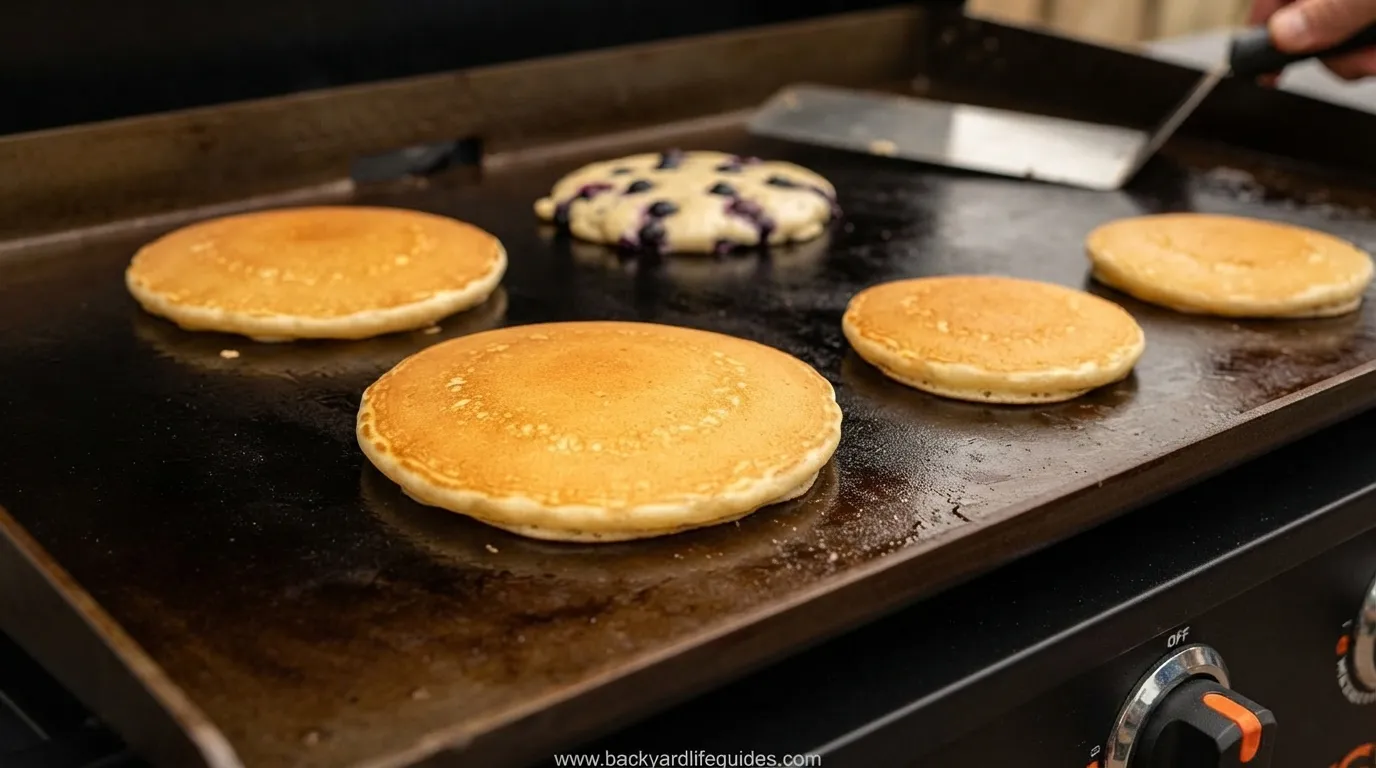
Leave approximately 2–3 inches between pancakes, so you have enough space to flip them without disturbing neighboring pancakes.
Should You Use Butter or Oil on a Blackstone?
The five approaches provide an important distinction between butter and oil.
Some recommend buttering the surface liberally, while another specifically recommends a very thin butter layer for fluffier and more evenly colored pancakes.
Another approach recommends vegetable or avocado oil because of their high smoke points and suggests saving butter for after cooking.
Thin Butter for a More Even Finish
The testing-focused approach found that a very thin layer of butter can help produce fluffier, more evenly colored pancakes.
Using more butter can create a crispier, more buttery exterior, but it may also cause the batter to spread more and produce flatter pancakes.
For this reason, avoid creating a thick pool of butter beneath each pancake.
Oil as an Alternative
Vegetable oil and avocado oil are also specifically recommended for greasing the Blackstone.
The important distinction is that butter can burn quickly on the hot cooking surface, while these oils have higher smoke points.
How to Cook Pancakes on a Blackstone Griddle
Once the batter is prepared and the griddle reaches approximately 375°F, the cooking process is straightforward.
1. Preheat the Blackstone
Preheat the griddle for approximately 10–15 minutes.
Aim for around 375°F / 190°C.
A water-drop test can also be used to check the surface.
2. Lightly Grease the Surface
Use a thin layer of butter or an appropriate cooking oil.
Avoid excessive butter if you want evenly colored pancakes.
3. Pour the Batter
Use approximately ¼ cup of batter for each pancake.
Leave around 2–3 inches between pancakes.
Do not spread the batter after pouring.
4. Add Optional Toppings
If using additions such as chocolate chips, berries, banana slices, or other ingredients mentioned in the recipes, add them after pouring the batter.
One large-batch recipe allows up to 1 cup of add-ins.
5. Watch the First Side
Cooking time depends on the recipe and griddle conditions.
Several approaches suggest approximately 1–2 minutes on the first side, while one extensively tested recipe uses 4–5 minutes on its first side.
Rather than relying exclusively on the clock, watch the pancake’s appearance.
6. Flip Once
Use a wide griddle spatula and flip the pancake once.
The visual cue emphasized by this is the appearance of many small bubbles and a properly browned underside.
Avoid repeatedly flipping the pancake.
7. Finish the Second Side
Cook the second side for approximately 1–2 minutes in the shorter cooking approaches.
The testing-focused recipe uses 2–3 minutes.
The finished pancake should have a golden-brown exterior without being excessively dark.
8. Move Finished Pancakes to the Cooler Area
Once cooked, move the pancakes to the cooler side of the griddle.
This is particularly useful when preparing a large batch.
How to Make Pancakes for a Crowd
One major advantage of the Blackstone is its large cooking surface.
The Flat Top King approach reports cooking approximately 12–16 pancakes at once, compared with only 2–3 on a conventional skillet.
Another large-batch recipe produces approximately 24 pancakes and serves 8.
Keep the Pancakes Warm
When making a large batch, place finished pancakes on the cooler area of the griddle while the remaining pancakes cook.
This makes the Blackstone particularly useful for family breakfasts or larger groups because several pancakes can be cooked together rather than working through small batches.
Common Blackstone Pancake Problems
The approaches identify several recurring pancake problems.
Pancakes Stick to the Griddle
Insufficient greasing can contribute to sticking.
Use a suitable amount of butter or oil rather than leaving the cooking surface completely dry.
However, avoid excessive butter if you want a flatter, more evenly colored cooking surface.
Pancakes Have Dark Bottoms
A griddle that is too hot can brown the outside before the pancake is properly cooked inside.
Start around 375°F and pay attention to the color of the cooked surface.
One specifically recommends 350°F, so temperature adjustment may be necessary depending on the result.
Pancakes Are Flat
Too much butter can cause the batter to spread more.
Overmixing the batter can also produce less desirable texture.
For a fluffier result, use a thin butter layer, mix gently, and avoid spreading the batter after pouring.
Pancakes Are Raw in the Center
Large pancakes or excessive batter can require more cooking time.
Use approximately ¼ cup of batter, watch the bubbles and surface appearance, and allow the pancake enough time on each side.
Pancakes Are Tough or Rubbery
The strongest warning across the techniques is overmixing.
Mix the wet and dry ingredients gently and stop once they are combined, even if some lumps remain.
Blackstone Pancake Add-In Ideas
The recipes reviewed provide several simple additions that can be added after pouring the batter.
- Chocolate chips
- Blueberries
- Strawberries
- Banana slices
- Fresh berries
- Chopped nuts
- Sprinkles
- Pumpkin puree and cinnamon
One recipe specifically recommends keeping total add-ins to approximately 1 cup.
Blackstone Pancake Recipe Variations
The five recipes use different ingredient ratios, so there is no single universal batter formula among them.
Here are the main measurements represented across the reviewed recipes:
| Ingredient | Range / Example |
|---|---|
| Flour | 2–3 cups |
| Sugar | 1–⅓ cup |
| Salt | ½–1 tsp |
| Baking powder | ½–1½ tbsp |
| Baking soda | 2 tsp in one recipe |
| Eggs | 2–3 |
| Milk | 1–2½ cups |
| Buttermilk | 2½ cups in one recipe |
| Melted butter | 4–6 tbsp |
| Vanilla | 1–2 tsp |
Because these proportions differ, select one recipe’s ingredient measurements and follow that recipe consistently.
How to Store Blackstone Pancakes
One large-batch approach recommends refrigerating cooked pancakes for up to 3 days.
For longer storage, pancakes can be frozen for up to 3 months.
Refrigerator Storage
Cooked pancakes can be refrigerated for:
Up to 3 days
Freezer Storage
For longer-term storage, the reviewed recipe allows:
Up to 3 months
Reheating
One recipe specifically recommends reheating pancakes in the microwave for approximately:
30 seconds
Frequently Asked Questions
What is the best temperature for pancakes on a Blackstone?
The most frequently recommended target is 375°F (190°C). Other approaches use 350°F or a range of 375–400°F.
How long should pancakes cook on a Blackstone?
Several recipes recommend approximately 1–2 minutes per side, while one tested recipe uses 4–5 minutes for the first side and 2–3 minutes for the second.
How much batter should I use for each pancake?
Use approximately ¼ cup of batter per pancake. Some recipes allow a range of ¼–⅓ cup.
Should I butter or oil my Blackstone for pancakes?
Both are used. A thin butter layer can provide even coloring, while vegetable or avocado oil is recommended as a high-smoke-point alternative.
What temperature does the Flat Top King recommend?
The Flat Top King approach recommends 375°F and describes testing lower temperatures around 325–350°F.
How long should pancake batter rest?
One tested approach recommends allowing the batter to rest for 5–7 minutes before cooking.
Why should pancake batter not be overmixed?
The reviewed techniques emphasize gentle mixing because overmixing can produce pancakes that are tough or rubbery rather than soft and fluffy.
How many pancakes can you cook on a Blackstone?
The large griddle approach reports cooking approximately 12–16 pancakes at once, while a large-batch recipe produces about 24 pancakes.
How long can Blackstone pancakes stay refrigerated?
One recipe recommends keeping cooked pancakes refrigerated for up to 3 days.
Can Blackstone pancakes be frozen?
Yes. The reviewed large-batch approach gives a freezer storage period of up to 3 months.
How do I know when to flip a pancake?
Look for many small bubbles and a properly browned underside. Then use a wide spatula to flip it once.
Should I spread pancake batter on the Blackstone?
No. The tested technique recommends pouring approximately ¼ cup of batter and allowing it to form naturally rather than spreading it.
The Simple Blackstone Pancake Formula
For a dependable starting method, bring the techniques together like this:
375°F → 10–15 minute preheat → thin grease layer → ¼ cup batter → 2–3 inches apart → gentle mixing → 5–7 minute batter rest → watch for bubbles → flip once → finish the second side.
The biggest lesson from the five approaches is that perfect Blackstone pancakes are less about complicated equipment and more about temperature control, batter consistency, careful timing, and gentle handling.
If the first pancake does not turn out exactly right, use it as a test. Adjust the temperature, batter consistency, or cooking time before preparing the rest of the batch.