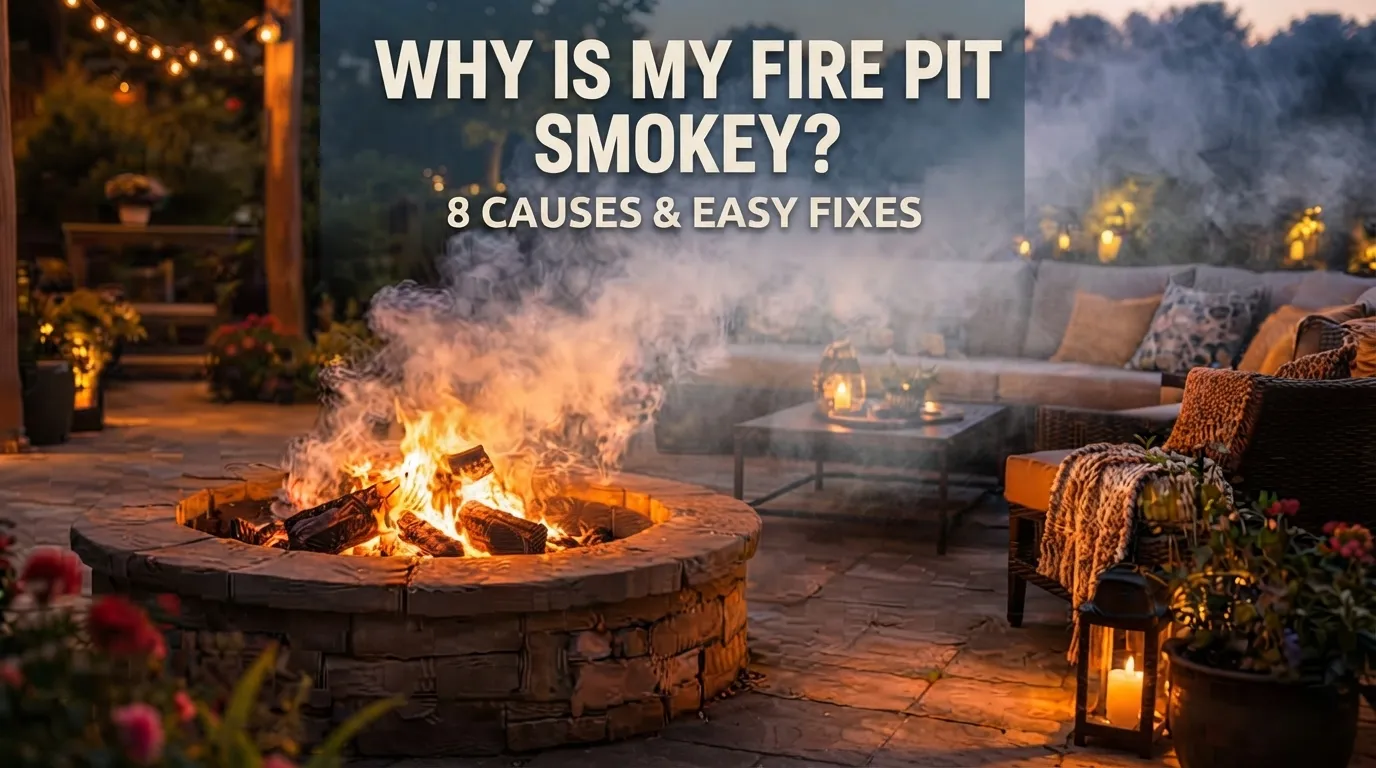
Why Is My Fire Pit Smokey? 8 Causes & Easy Fixes
- Disclosure: This post may include affiliate links. If you click a link and complete a purchase, I may earn a commission. Additionally, as an Amazon Associate, I earn from eligible purchases.
A fire pit naturally produces some smoke when wood burns, especially while a fire is getting started. But heavy, persistent smoke usually means something is preventing the wood from burning efficiently.
The most common problems are wet or green firewood, restricted airflow, poor log placement, sap or debris on the wood, excess ash, and an unsuitable fire-pit design. The good news is that most smoky-fire problems can be corrected without replacing your entire setup.
For most wood-burning fire pits, start with one simple check: is the wood actually dry? Properly seasoned firewood should generally be below 20% moisture content. Freshly cut wood can contain 50% or more moisture, which makes clean combustion much harder.
This guide walks through the main causes and practical fixes so you can identify the problem before your next fire.
Why Is My Fire Pit Smokey?
A smoky fire pit is usually caused by one or more of these 8 problems:
| Cause | What happens | What to do |
|---|---|---|
| Wet wood | Water must evaporate before clean combustion | Use properly seasoned wood |
| Green wood | Fresh wood contains excessive moisture | Let it season before burning |
| Sap or resin | Can increase smoke and residue | Choose suitable hardwood |
| Poor airflow | Fire cannot get enough oxygen | Leave gaps between logs |
| Tight stacking | Logs smolder instead of burning efficiently | Use a teepee or log-cabin arrangement |
| Mold, fungus, or debris | Contaminated wood can produce additional smoke | Inspect wood before burning |
| Yard waste or trash | Leaves, pinecones, paper, and other materials can smoke heavily | Burn only appropriate firewood |
| Dirty or poorly ventilated pit | Ash and debris restrict airflow | Clean the pit and check ventilation |
These causes overlap. For example, wet wood + poor airflow can create much more smoke than either problem alone.
1. Your Firewood Is Too Wet
Wet firewood is one of the most important things to check when a fire pit suddenly becomes smoky.
Wood contains moisture, and that water has to be driven out as the fire heats the log. Instead of putting its available energy into clean combustion, the fire spends part of that energy evaporating water.
The result can be white or heavy smoke, weak flames, and difficulty getting larger logs burning properly.
What moisture level should firewood have?
A useful target is below 20% moisture content.
Freshly cut wood can contain 50% or more moisture, while properly seasoned firewood should be below 20%. A moisture meter is the easiest way to check the actual condition of a log.
If you do not have a meter, inspect the wood:
- Look for cracks or checks at the ends.
- Dry wood is generally lighter than freshly cut wood.
- Two dry pieces can make a more hollow sound when knocked together.
- Wet or green wood tends to feel heavier and may produce a duller sound.
Quick tip: If you split a questionable log, check the freshly exposed interior rather than judging only the outside.
2. The Wood Is Still Green
Green wood means recently cut or insufficiently dried wood.
Even if the outside looks reasonably dry, the interior can still contain substantial moisture. This is why newly cut logs often struggle to burn cleanly.
The give several seasoning timeframes. A common recommendation is 6–12 months, while naturally seasoned firewood may be dried for 18 months or more, depending on the wood and conditions.
The important factor is not simply the calendar. The goal is to reach sufficiently low moisture content.
Seasoned vs. green wood
| Firewood | Typical signs | Expected result |
|---|---|---|
| Green wood | Heavy, moist, less cracked | More smoke |
| Partially seasoned | Some cracking but may retain moisture | Variable |
| Properly seasoned | Lighter, cracked ends, dry interior | Cleaner burning |
| Kiln-dried | Very low moisture | Easy ignition and low smoke |
3. You Are Burning the Wrong Type of Wood
Wood species does matter, but moisture is usually the more important starting point.
Once the wood is properly dry, dense hardwoods such as oak, maple, hickory, and ash are repeatedly identified in the material as good choices for lower-smoke fires.
Some softwoods, including pine, cedar, fir, spruce, and hemlock, can contain more sap or resin and may produce more smoke.
That does not mean every softwood is automatically unusable. A properly dry piece can still burn. However, if your goal is a hotter, cleaner-burning fire, seasoned hardwood is the safer choice among the woods.
Best options mentioned
- Oak
- Maple
- Hickory
- Ash
Woods to use more cautiously
- Pine
- Cedar
- Fir
- Spruce
- Hemlock
Also avoid burning treated, painted, or stained wood, plywood, particle board, or old furniture. These materials are not appropriate substitutes for ordinary firewood.
4. Your Fire Does Not Have Enough Airflow
A fire needs oxygen to burn efficiently.
If logs are packed together tightly, the flames may not receive enough air. Instead of producing a strong, hot flame, sections of the wood can smolder and produce smoke.
Check these areas:
- Bottom ventilation openings
- Fire-pit grate
- Spaces between logs
- Ash accumulation
- Debris blocking vents
Give the fire room to breathe
Do not create a solid wall of logs.
Leave visible gaps between pieces so air can travel through the structure. Two commonly discussed arrangements are the teepee and log-cabin styles.
The goal is simple: allow oxygen to reach the fire while keeping the logs close enough to transfer heat.
5. Your Logs Are Stacked Too Tightly
Poor stacking is closely related to airflow, but it deserves separate attention because the way you build the fire can determine how quickly it becomes established.
A tightly packed pile can restrict oxygen. The outer surfaces may remain smoky while the fire struggles to generate enough heat.
Instead:
- Put your tinder and smaller kindling where air can reach them.
- Add larger pieces without completely closing the structure.
- Keep gaps between logs.
- Let the fire establish itself before adding large pieces.
- Maintain enough space for air to circulate from below and around the wood.
A teepee-shaped structure can provide natural openings around the kindling. A square log-cabin arrangement can also create airflow channels.
6. There Is Sap, Mold, Fungus, or Other Material on the Wood
Firewood stored outdoors can collect more than moisture.
The specifically identify sap, pitch, moss, fungus, and mold as potential contributors to smoky burning.
Before putting a log on the fire, inspect it.
If you see:
- Heavy mold
- Fungus
- Moss
- Excessive debris
- Contamination
- Unusual coatings
choose another suitable piece of firewood.
This is particularly important if logs have been sitting exposed to weather for an extended period.
7. You Are Burning Yard Waste or Trash
A backyard fire pit can make it tempting to throw miscellaneous materials into the flames.
Avoid using the fire as a disposal bin.
Materials specifically discussed:
- Leaves
- Grass clippings
- Pinecones
- Pine straw
- Paper
- Wrappers
- Paper cups
- Yard debris
These materials can create extra smoke and may make the fire harder to control.
Instead, keep the fire limited to appropriate firewood. Yard waste can be handled through suitable disposal or composting methods rather than being added to the fire.
8. Your Fire Pit Is Dirty or Has Poor Ventilation
Sometimes the wood is fine, but the fire pit itself is restricting combustion.
Old ash, embers, and debris can accumulate around the base and interfere with airflow. If vents become blocked, the fire may not receive enough oxygen.
Check your pit before lighting it
Look for:
- Ash covering ventilation openings
- Blocked bottom vents
- Debris under the grate
- Excessive ash buildup
- Logs sitting directly on a blocked surface
A grate that raises the wood slightly can help create space underneath the fire where air can move.
Deep or poorly ventilated fire pits can also have trouble drawing air effectively. If your wood is genuinely dry and your fire still smokes heavily, fire-pit design deserves attention.
How Dry Should Firewood Be?
The most useful number to remember is 20%.
The material repeatedly uses a moisture level below 20% as the practical benchmark for properly seasoned firewood.
| Firewood condition | Moisture information |
|---|---|
| Freshly cut wood | 50%+ can occur |
| Properly seasoned | Below 20% |
| Low-smoke target discussed | 15–20% |
| Kiln-dried | Well below 20% |
A moisture meter removes much of the guesswork. If a log measures above 20%, it may be a major reason your fire is producing excessive smoke.
How Long Does Firewood Need to Dry?
There is no single drying time that works for every piece of wood.
The mention:
- 6–12 months as a common seasoning period.
- 18 months or more for naturally air-dried firewood in some circumstances.
- Around 6 days for the kiln-drying process described by one.
- Kiln drying temperatures of approximately 120–220°F.
- Another describes kiln drying in approximately 2 days in its discussion of moisture reduction.
The difference shows why moisture content is more useful than simply counting months.
If you can measure the wood and confirm it is below 20%, you have a much better indication that it is ready.
What Is the Best Firewood for a Low-Smoke Fire?
Based on the firewood types discussed across the supplied material, seasoned hardwood is the strongest overall choice.
Oak
Oak is repeatedly mentioned as a good lower-smoke option when properly seasoned. It is dense and can provide a long-lasting fire.
Maple
Maple is another hardwood mentioned among the preferred options for lower-smoke burning.
Hickory
Hickory is identified as a dense hardwood capable of producing a hot, longer-lasting fire when properly seasoned.
Ash
Ash is also recommended among the hardwood options discussed.
The key point is worth repeating:
Dry wood matters more than simply choosing a particular species.
Dry softwood can perform better than wet hardwood because moisture has such a strong effect on combustion.
How to Build a Fire With Less Smoke
A good fire-building technique can make a noticeable difference.
Start with small, dry material
Use appropriate dry tinder and small kindling rather than immediately trying to ignite a large log.
Build for airflow
Create a structure that leaves spaces between pieces. A teepee or log-cabin arrangement can provide useful air channels.
Let the fire become established
A fire that has just been lit may produce some smoke before it becomes hot enough for cleaner combustion.
Avoid immediately covering a weak flame with large logs.
Add larger logs gradually
Once you have a stronger flame and developing coal bed, add larger pieces as needed.
This approach helps the fire generate enough heat before it has to deal with large amounts of fuel.
Does a Smoky Fire Mean Something Is Wrong?
Not necessarily.
Some smoke during startup can be normal. The problem is persistent, heavy smoke after the fire has had enough time to become established.
If the fire remains smoky, work through the checklist:
Wood → Moisture → Airflow → Stacking → Ash → Fire-pit design → Wind
This order helps you find the most likely problem without changing everything at once.
What If the Fire Pit Smokes Even With Dry Wood?
If your firewood is confirmed below 20% moisture and you still have excessive smoke, move to the airflow and fire-pit checks.
Check the vents
Make sure ash or debris is not blocking ventilation openings.
Check the grate
If the logs sit directly on the bottom, an appropriate grate can help create space underneath the fire.
Check your stacking
Separate the logs enough to allow air through the fire.
Check the fire-pit design
A very deep bowl or a design with limited bottom ventilation may have weaker airflow.
Check the wind
Wind can dramatically change where smoke travels. A shifting breeze can repeatedly push smoke toward seating areas even when the fire itself is burning reasonably well.
If the smoke is mainly a direction problem, changing seating position may help. If the fire itself is producing excessive smoke, return to the fuel and airflow checks.
Can a Smokeless Fire Pit Eliminate Smoke?
A smokeless fire pit can significantly reduce visible smoke through improved airflow and secondary combustion, but “smokeless” should not be interpreted as literally producing zero emissions under every condition.
The material discusses designs using airflow systems to improve combustion and burn smoke before it escapes.
Even with a smokeless design, the fundamentals still matter:
- Use dry wood.
- Avoid oversized or wet logs.
- Maintain airflow.
- Do not overload the fire.
- Keep the system clean.
A better-designed pit cannot completely compensate for poor-quality fuel.
A Quick 5-Minute Smoky Fire Pit Check
If you are sitting beside the fire right now and want the fastest troubleshooting method, use this sequence.
| Check | Question | Action |
|---|---|---|
| 1. Wood | Is it dry? | Aim for below 20% moisture |
| 2. Fire | Is it actually hot? | Give the starter fire time to establish |
| 3. Air | Can oxygen reach the logs? | Open gaps and clear vents |
| 4. Ash | Is the base blocked? | Remove excess ash and debris |
| 5. Design | Does the pit draw air properly? | Check grate and bottom ventilation |
If the first two checks fail, fix those before changing anything else.
Common Mistakes That Make Fire Pits Smokier
Burning freshly cut wood
Fresh wood may look like perfectly good firewood, but its moisture content can be high.
Adding large logs too early
A large log placed onto a weak fire can smolder rather than burn cleanly.
Packing the logs tightly
A fire needs oxygen. A solid pile can restrict the airflow it needs.
Ignoring ash buildup
Ash can accumulate around the base and interfere with ventilation.
Burning yard debris
Leaves, pinecones, grass, and similar materials can create significantly more smoke.
Assuming hardwood automatically means dry
Hardwood is not automatically seasoned. A wet oak log can still produce plenty of smoke.
Ignoring the fire-pit design
If your fuel is dry and your fire is properly built but smoke remains excessive, the pit’s airflow may be part of the problem.
Frequently Asked Questions
Why is my fire pit smokey even with dry wood?
If the wood is genuinely dry, check airflow, ash buildup, log spacing, fire temperature, and fire-pit design. Restricted oxygen can cause even dry wood to smolder.
What moisture level should firewood have?
The practical target discussed is below 20% moisture content. A moisture meter is the most reliable way to check a log.
How long should firewood season before burning?
A common recommendation is 6–12 months, although some naturally seasoned wood may require 18 months or more. Actual moisture content is a better indicator than time alone.
What wood produces the least smoke?
The commonly identify properly seasoned oak, maple, hickory, and ash as good lower-smoke choices. However, moisture content is more important than species alone.
Why does my fire pit smoke when I first light it?
A newly started fire may smoke because it has not yet reached a sufficiently hot combustion stage. Small, dry kindling, good airflow, and allowing the fire to establish can reduce startup smoke.
Does wet wood cause more smoke?
Yes. Wet wood must first release its moisture before it can burn efficiently, which can create substantial smoke.
Can a fire pit grate reduce smoke?
A suitable grate can help by raising the wood and creating space for air to reach the underside of the fire. It will not compensate for wet fuel or blocked ventilation.
Should I burn pine in a fire pit?
The material notes that pine can contain more resin than many hardwoods and may produce more smoke. If using it, properly dry wood is important. Seasoned hardwood is generally the better choice for a lower-smoke fire.
Can I burn leaves and pinecones in my fire pit?
The supplied advise against using yard waste such as leaves, grass clippings, pinecones, and pine straw because these materials can generate additional smoke.
What should I do if my fire pit still smokes after everything is correct?
Confirm the wood is below 20% moisture, check all ventilation openings, remove excess ash, improve log spacing, and evaluate the fire-pit design. Wind direction can also make smoke appear worse by pushing it toward your seating area.
Final Takeaway
A smokey fire pit usually does not require an expensive solution.
Start with the wood. Properly seasoned firewood below 20% moisture is one of the most important factors. From there, make sure the fire has enough oxygen, the logs are not packed too tightly, and the pit is free from excessive ash and debris.
For lower-smoke burning, the material consistently points toward seasoned hardwoods such as oak, maple, hickory, and ash. Avoid green wood, contaminated logs, yard waste, and inappropriate materials such as treated or painted lumber.
If your fire still produces heavy smoke after the basics are correct, investigate ventilation, grate position, fire-pit design, and wind direction.
The goal is not necessarily a completely smoke-free fire. The goal is a hot, well-ventilated, efficiently burning fire that produces far less unnecessary smoke.
Practical Fire Pit Smoke Checklist
Before your next fire, save this checklist:
- Firewood is below 20% moisture
- Wood is properly seasoned
- Logs are not green or visibly wet
- Wood is free from mold and fungus
- Logs are spaced for airflow
- Fire-pit vents are clear
- Excess ash has been removed
- No leaves, grass, pinecones, or trash are being burned
- Small kindling is used to establish the fire
- Larger logs are added gradually
- The fire pit has adequate ventilation
- Seating is positioned with wind direction in mind
A few simple checks can turn a smoky backyard fire into a much more enjoyable outdoor experience.