
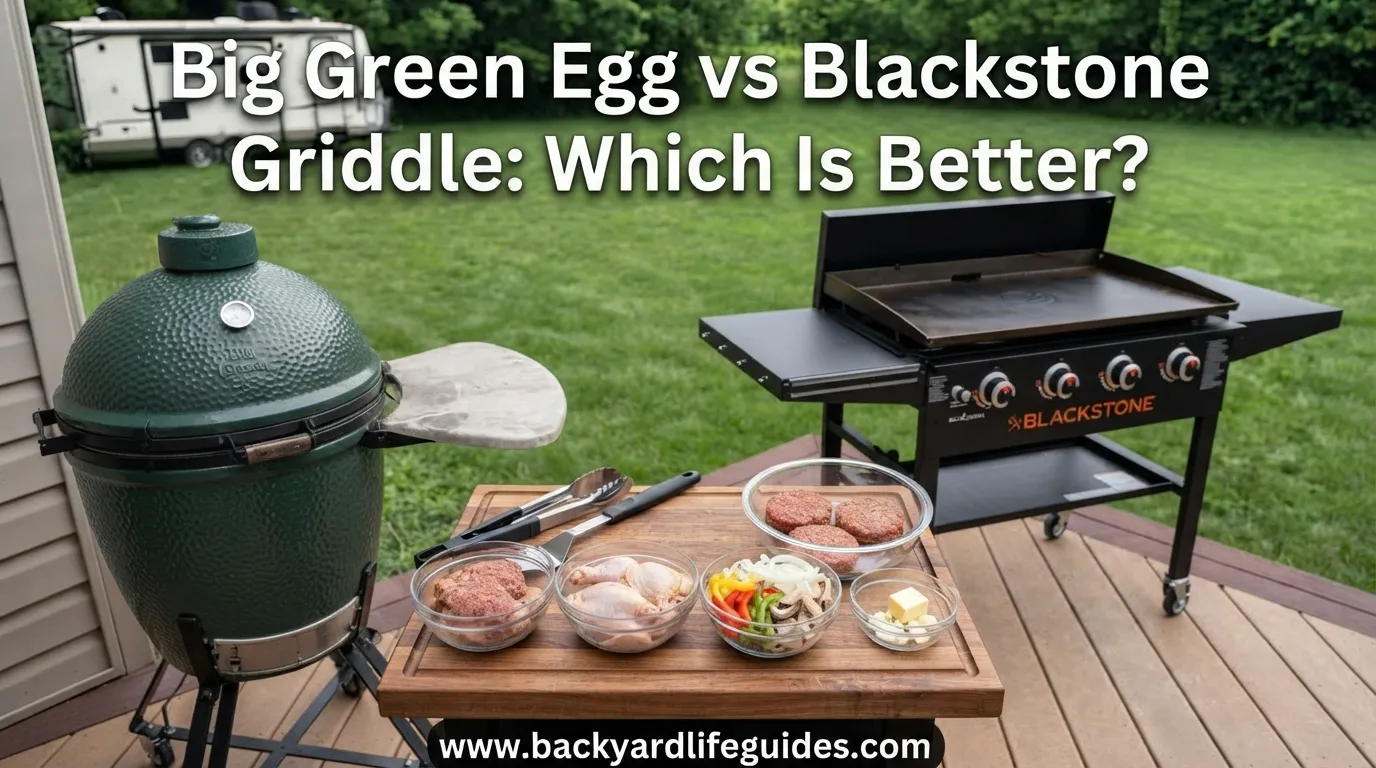
Big Green Egg vs Blackstone Griddle: Which Is Better?
- Disclosure: This post may include affiliate links. If you click a link and complete a purchase, I may earn a commission. Additionally, as an Amazon Associate, I earn from eligible purchases.
Choosing between a Big Green Egg and a Blackstone Griddle comes down to how you actually like to cook outdoors.
The Blackstone is built around speed, convenience, flat-top cooking, and propane-powered heat. It makes breakfast foods, smash burgers, fried rice, fajitas, cheesesteaks, vegetables, and similar meals straightforward.
The Big Green Egg takes a very different approach. It uses lump charcoal and a kamado-style ceramic cooking chamber to deliver smoky flavor, high temperatures, controlled low-and-slow cooking, roasting, grilling, and baking.
Neither cooker is automatically better for everyone. The better choice depends on your cooking style, available space, budget, preferred fuel, and how much versatility you want.
This comparison looks at the practical differences between the two so you can decide without buying more outdoor cooking equipment than you actually need.
What Is a Blackstone Griddle?
A Blackstone is a propane-powered outdoor griddle designed around a large flat cooking surface.
Unlike a traditional grill grate, the flat top allows food to cook directly against a heated steel surface. This makes it particularly useful for foods that are difficult to cook over open grates.
The Blackstone sizes discussed by the site include 17-inch, 22-inch, 28-inch, and 36-inch models.
The original Blackstone design was 36 inches, while smaller versions provide options for people with less outdoor space.
What Can You Cook on a Blackstone?
One of the biggest advantages is the sheer variety of foods that work naturally on a flat top.
Common examples include:
- Pancakes
- Eggs
- Bacon
- Smash burgers
- Hot dogs
- Grilled cheese
- Cheesesteaks
- Steak
- Stir-fry
- Fajitas
- Seafood
- Vegetables
- Hash browns
- Fried rice
- Beef birria tacos
- Chicken-fried steak
The flat surface also makes it easier to move food around different heat areas while cooking several ingredients at once.
Blackstone Temperature Range
The typical cooking range discussed by the manufacturer is approximately 250°F to 500°F, although a Blackstone can potentially reach around 650°F under suitable conditions.
For many everyday meals, a practical range around 300°F–400°F is enough.
That makes the griddle particularly convenient when you want to turn it on, heat the surface, and start cooking without building a charcoal fire.
What Is a Big Green Egg?
The Big Green Egg is a kamado-style cooker based on the concept of ceramic cooking vessels associated with Japan and East Asia.
The modern Big Green Egg was founded in 1974, while the broader kamado cooking tradition is described as being at least 3,000 years old.
Its ceramic construction and charcoal fuel make it fundamentally different from a propane flat-top griddle.
Instead of primarily cooking food against a steel surface, the Big Green Egg creates an enclosed cooking environment where you can grill, smoke, roast, and bake.
What Can You Cook on a Big Green Egg?
Its versatility is one of the main reasons we prefer it for more advanced outdoor cooking.
You can prepare:
- Burgers
- Steaks
- Vegetables
- Ribs
- Brisket
- Pulled pork
- Pizza
- Bread
- Casseroles
- Whole chicken
- Turkey
- Prime rib
- Salmon
With appropriate accessories and configurations, the cooker can function as a grill, smoker, oven, and roaster.
Big Green Egg Temperature Range
The Big Green Egg offers a much wider temperature range.
The s describe cooking from approximately 200°F to 700°F+, while temperatures of 842°F+ / 450°C+ are also discussed for very high-heat cooking.
That wide range is important because the same cooker can handle gentle low-temperature cooking and extremely hot grilling.
For everyday grilling, however, you do not necessarily need the maximum temperature. A range around 300°F–400°F can cover many common cooking situations.
Fuel: Propane vs Lump Charcoal
Fuel is one of the clearest differences between these cookers.
The Blackstone uses propane, while the Big Green Egg uses lump charcoal.
Blackstone: Propane Convenience
Propane makes the Blackstone straightforward to start and adjust.
Turn on the fuel, ignite the burners, allow the surface to heat, and adjust the burners according to the cooking zone you need.
This is especially useful when you want a quick outdoor meal.
The downside is that propane can be consumed relatively quickly, particularly when using a larger griddle for extended cooking.
Big Green Egg: Lump Charcoal Flavor
The Big Green Egg’s charcoal system gives it a completely different cooking character.
Lump charcoal can provide the smoky, grilled flavor many outdoor cooks want.
It also works particularly well for longer cooking sessions such as:
- Brisket
- Ribs
- Pulled pork
- Smoked chicken
- Roasting
- Low-and-slow barbecue
The tradeoff is that charcoal cooking generally requires more attention and preparation than simply turning on propane burners.
Flavor: Which One Tastes Better?
If smoky charcoal flavor is your priority, the Big Green Egg has the advantage.
Its charcoal-fired cooking environment naturally lends itself to smoky and deeply grilled food.
The Blackstone can produce excellent browning and crust because food is in direct contact with the hot steel surface. However, it does not naturally create the same traditional smoky character.
This difference becomes particularly noticeable with foods such as steaks, ribs, brisket, and other barbecue-style dishes.
Blackstone Flavor Strength
The Blackstone’s strength is surface contact.
Foods such as smash burgers, cheesesteaks, fried rice, vegetables, and pancakes benefit from direct contact with the hot griddle.
You get browning and crisp edges without needing an open flame directly underneath the food.
Big Green Egg Flavor Strength
The Big Green Egg excels when the cooking method itself is part of the flavor.
Charcoal, smoke, controlled heat, and enclosed cooking combine to create a style of food that a flat-top propane griddle cannot completely reproduce.
Cooking Versatility
This is where the Big Green Egg pulls significantly ahead.
A Blackstone is exceptionally good at what it was designed to do, but the Big Green Egg covers more cooking methods.
| Cooking Method | Blackstone | Big Green Egg |
| Flat-top cooking | Excellent | Limited |
| Pancakes | Excellent | Good |
| Eggs | Excellent | Good |
| Smash burgers | Excellent | Very good |
| Cheesesteaks | Excellent | Limited |
| Fried rice | Excellent | Good with suitable setup |
| Steaks | Very good | Excellent |
| Smoking | Limited | Excellent |
| Ribs | Limited | Excellent |
| Brisket | Limited | Excellent |
| Pizza | Limited | Excellent |
| Bread | Limited | Excellent |
| Roasting | Limited | Excellent |
| Pulled pork | Limited | Excellent |
If your cooking list mainly contains griddle foods, Blackstone makes more sense.
If you want one cooker that can move between grilling, smoking, roasting, and baking, the Big Green Egg offers greater flexibility.
Size Comparison
Both product families offer different sizes, but they serve different needs.
Blackstone Sizes
The s discuss:
- 17-inch
- 22-inch
- 28-inch
- 36-inch
The 36-inch version is highlighted as a favorite for people who want a large cooking area.
For many buyers, 22–28 inches represents a more manageable middle ground.
Big Green Egg Sizes
The sizes specifically mentioned:
- MiniMax: 13 inches
- 2XL: 28.7 inches
The MiniMax is aimed at people who want a smaller Egg, while the 2XL provides a substantially larger cooking capacity.
Which Size Makes Sense?
Think about how many people you normally cook for rather than simply buying the biggest model available.
A large cooker can be useful for parties and family gatherings, but it also takes more space and can cost substantially more.
For someone cooking for only 1–2 people, buying an extremely large outdoor cooker may not provide enough additional value to justify the expense.
Price: Which One Costs More?
The price gap can be significant.
The information places smaller or entry-level Blackstone options around $150, while popular 22–28-inch sizes are discussed around $150–$350.
Fully loaded larger Blackstone units can reach $600–$700+.
Big Green Egg pricing starts considerably higher. Entry-level sizes are discussed around $400–$500, while large models can reach $1,000+.
Some buyers may therefore find themselves considering an overall investment of approximately $800–$1,500+ once a larger Egg and additional accessories are involved.
| Budget Area | Blackstone | Big Green Egg |
| Entry-level discussion | Around $150 | Around $400–$500 |
| Common sweet spot | $150–$350 | Higher initial investment |
| Larger setups | $600–$700+ | $1,000+ |
| Accessories | Additional | Can add significantly to cost |
The exact price depends on model and configuration, but the basic takeaway is simple: Blackstone generally has the lower entry cost.
Ease of Use
If you want the easier learning curve, choose the Blackstone.
Its basic process is straightforward:
- Connect propane.
- Ignite the burners.
- Preheat the cooking surface.
- Set your heat.
- Cook.
- Clean and protect the surface.
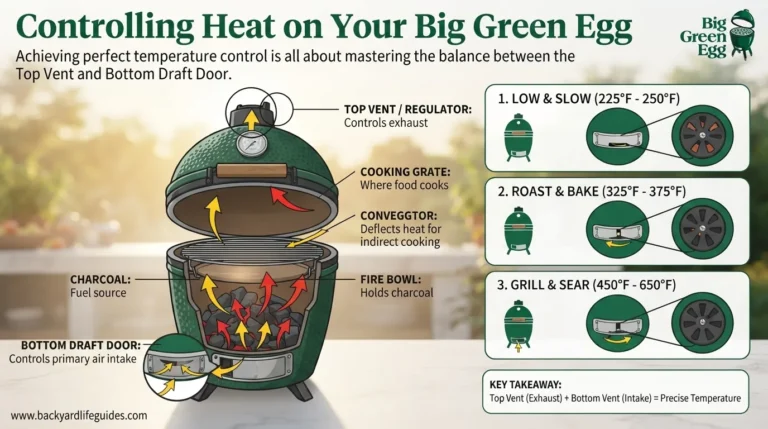
The Big Green Egg requires more familiarity with airflow, charcoal, temperature management, and cooking configuration.
Once mastered, that control becomes one of its biggest strengths.
But if your priority is simply getting dinner cooked quickly, the Blackstone is easier for most beginners.
Two-Zone Cooking
Two-zone cooking means creating different temperature areas so you can move food between hotter and cooler sections.
This technique is particularly useful when cooking food that needs different levels of heat during the same meal.
The Blackstone can create separate heat zones through its multiple burners.
For example, you could use a hotter area for browning while keeping another section at a lower temperature.
The Big Green Egg approaches temperature management differently because its enclosed cooking chamber and airflow controls regulate the overall cooking environment.
Both can support controlled cooking, but they require different techniques.
Blackstone Two-Zone Cooking
The learning curve comes from understanding how quickly different burner areas heat the cooking surface.
Wind can also interfere with burner performance.
Big Green Egg Two-Zone Cooking
The Big Green Egg requires more understanding of airflow and charcoal placement.
Its advantage is that the same basic cooker can support very different cooking temperatures and methods.
Breakfast: Blackstone Wins
For breakfast, the Blackstone is difficult to beat.
A large flat surface lets you cook eggs, bacon, pancakes, and hash browns together.
You can spread ingredients across the cooking area and move them between heat zones.
This is one of the clearest examples of choosing a cooker based on cooking style rather than simply asking which product is “better.”
If weekend breakfast is one of your main outdoor cooking activities, Blackstone is the more natural fit.
Burgers and Steaks
Both cookers can handle burgers and steaks well, but they produce different results.
Smash Burgers
Blackstone wins.
The flat surface provides excellent direct contact for smashing burgers and developing a browned crust.
Traditional Grilled Steak
Big Green Egg wins for versatility and smoky flavor.
The Egg can provide high heat while also giving you the option of charcoal-driven flavor and different cooking techniques.
Regular Burgers
Both are capable.
Choose Blackstone for surface contact and convenience. Choose Big Green Egg when charcoal flavor and broader grilling capability matter more.
Smoking, Ribs, and Brisket
This category strongly favors the Big Green Egg.
Low-and-slow cooking is one of its defining strengths.
The material specifically discusses cooking sessions lasting 8+ hours for low-and-slow food.
That makes it suitable for barbecue staples such as:
- Brisket
- Ribs
- Pulled pork
- Smoked chicken
A Blackstone is simply not designed to replace a dedicated smoker-style cooking environment.
Pizza and Baking
The Big Green Egg again has the advantage.
Its oven-like enclosed environment makes it suitable for:
- Pizza
- Bread
- Casseroles
- Roasted foods
The s also highlights baking and roasting with accessories such as the convEGGtor.
A Blackstone can cook some of these ingredients in different ways, but baking is not its primary purpose.
Cleanup and Maintenance
Neither cooker is completely maintenance-free.
Blackstone Maintenance
The cold-rolled steel surface needs regular care.
Important maintenance considerations include:
- Regular seasoning
- Applying oil
- Protecting the surface
- Keeping moisture away
- Using a cover
- Cleaning grease after cooking
One major concern is rust if the steel surface is not properly maintained.
Grease can also make cleanup messy, especially after large meals.
Big Green Egg Maintenance
The Big Green Egg avoids the same type of steel-flat-top seasoning routine, but charcoal cooking creates its own maintenance requirements.
You need to manage:
- Charcoal
- Ash
- Temperature
- Cooking accessories
- Ceramic equipment
The cooker is also heavy, which makes moving it difficult.
Space and Portability
Before buying either cooker, measure your available outdoor space.
A 36-inch Blackstone provides a generous cooking surface but can become bulky on a small patio or balcony.
Large Big Green Egg models are also heavy and require a suitable permanent or semi-permanent location.
The compact 13-inch MiniMax offers a smaller option within the Big Green Egg lineup, while the 28.7-inch 2XL is designed for much greater capacity.
For limited outdoor space, size should be treated as a major buying factor rather than an afterthought.
Blackstone Pros and Cons
Blackstone Advantages
- Fast propane startup
- Excellent flat-top cooking
- Great for breakfast
- Excellent for smash burgers
- Excellent for cheesesteaks
- Great for fried rice and stir-fries
- Multiple cooking zones
- Several size options
- Lower entry price
- Easier learning curve
Blackstone Disadvantages
- Requires regular seasoning
- Cold-rolled steel can rust
- Needs oil and protection
- Can be bulky and heavy
- Large models may not suit small patios
- Wind can affect burners
- Propane can be consumed relatively quickly
- Does not provide traditional grill marks
- Less smoky flavor
- Grease cleanup can be messy
Big Green Egg Pros and Cons
Big Green Egg Advantages
- Charcoal flavor
- Excellent smoking capability
- High-temperature cooking
- Low-and-slow cooking
- Grilling
- Roasting
- Baking
- Pizza cooking
- Moisture retention
- Fuel efficiency
- Durable construction
- Year-round cooking potential
- Highly versatile
Big Green Egg Disadvantages
- Higher purchase price
- Heavy
- Steeper learning curve
- Accessories can increase total cost
- Requires charcoal management
- May be excessive for people cooking for only 1–2 people
- Less convenient when you simply want a quick meal
Which One Is Better for Beginners?
For a beginner who wants simple outdoor cooking, Blackstone is the easier starting point.
Its propane burners and flat cooking surface make it relatively intuitive.
You do not need to master charcoal airflow before cooking breakfast or burgers.
The Big Green Egg has a higher learning curve, but that learning investment can pay off if you want to develop more advanced grilling and smoking skills.
Which One Is Better for Families?
It depends on what your family eats.
Choose Blackstone if your family regularly enjoys:
- Pancakes
- Eggs
- Bacon
- Burgers
- Hot dogs
- Grilled cheese
- Stir-fry
- Fajitas
- Fried rice
Choose Big Green Egg if your family enjoys:
- Ribs
- Brisket
- Pulled pork
- Smoked chicken
- Pizza
- Roasted meats
- Steaks
- Slow-cooked barbecue
For a family that wants maximum cooking variety, the Big Green Egg has the stronger case.
For a family that wants quick and convenient meals, Blackstone may be the better fit.
Which One Should You Buy?
The answer becomes easier when you focus on your priorities.
Choose Blackstone If You Want:
- Convenience
- Propane cooking
- Quick startup
- Flat-top meals
- Breakfast cooking
- Smash burgers
- Cheesesteaks
- Fried rice
- Fajitas
- A lower initial investment
- A gentler learning curve
Choose Big Green Egg If You Want:
- Versatility
- Charcoal flavor
- Smoking
- High-heat grilling
- Low-and-slow cooking
- Brisket and ribs
- Pizza
- Baking
- Roasting
- Long cooking sessions
- A cooker capable of multiple cooking styles
What If You Want Both?
For serious outdoor cooks, the two appliances can complement rather than replace one another.
A Blackstone can handle the foods it does best while the Big Green Egg handles smoking, roasting, baking, and charcoal grilling.
For example, you could use the Big Green Egg for smoked meat and the Blackstone for:
- Breakfast
- Side dishes
- Fried rice
- Vegetables
- Smash burgers
- Cheesesteaks
However, buying both only makes sense if you will genuinely use both.
If your outdoor cooking needs are simple, purchasing two large appliances may create unnecessary expense and consume valuable patio space.
Final Verdict
The Blackstone Griddle is the better choice for convenience, while the Big Green Egg is the better choice for versatility and charcoal cooking.
Blackstone shines when you want a large flat cooking surface, propane-powered heat, quick meals, and foods such as pancakes, eggs, smash burgers, cheesesteaks, fried rice, and fajitas.
Big Green Egg stands out when you want one cooker capable of grilling, smoking, roasting, and baking. Its approximately 200°F–700°F+ working range and potential for 842°F+ high heat give it significantly broader temperature capability.
The price difference is also important. Blackstone options discussed by the s range from approximately $150 to $700+, while Big Green Egg models begin around $400–$500 and larger setups can exceed $1,000.
So the simplest decision is:
Buy Blackstone for easy flat-top cooking.
Buy Big Green Egg for smoky flavor and maximum versatility.
Neither is the universal winner. The right cooker is the one that matches the food you actually plan to cook.
Frequently Asked Questions
Is a Big Green Egg better than a Blackstone?
A Big Green Egg is better for smoking, charcoal flavor, roasting, baking, and versatile grilling. Blackstone is better for flat-top cooking, breakfast, smash burgers, and quick propane-powered meals.
Can a Blackstone replace a Big Green Egg?
Not completely. A Blackstone can handle many everyday foods, but it does not provide the same charcoal-fired smoking, roasting, and enclosed cooking capabilities as a Big Green Egg.
Can you cook steak on a Blackstone?
Yes. A Blackstone is very capable of cooking steak and can produce strong browning from direct contact with its flat cooking surface.
Is the Big Green Egg good for low-and-slow cooking?
Yes. Low-and-slow cooking is one of the Big Green Egg’s major strengths, and the material discusses cooking sessions of 8+ hours for foods such as barbecue.
Which is easier to use, Big Green Egg or Blackstone?
Blackstone is generally easier for beginners. Propane burners provide direct heat control, while Big Green Egg users need to learn charcoal and airflow management.
Which produces more smoky flavor?
The Big Green Egg produces more traditional smoky flavor because it cooks with lump charcoal and is designed for grilling and smoking.
What Blackstone size should I choose?
The main sizes discussed are 17, 22, 28, and 36 inches. The 22–28-inch range is presented as a practical sweet spot, while the 36-inch model provides the most cooking space.
How hot can a Big Green Egg get?
Theinformationn discusses normal cooking from around 200°F to 700°F+, with high-heat capability reaching approximately 842°F+ / 450°C+.
How hot does a Blackstone get?
Typical temperatures are around 250°F–500°F, while higher temperatures of approximately 650°F may be possible depending on conditions.
Is a Blackstone good for breakfast?
Yes. Breakfast is one of its strongest use cases because the flat cooking surface works particularly well for pancakes, eggs, bacon, and hash browns.
Is a Big Green Egg good for pizza?
Yes. Its enclosed cooking environment and high-temperature capability make it suitable for pizza, as well as other baking applications.
Which one costs less?
Blackstone generally has the lower entry price. Information places compact options around $150, while Big Green Egg entry-level sizes are discussed around $400–$500.
Is a Big Green Egg worth the extra money?
It can be worthwhile if you will actually use its smoking, roasting, baking, grilling, and low-and-slow capabilities. If you mainly want burgers, breakfast, and flat-top meals, Blackstone may provide better value.
Which is better for a small patio?
A smaller model is generally more practical. Blackstone offers 17-inch and 22-inch options, while the Big Green Egg lineup discussed includes the 13-inch MiniMax.
Can you use a Big Green Egg all year?
The material presents the Big Green Egg as suitable for year-round use, provided it is properly managed and maintained.
One Comment