
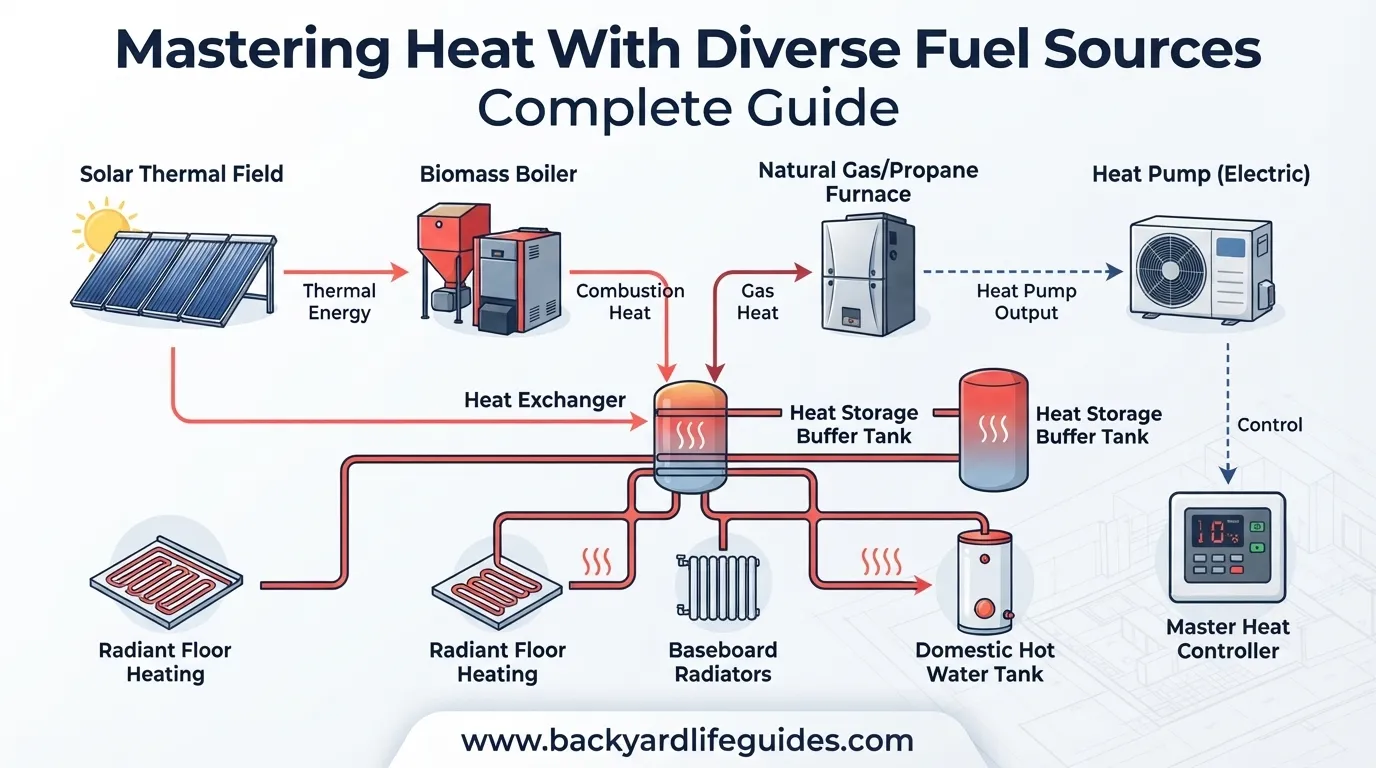
Mastering Heat With Diverse Fuel Sources: Complete Guide
- Disclosure: This post may include affiliate links. If you click a link and complete a purchase, I may earn a commission. Additionally, as an Amazon Associate, I earn from eligible purchases.
Heat can come from very different fuel sources and technologies, and the best choice depends heavily on what you are trying to achieve. A backyard griddle, for example, has very different requirements from a municipal heating network.
For cooking, flavor, heat control, speed, and burn duration are major considerations. For larger heating systems, the priorities shift toward generation cost, renewable energy, waste heat, storage, temperature requirements, and emissions.
Looking at these applications together provides a useful way to understand how different heat sources perform and why there is no single fuel that is ideal for every situation.
The main sources and technologies covered here are:
- Charcoal
- Gas
- Wood
- Renewable heat
- Waste heat
- Large-scale heat pumps
- Thermal energy storage
- Fossil-fired heat generation
The important lesson is simple: the right heat source depends on the application.
Choosing Heat for Cooking
Charcoal for Deep Smoky Flavor
Charcoal remains an attractive choice when flavor is one of the most important parts of cooking.
It works particularly well with foods such as:
- Sausages
- Steak
- Burgers
- Vegetables
The main advantage of charcoal is the distinctive smoky character it can bring to food. However, it generally requires more preparation than gas.
Charcoal can be divided into two primary types: briquettes and hardwood lump charcoal.
Charcoal Briquettes
Briquettes are made from densely packed sawdust and may contain additives such as starch, borax, and sodium nitrate.
Their characteristics make them useful when a longer, steady burn is preferred. Compared with lump charcoal, briquettes generally burn for longer but do not burn as hot or as quickly.
They are also presented as a more budget-friendly option.
Hardwood Lump Charcoal
Hardwood lump charcoal is described as 100% natural and can be produced from hardwoods including:
- Hickory
- Oak
- Maple
- Mesquite
It can ignite quickly, burn cleanly, and provide useful temperature control.
This makes it suitable for both lower-temperature cooking and high-heat searing.
How Long Does Charcoal Take to Prepare?
Charcoal preparation can take approximately 10–20 minutes, depending on the type being used.
A practical indicator is to wait until the charcoal develops a layer of white ash before spreading it across the griddle.
The way the charcoal is distributed can also influence cooking temperature:
| Charcoal arrangement | Expected heat |
|---|---|
| More densely packed | Higher heat |
| More sparsely distributed | Lower heat |
This creates different heat zones, allowing multiple foods or cooking stages to be managed on the same griddle.
Gas for Speed and Convenience
Why Choose Gas?
Gas is the more convenient option when fast startup and straightforward heat management are priorities.
It is particularly useful for:
- Steaks
- Fajitas
- Stir-fries
- Pancakes
- Quick weeknight meals
- Spontaneous gatherings
Gas lights quickly, heats evenly, and can reach high temperatures rapidly. Unlike charcoal, there is little waiting time before cooking.
For many users, this makes gas the practical choice when speed matters more than smoky flavor.
When Gas May Be Better Than Charcoal
Not every food benefits from a strong smoky character.
Foods such as pancakes, eggs, bacon, fish, and scallops may be better suited to a cleaner cooking environment where their natural flavors are not dominated by smoke.
Gas can therefore be particularly useful for mixed menus where precise and convenient heat is more important than adding smoke.
Adding Smoke Flavor to Gas Cooking
Gas does not naturally provide the same signature smoky flavor associated with charcoal or wood.
However, the supplied comparison suggests several ways to introduce additional smoke character, including:
- Pre-smoked ingredients
- Pre-soaked wood chips
- Foil packets
These approaches can provide some smoky character while retaining the convenience of gas.
Wood for Distinctive Natural Aromas
Why Use Wood?
Wood is another option when natural aromas and distinctive flavor are important.
High-quality wood can provide:
- Distinctive flavor
- Longer burn time
- Natural aromas
- Easier ash management compared with finer charcoal ash
Different woods can create different sensory characteristics.
For example:
- Mesquite → sweet scent
- Apple wood → light, refreshing zest
Wood can also produce larger ash particles, which are described as easier to manage than the finer, dustier ash associated with charcoal.
Comparing Cooking Fuel Sources
Choosing between charcoal, gas, and wood becomes much easier when the priorities are clearly separated.
| Fuel | Main strength | Best suited to | Main consideration |
|---|---|---|---|
| Charcoal | Smoky flavor | Burgers, steak, sausages, vegetables | 10–20 minutes preparation |
| Gas | Speed and convenience | Steaks, fajitas, stir-fries, pancakes | Less natural smoky flavor |
| Wood | Natural aroma and distinctive flavor | Flavor-focused cooking | Fuel quality affects results |
There is no universal winner.
If flavor is the priority, charcoal or wood may be more attractive. If speed and convenience matter most, gas has a clear advantage.
Heat Sources Beyond Outdoor Cooking
The idea of choosing the right heat source becomes even more important when moving from cooking equipment to district heating.
Large heating systems have different requirements from a griddle. Instead of focusing primarily on taste or cooking speed, operators need to consider factors such as:
- Generation costs
- Availability of heat
- Renewable energy
- Waste heat
- Temperature requirements
- Thermal storage
- Renewable electricity
- Fossil-fuel dependence
This is where modern heating technologies such as large-scale heat pumps become important.
Renewable Heat and Waste Heat
Why Alternative Heat Sources Matter
Research into district heating shows that renewable heat and waste heat can often have low generation costs.
However, these sources are not necessarily available at every moment. Their economics can also change depending on the operating conditions.
This means that simply having access to a renewable or waste heat source does not automatically make it the best option at every moment.
A more flexible approach is required.
The Heat Merit Order Approach
The research described in the supplied ScienceDirect study uses a heat merit order approach to evaluate the short-term marginal generation costs of different technologies.
The study examined 2 real German district-heating systems containing conventional and novel heat sources.
The approach considers technical and economic parameters to help determine which heat source can be operated most cost-effectively under particular conditions.
This provides an important principle for modern heating systems:
Heat sources should be evaluated according to their availability, cost, and operating conditions rather than treated as universally interchangeable.
Large-Scale Heat Pumps
Heat Pumps in the Heating Transition
Large heat pumps are highlighted as an important technology for reducing dependence on fossil fuels in urban and municipal heating systems.
The supplied ENGIE Refrigeration material focuses on two systems:
- SPECTRUM Water
- thermeco₂
These systems demonstrate how heat pumps can be designed for different temperature and capacity requirements.
SPECTRUM Water
The SPECTRUM Water system described in the supplied material has a rated heating capacity of 350–3,100 kW.
Its condenser leaving-water temperature can reach up to +65°C.
The system has applications including:
- Small low-temperature district heating networks
- Multivalent heating systems
- Energy hubs
- Renewable heat integration
- CHP systems
- Urban heating networks
The refrigerant options listed are:
- R-1234ze
- R-515B
- R-513a
The system uses an oil-free machine design with magnetic-bearing turbo compressors.
Bordeaux Heating Example
The supplied ENGIE example describes a residential district in Bordeaux covering 40,000 m².
The SPECTRUM Water heat pump has a thermal capacity of 1 megawatt for this project.
The example demonstrates how a large heat pump can be incorporated into a residential heating concept while supporting the broader sustainability objectives of the development.
High-Temperature Heat With thermeco₂
What Makes thermeco₂ Different?
The thermeco₂ system is presented as a high-temperature heat pump using a natural refrigerant.
According to the supplied information, it can provide heating-network temperatures of up to 90°C.
Its power range is:
90–1,000 kW
This makes the technology relevant where heating systems require higher water temperatures.
Braunschweig Residential Example
The supplied article references Heinrich der Löwe, a residential district in Braunschweig containing 600 residential units.
The thermeco₂ system is used as part of an innovative waste-heat concept for the district.
Another application mentioned is a district administration in Ludwigsburg, where the system is used for an in-house data centre.
These examples illustrate an important feature of modern heating: available waste heat can become a useful heat source when suitable technology is available to recover and integrate it.
Germany’s Heating Transition
Renewable Energy in Heating
The supplied ENGIE article describes a significant difference between renewable energy’s role in heating and electricity.
At the time discussed in that article, regenerative energy sources accounted for around 17% of Germany’s heating supply.
By comparison, regenerative energy represented more than 40% of the electricity sector.
The article discusses a German government target of reaching a 50% renewable share in heating supply by 2030.
These figures demonstrate why heating presents a different transition challenge from electricity.
Building Heating Demand
Building heating is another important part of the transition.
The supplied material states that building heating accounts for around 35% of Germany’s current energy requirements.
It also states that only around one quarter of this demand is covered using regenerative energies.
This helps explain why changing the way buildings and heating networks receive their heat can have a significant impact on the overall energy system.
Heating Networks and Fossil Fuels
Why Heating Networks Matter
Heating networks can connect multiple sources of heat instead of depending on a single technology.
They can:
- Connect different energy sources
- Balance surplus and demand
- Provide storage possibilities
- Supply existing buildings
- Supply new buildings
- Support decarbonization in dense urban areas
The supplied material describes a goal of making heating networks carbon-neutral by 2045.
Current Fossil-Fuel Dependence
One of the most important figures from the supplied ENGIE material is that around 70% of the energy supplied through heating networks is still produced using natural gas and coal.
This illustrates why replacing or reducing fossil-fuel generation remains an important part of the heating transition.
Large heat pumps, renewable heat, waste heat, and thermal storage can all play different roles in creating a more flexible heating mix.
Why Thermal Energy Storage Matters
Matching Heat Supply With Demand
Renewable and waste heat sources are valuable, but they may not always be available when demand is highest.
This creates a timing problem.
Thermal energy storage can help address this issue by allowing useful heat to be stored and made available when required.
The supplied research specifically emphasizes large-scale thermal energy storage as an important element for integrating renewable and waste heat.
This means storage is not simply an additional component. It can help connect intermittent or variable heat availability with changing heating demand.
A Practical Way to Choose a Heat Source
Whether you are choosing fuel for a griddle or evaluating heat sources for a larger heating system, the same basic principle applies: start with the requirement, then choose the heat source.
Step 1: Define the Required Heat
First determine how much heat is actually needed.
A backyard griddle has a very different requirement from a district heating network, so capacity should always be considered before selecting a fuel or technology.
Step 2: Consider Speed
If rapid startup is important, gas has an advantage in cooking because it lights quickly and heats rapidly.
For larger systems, the equivalent question is how quickly a particular heat source can respond to demand.
Step 3: Consider Heat Control
Charcoal can be distributed more densely or sparsely to create different heat levels.
Modern heating systems similarly need to manage different sources according to their operating conditions and costs.
Step 4: Consider Availability
A theoretically inexpensive or renewable heat source is not useful if it cannot supply the required heat when needed.
This is one reason the merit-order concept and thermal storage are important for larger heating systems.
Step 5: Consider the Desired Outcome
For cooking, the desired outcome could be:
- Smoky flavor
- Fast preparation
- Natural aroma
- High heat
- Easy operation
For district heating, the priorities may instead include:
- Lower generation costs
- Renewable heat integration
- Waste heat recovery
- Reduced fossil-fuel dependence
- Suitable temperatures
- Flexible operation
What These Heat Sources Have in Common
At first glance, charcoal, gas, wood, heat pumps, and district-heating technologies seem unrelated.
However, they all involve the same fundamental decision: how should available energy be converted into useful heat for a particular purpose?
The answer depends on several factors.
For cooking, the most important variables include flavor, preparation time, heat control, and burn characteristics.
For district heating, the variables become generation costs, source availability, renewable integration, temperature, storage, and fossil-fuel dependence.
The common lesson is therefore not that one source is better than another.
It is that heat should be matched to the job it needs to perform.
Frequently Asked Questions
What is the best fuel for smoky cooking?
Charcoal is the strongest choice when deep smoky flavor is the main priority. It is especially suitable for foods such as steak, burgers, sausages, and vegetables.
Is gas better than charcoal for quick cooking?
Gas is generally the more convenient option when speed matters. It lights quickly, heats evenly, reaches high temperatures rapidly, and requires little waiting before cooking.
How long does charcoal take to prepare?
The supplied comparison gives an approximate preparation time of 10–20 minutes, depending on the charcoal type. Waiting for white ash is recommended before spreading it across the griddle.
What is the difference between briquettes and lump charcoal?
Briquettes are densely packed and generally burn longer, while hardwood lump charcoal is described as 100% natural, ignites quickly, and provides useful temperature control.
Which wood flavors are mentioned?
The supplied material specifically mentions mesquite, associated with a sweet scent, and apple wood, associated with a light, refreshing zest.
Why are large heat pumps important?
Large heat pumps can help heating systems integrate renewable and waste heat while reducing reliance on conventional fossil-fuel heat generation.
What temperature can SPECTRUM Water provide?
The supplied ENGIE material states that SPECTRUM Water has a condenser leaving-water temperature of up to +65°C.
What temperature can thermeco₂ provide?
The thermeco₂ system is described as providing heating-network temperatures of up to 90°C.
Why is thermal energy storage important?
Thermal storage can help connect renewable and waste heat availability with changing demand, making these sources easier to integrate into larger heating systems.
What is the heat merit order approach?
It is an approach used to compare the short-term marginal generation costs of different heat technologies under particular operating scenarios, helping identify cost-efficient options.
Final Takeaway
There is no single best heat source for every application.
For a griddle, charcoal can be the better choice when smoky flavor matters, gas when speed and convenience are more important, and wood when distinctive natural aromas are desired.
At the district-heating scale, the decision becomes more complex. Renewable heat, waste heat, large-scale heat pumps, thermal storage, and existing fossil-fired generators may all have different roles depending on availability, temperature, cost, and demand.
The most useful approach is therefore to evaluate the requirement first and the fuel or technology second.
That principle leads to better cooking decisions at home and more informed thinking about how modern heating systems can combine different sources efficiently.





5 Comments