
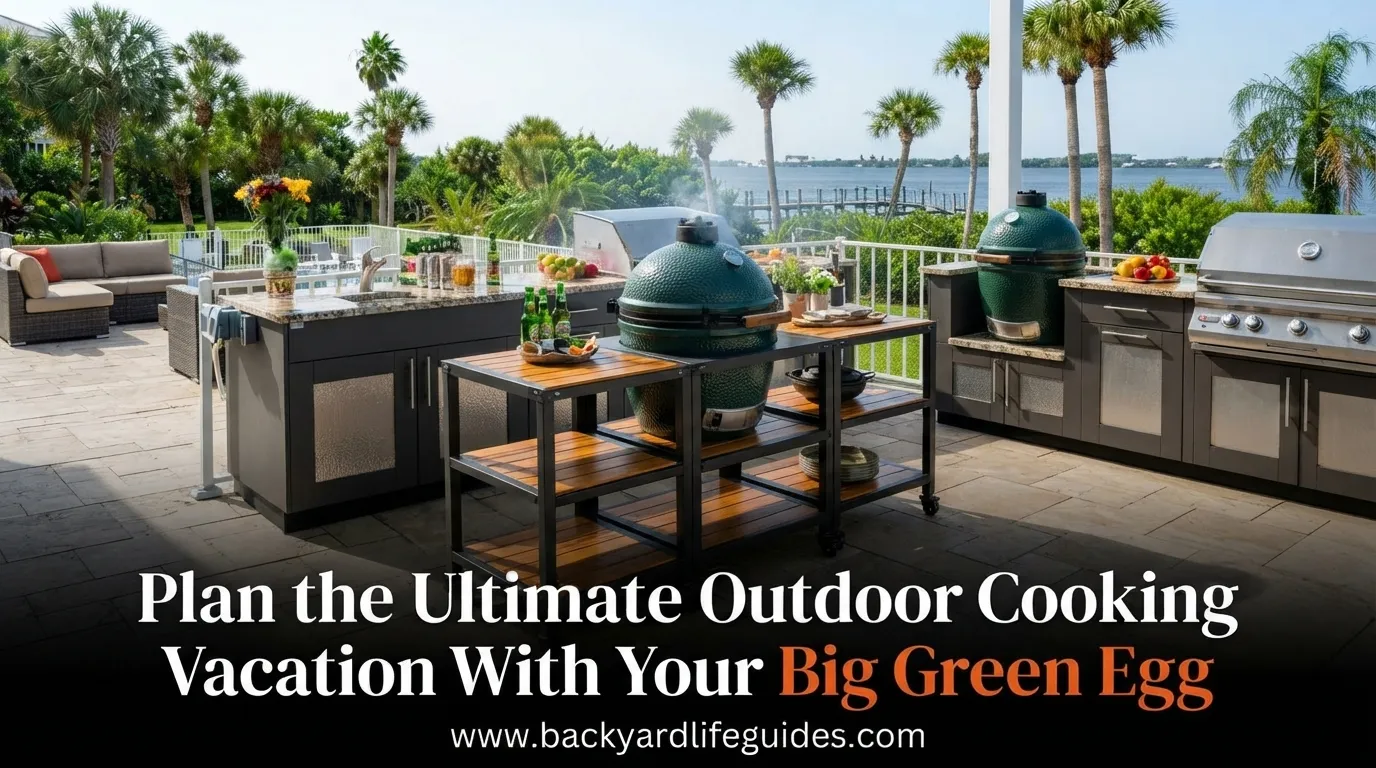
Plan the Ultimate Outdoor Cooking Vacation With Your Big Green Egg
- Disclosure: This post may include affiliate links. If you click a link and complete a purchase, I may earn a commission. Additionally, as an Amazon Associate, I earn from eligible purchases.
A vacation becomes even more memorable when the destination, food, and outdoor cooking experience are planned together. If you own a Big Green Egg, you can build an entire getaway around grilling, roasting, baking, or smoking outdoors.
The key is to plan more than just the food. You need to think about where you are going, what equipment you need, how many people you are feeding, how long you will be away, and which cooking methods fit your menu.
A cabin retreat, beach getaway, or other outdoor destination can turn a normal weekend away into a complete outdoor cooking experience.
This guide brings together practical planning, equipment preparation, Big Green Egg setup, temperature guidance, meal organization, and safety considerations so you can spend less time troubleshooting and more time enjoying your vacation.
Start With the Right Outdoor Destination
The location should support the kind of cooking experience you want.
A cabin retreat can work particularly well when you want several cooked meals during a longer stay. A suitable beach or outdoor destination may be better for a simpler grilling-focused trip.
Before choosing your destination, consider:
- Is outdoor cooking permitted?
- Is there a safe and suitable place for the Big Green Egg?
- Will you have enough space around the cooker?
- Is the cooking area protected from unnecessary hazards?
- How will you transport food and ice?
- Will you have access to water for cleaning?
- How far will you need to carry your cooking equipment?
A good destination makes the cooking process convenient rather than turning it into another chore.
Plan Your Meals Before Packing
One of the easiest ways to overpack is to start throwing food into a cooler without deciding what you are actually going to cook.
Begin with four simple questions:
- How many people are you feeding?
- How long will the vacation last?
- Will you prepare three meals a day or mostly grab-and-go food?
- How much time do you want to spend cooking?
Then consider allergies and dietary restrictions before creating the menu.
For a longer stay, you might combine different Big Green Egg capabilities rather than grilling every meal. The cooker can be used as a grill, smoker, or oven, allowing you to create more variety without taking several cooking appliances.
Build a Simple Vacation Menu
A practical menu can be divided into:
| Meal type | Planning approach |
|---|---|
| Breakfast | Keep preparation simple and quick |
| Lunch | Use easy-to-cook foods or leftovers |
| Dinner | Reserve more time for grilling, roasting, or smoking |
| Snacks | Prepare grab-and-go options |
| Dessert | Consider baking on the Egg |
The goal is not to make every meal complicated. A successful outdoor cooking vacation should leave you enough time to enjoy the destination.
Big Green Egg Vacation Equipment Checklist
Your cooking setup should include the equipment required for cooking, temperature control, cleaning, food preparation, and storage.
Core Grilling Equipment
Pack the essentials:
- Grill brush
- Tongs
- Meat thermometer
- Skillet
- Drip pan
- Ash poker
- Ash removal pan
These items cover many of the basic tasks involved in grilling and maintaining the cooker.
Food Preparation Supplies
Do not forget the items that make food preparation possible:
- Cutting board
- Knife
- Aluminum foil
- Plates
- Cups
- Utensils
- Cooler
- Ice
- Rubs
- Marinades
- Seasonings
Keeping preparation supplies together prevents the common problem of arriving at your destination with the grill but forgetting something needed to actually serve the meal.
Cleaning and Waste Supplies
Outdoor cooking also creates cleanup work.
Bring:
- Scrubber
- Dish soap
- Trash bags
A simple cleanup kit can make the final part of each meal considerably easier.
Charcoal and Fire Supplies
For the Big Green Egg, plan your fuel and ignition method before leaving home.
Useful supplies include:
- Natural lump charcoal
- Natural fire starters
- Electric lighter
- Hardwood chips
If you intend to smoke food, decide which wood you need before the trip rather than improvising at the destination.
How to Set Up the Big Green Egg
Once you reach your destination, give yourself enough time to establish a stable cooking temperature.
A basic startup process begins by loading the Egg with natural lump charcoal.
Natural starters or an electric lighter can then be used to start the fire.
Keep the vents and lid open for approximately 7–10 minutes while the fire gets established.
After this initial period, close the lid and allow the Egg to reach the desired cooking temperature.
Initial heating generally takes about 15–20 minutes, although cold weather can make the process take longer.
The important point is not to rush the cooker. Give the fire enough time to become stable before putting food on the grate.
The 10 × 10 × 10 Fire-Starting Method
For a more structured startup, one of the approaches uses a 10 × 10 × 10 method.
First 10 Minutes
Fill the Fire Bowl approximately halfway with lump charcoal.
Use 3 fire starters, positioned around:
- 12:00
- 4:00
- 8:00
Keep the draft door fully open and the dome raised.
Allow the fire to burn for approximately 10 minutes.
Second 10 Minutes
Install the cooking grate and close the dome.
Keep the upper and lower vents fully open while the fire continues building.
Allow another 10 minutes.
Final 10 Minutes
Use the final 10 minutes to stabilize the cooker.
Make small vent adjustments until the Egg approaches your desired cooking temperature.
This gives you an overall startup and stabilization period of roughly 30 minutes.
The exact time can vary, especially in colder conditions, so the important principle is to prioritize temperature stability instead of rushing the process.
Choose Your Cooking Setup
There is no single Big Green Egg configuration that works for every food.
Your setup should match the type of meal you are preparing.
Out-of-the-Box Direct Grilling
The standard direct setup places the cooking grate several inches above the burning lump charcoal without a convEGGtor or heat deflector.
A useful temperature range is approximately 350–500°F.
This setup works well for foods such as:
- Burgers
- Hot dogs
- Chicken breasts
- Pork chops
- Sausages
- Vegetables
Because food is directly exposed to the heat source, dripping fat can cause flare-ups.
Raised Direct Grilling
Raised direct grilling moves the cooking surface higher, closer to the felt line.
The additional distance from the charcoal can provide:
- Better temperature control
- More even cooking
- Fewer flare-ups
- Reduced risk of burning
- More room for cooking mistakes
The EGGspander system can be used for this type of setup, while a Woo Ring is another possible approach.
This method is particularly useful for foods such as chicken thighs, seafood, pork chops, burgers, and reverse-seared steaks.
Two-Zone Grilling
A two-zone setup gives you two different cooking areas:
- Direct heat
- Indirect heat
This is useful when food needs to move between hotter and gentler cooking areas.
Two possible approaches include a Fire Bowl Divider or Kick Ash Basket Divider, or an EGGspander setup with a half-moon convEGGtor.
Two-zone cooking can be particularly helpful for:
- Reverse-seared steaks
- Thick pork chops
- Bone-in chicken
- Larger cuts of meat
Cowboy Grilling
Cowboy grilling is the high-heat option.
The cooking grate sits only a few inches above the burning lump charcoal, allowing temperatures of 600°F or higher.
This setup is suited to foods such as:
- Steaks
- Smash burgers
- Skirt steak
- Fajita meat
- Thin cuts
Many foods can cook in only a few minutes per side at these temperatures, so close attention is important.
Big Green Egg Temperature Guide
Temperature selection should always match the cooking method and food.
| Food | Suggested temperature |
|---|---|
| Burgers | 400–450°F |
| Hot dogs and sausages | 375–425°F |
| Chicken breasts | 375–400°F |
| Chicken thighs | 400–450°F |
| Wings | 400–450°F |
| Pork chops | 400–450°F |
| Steaks | 500–650°F |
| Seafood | 350–450°F |
| Vegetables | 350–450°F |
| Pizza | 500–600°F |
For everyday grilling, 400–450°F is a useful general target from the supplied grilling guidance.
Most everyday grilling should be performed with the dome closed. Cowboy grilling is the notable high-heat exception described in the material.
Use the Big Green Egg for More Than Grilling
A major advantage of planning a cooking vacation around the Big Green Egg is its range of cooking methods.
The cooker can be used for:
- Grilling
- Roasting
- Baking
- Smoking
- Steaming
This makes it possible to create a varied vacation menu without treating every meal as a conventional barbecue.
Roasting on the Big Green Egg
For standard roasting, a temperature range of approximately 175–200°C can be used.
For larger roasts, a slower start around 130–140°C can be followed by an increase toward 175–200°C.
Possible roasting foods include:
- Pork belly
- Roulade
- Roast beef
- Venison rack
- Beer-can chicken
- Vegetables
- Fruit
- Pineapple
A rotisserie can provide another option for roasting during an outdoor cooking trip.
Additional accessories can include a Rotisserie, 2-Piece Multi Level Rack, Ribs and Roasting Rack, Tumbler Basket, or Flat Basket.
Reverse-Seared Steak for a Vacation Dinner
If steak is one of the main events of your trip, reverse searing is particularly useful for thick cuts.
For steaks thicker than 5 cm, start by cooking indirectly.
Bring the meat close to its desired internal temperature before transferring it to a preheated cast-iron grid for the final direct sear.
This approach separates the slower cooking stage from the high-heat finishing stage.
After grilling, allow meat or poultry to rest for approximately 5–10 minutes, loosely covered with aluminum foil.
Baking on the Big Green Egg
The Big Green Egg can also work as a convection-style oven when a convEGGtor is used.
A general baking range is approximately 180–300°C.
This opens up options such as:
- Bread
- Quiches
- Pies
- Desserts
- Pizza
- Flammkuchen
Allow for the Temperature Drop
One important planning detail is the temperature change that can occur when the convEGGtor is inserted.
The Egg temperature can drop by approximately 50°C.
For example, if you want to bake at 180°C, you may first bring the cooker to approximately 230°C before inserting the convEGGtor and Stainless Steel Grid.
The cooker can then settle toward approximately 180°C.
This is especially useful to remember when cooking outdoors because you do not want to discover the temperature drop after your food is already waiting to go on the Egg.
Preheat the Baking Stone
For short, hot baking sessions, allow at least 20 minutes for the Baking Stone to preheat.
For longer preparations around 200°C, a cold Baking Stone can also function as an additional heat shield.
Smoking During an Outdoor Cooking Vacation
Smoking is ideal when you have enough time to let the cooker work while you enjoy the rest of your vacation.
The general smoking range is approximately 70–120°C.
For thinner ingredients, use approximately:
70–90°C
For larger cuts such as pork neck, pork shoulder, and brisket:
90–120°C
The key is to choose your smoking temperature based on the size and type of food rather than treating one temperature as universal.
Wood Chips vs. Wood Chunks
Wood selection also depends on the length of your cooking session.
Wood chips are suited to shorter smoking sessions of up to approximately 30 minutes.
They can work well with:
- Fish
- Poultry
- Thin meat
- Couscous
Wood chunks are better suited to longer smoking sessions and larger cuts.
Common wood choices include:
- Apple
- Cherry
- Mesquite
- Hickory
- Pecan
A wooden grilling plank can provide another smoking-related option.
Steaming on the Big Green Egg
Steaming is another way to add variety to a vacation menu.
The supplied cooking guidance starts with an Egg temperature of approximately 220°C.
Firm vegetables should be cut into equal strips so they cook more consistently.
Suitable ingredients can include:
- Root vegetables
- Cabbage
- Samphire
- Fish
- Chicken
For steaming, approximately 1 cm of cold liquid can be placed in a skillet.
The food should remain above the liquid rather than sitting directly in it.
After approximately 6 minutes, the liquid can reach around 80°C, allowing steam to develop.
Suggested cooking times include:
| Food | Approximate cooking time |
|---|---|
| Fish fillet | 10–15 minutes |
| Chicken fillet | 25 minutes |
Keep the Cast Iron Grid Ready
If you plan to grill during the trip, the Cast Iron Grid can help create stronger grill marks because it absorbs and releases heat effectively.
Allow approximately 10 minutes for the grid to heat before grilling.
This small preparation step can help ensure that the cooking surface is properly heated before the food goes on.
Control Heat Before You Start Cooking
Temperature management is easier when you make adjustments gradually.
Rather than constantly opening the dome, allow the Egg to build and stabilize heat with the lid closed.
A useful vacation routine is:
- Light the charcoal.
- Allow the initial fire to develop.
- Close the dome.
- Allow the cooker to approach the desired temperature.
- Adjust the vents gradually.
- Wait for the temperature to stabilize.
- Begin cooking.
Remember that inserting equipment such as a convEGGtor can cause a significant temperature change. The supplied guidance indicates a drop of approximately 40–50°C in some setups.
Planning for that change is easier than trying to recover the temperature after your food is already inside.
Do Not Forget the Safety Step: Burp the Egg
One of the most important safety practices is to burp the Big Green Egg before fully opening a hot cooker.
Open the lid slightly, then close it again a few times before opening it completely.
This helps reduce the risk associated with a sudden burst of heat.
Also keep the draft-door mesh closed during normal operation to help reduce sparks and flying embers. When removing cold ashes, it can be opened as needed.
A vacation is supposed to be relaxing, so build safe operating habits into your normal cooking routine rather than treating them as optional extras.
Pack for Cleanup, Not Just Cooking
The cooking itself is only one part of an outdoor kitchen.
After dinner, you may need to:
- Clean the cooking surface
- Remove food residue
- Handle ashes
- Store leftovers
- Wash utensils
- Dispose of waste
Keep your scrubber, dish soap, trash bags, ash poker, and ash removal equipment together.
Having these supplies ready means you can finish cleanup before moving on to the next vacation activity.
A Simple Big Green Egg Vacation Workflow
A practical cooking day can follow this sequence:
Before Cooking
Check your charcoal, ingredients, cooking equipment, and temperature target.
During Startup
Light the lump charcoal and give the Egg enough time to establish the fire.
A basic startup can take 15–20 minutes, while the structured 10 × 10 × 10 method allows approximately 30 minutes for fire development and stabilization.
During Cooking
Keep the dome closed for most normal grilling and make temperature adjustments gradually.
Use direct heat when you want strong, fast cooking and indirect heat when food needs more controlled cooking.
After Cooking
Rest meat for approximately 5–10 minutes where appropriate, then clean the cooking area and safely handle waste and ashes.
Big Green Egg Vacation Packing Checklist
Use this checklist before leaving home.
Cooker Equipment
- Big Green Egg
- Cooking grate
- convEGGtor or heat-deflection equipment when required
- Cast Iron Grid when required
- EGGspander when required
- Drip pan
- Skillet
Fire Equipment
- Natural lump charcoal
- Natural starters
- Electric lighter
- Hardwood chips or chunks
Cooking Tools
- Grill brush
- Tongs
- Meat thermometer
- Ash poker
- Ash removal pan
- Cutting board
- Knife
Food Supplies
- Meat
- Seafood
- Vegetables
- Rubs
- Marinades
- Seasonings
- Aluminum foil
Serving Supplies
- Plates
- Cups
- Utensils
- Cooler
- Ice
Cleaning Supplies
- Scrubber
- Dish soap
- Trash bags
The exact quantity depends on the number of people, trip length, and number of meals you plan to cook.
How to Make the Vacation Easier
The best outdoor cooking vacation is not necessarily the one with the most elaborate menu.
Instead, reduce unnecessary work before you leave.
Prepare ingredients ahead of time where practical, organize seasonings together, and separate cooking equipment from serving and cleaning supplies.
A good rule is to decide what you are cooking, how you are cooking it, and what equipment that method requires before packing.
This prevents you from bringing every accessory you own.
Big Green Egg Cooking Temperature Reference
For quick planning, keep these ranges available:
| Cooking method | Temperature |
|---|---|
| Everyday grilling | 400–450°F |
| Direct grilling | 350–500°F |
| Cowboy grilling | 600°F+ |
| Steak grilling | 500–650°F |
| General grilling | 180–250°C |
| Roasting | 175–200°C |
| Slow-start roasting | 130–140°C |
| Baking | 180–300°C |
| Smoking | 70–120°C |
| Thin-food smoking | 70–90°C |
| Large-cut smoking | 90–120°C |
| Steaming startup | Approx. 220°C |
These ranges are planning references from the cooking approaches covered above; your specific food, setup, and conditions can affect the final cooking process.
Frequently Asked Questions
How long does a Big Green Egg take to heat up?
A basic startup generally takes about 15–20 minutes, although colder weather can extend the heating time. A more structured 10 × 10 × 10 startup uses approximately 30 minutes for fire development and stabilization.
What temperature is best for everyday grilling on a Big Green Egg?
The supplied grilling guidance identifies 400–450°F as a useful everyday grilling range. Specific foods can require different temperatures.
What temperature is used for cowboy grilling?
Cowboy grilling uses very high heat, with temperatures of approximately 600°F or higher. The cooking grate sits only a few inches above the burning charcoal.
How long should I preheat a Cast Iron Grid?
Allow approximately 10 minutes for the Cast Iron Grid to heat before grilling.
How long should meat rest after grilling?
The supplied Big Green Egg EU guidance recommends approximately 5–10 minutes of loose resting under aluminum foil for grilled meat or poultry.
What temperature should I use for smoking?
Smoking generally falls between 70–120°C. Thinner ingredients can use approximately 70–90°C, while larger cuts can use 90–120°C.
How long can wood chips be used for smoking?
Wood chips are described as suitable for shorter smoking sessions of up to approximately 30 minutes. Wood chunks are better suited to longer sessions and larger cuts.
Why does the temperature drop when I add the convEGGtor?
Adding the convEGGtor can cause the Egg temperature to fall by approximately 40–50°C, depending on the setup. The supplied baking example describes heating to approximately 230°C to achieve around 180°C after the equipment is inserted.
How much liquid is used when steaming?
The supplied steaming method uses approximately 1 cm of cold liquid in the skillet, with the food positioned above the liquid.
How long does it take for steam to develop?
The steaming guidance indicates that after approximately 6 minutes, the liquid can reach around 80°C and begin producing steam.
Can I use the Big Green Egg for baking?
Yes. With the appropriate heat-deflection setup, the Big Green Egg can be used for baking at approximately 180–300°C. Bread, pizza, pies, quiches, desserts, and flammkuchen are among the possible applications.
What should I cook on a Big Green Egg vacation?
Choose foods according to your trip length, group size, available preparation time, dietary requirements, and preferred cooking method. A mixture of grilling, roasting, baking, and smoking can provide more variety than using direct grilling for every meal.
Final Planning Checklist
Before leaving for your outdoor cooking vacation, confirm:
- Destination: Outdoor cooking is suitable and permitted.
- People: You know how many people you are feeding.
- Duration: Your menu matches the length of the trip.
- Meals: You know which meals require cooking.
- Fuel: You have enough natural lump charcoal and fire-starting supplies.
- Equipment: Your cooking and temperature-control accessories are packed.
- Food: Ingredients, seasonings, marinades, and dietary requirements are covered.
- Cooling: Your cooler and ice are ready.
- Cleaning: Scrubber, dish soap, and trash bags are packed.
- Safety: You know how to manage heat and safely burp the Egg.
- Timing: You have allowed approximately 15–20 minutes or more for basic heating, or around 30 minutes for the structured startup and stabilization approach.
- Temperature: You know the target range before starting each meal.
The best Big Green Egg vacation combines good food with good planning. Choose a destination that supports outdoor cooking, prepare a realistic menu, pack only the equipment you need, and give the cooker enough time to reach a stable temperature.
With the Big Green Egg serving as your grill, oven, smoker, and more, an ordinary getaway can become an outdoor cooking experience that is just as memorable as the destination itself.
5 Comments