Griddle vs. Grill: When to Use Each for Maximum Flavor
- Disclosure: This post may include affiliate links. If you click a link and complete a purchase, I may earn a commission. Additionally, as an Amazon Associate, I earn from eligible purchases.
A griddle and a grill can both turn raw ingredients into a great meal, but they create very different cooking experiences. The biggest difference is simple: a griddle uses a flat cooking surface, while a grill uses raised grates.
That small design difference affects heat distribution, browning, grease management, texture, flavor, and even which foods are easiest to cook.
A grill is usually the better choice when you want smoky flavor, char marks, and high-heat cooking. A griddle is often better when you want even contact, crisp edges, breakfast foods, smash burgers, and large batches.
There is no universal winner. The right choice depends on what you cook most often and the type of result you want.
What Is the Difference Between a Griddle and a Grill?
The cooking surface is the most important distinction.
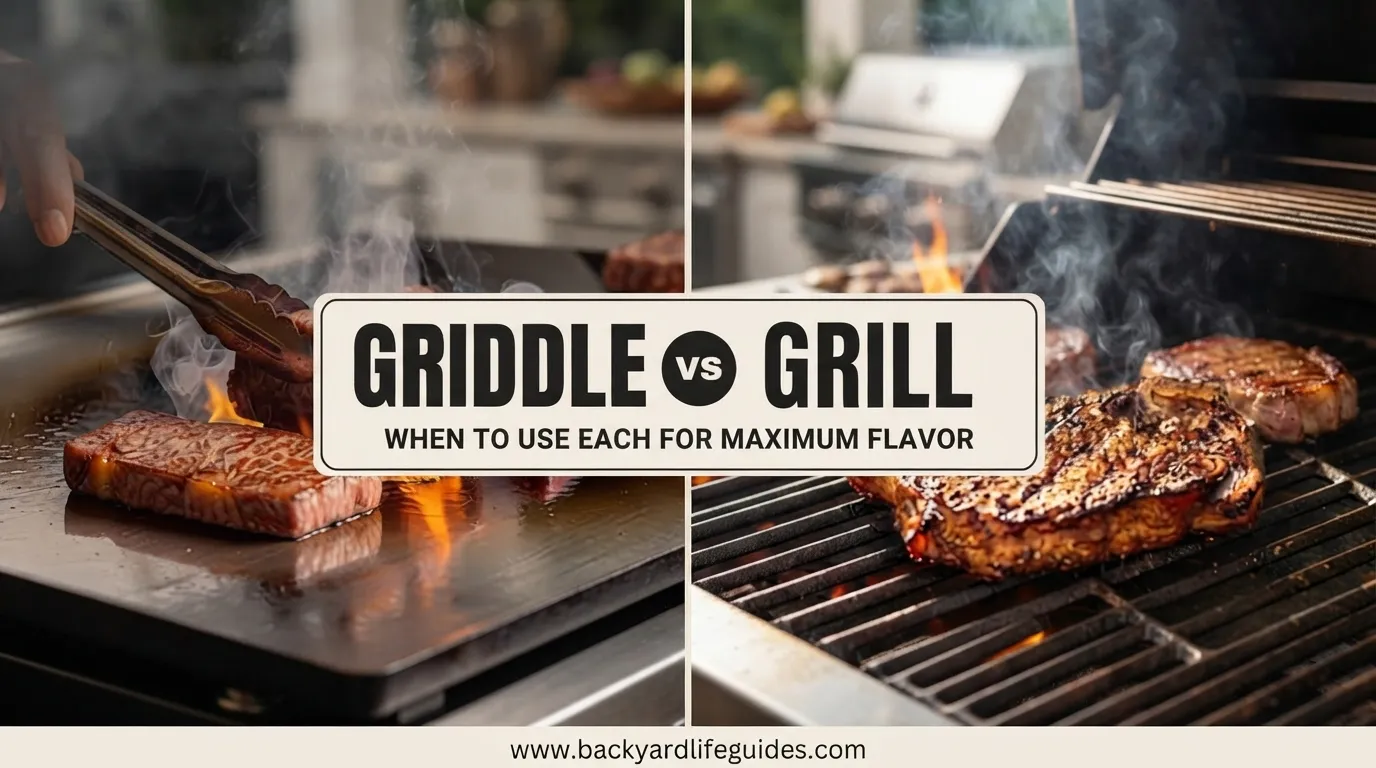
A griddle has a smooth, flat surface that makes direct contact with food across a large area. This makes it particularly useful for foods that are small, delicate, liquid-based, or likely to fall through traditional grates.
A grill uses raised or grooved grates. The spaces between the grates allow some grease and drippings to move away from the food while creating characteristic sear marks and opportunities for smoky, charred flavor.
Griddle at a glance
A griddle is especially useful for:
- Pancakes
- Eggs
- Bacon
- Sausage
- Smash burgers
- Grilled cheese
- Quesadillas
- Fried rice
- Stir-fried vegetables
- Shrimp
- Fish
- Thin steaks
- Small vegetables
Its flat surface gives food full-surface contact, which is one reason it works so well for browning and crisping.
Grill at a glance
A grill is especially useful for:
- Steaks
- Burgers
- Chicken
- Ribs
- Pork chops
- Lamb chops
- Kabobs
- Bone-in meats
- Larger fish
- Vegetables
- Grilled fruit
The open cooking surface is particularly valuable when you want char, grill marks, and smoke.
Griddle vs. Grill: How Heat Distribution Changes Cooking
Heat behaves differently on each surface.
A griddle provides broad contact between the food and the heated cooking surface. This makes it easier to maintain consistent contact while cooking foods such as eggs, pancakes, sandwiches, and smash burgers.
A grill creates different heat areas around the grates. That can be an advantage when you want to sear food over stronger heat and then move it to a cooler area to finish cooking.
This makes the grill more adaptable to direct and indirect cooking, while the griddle excels at consistent surface contact.
Why heat zones matter on a grill
A grill can give you more than one cooking environment.
You can:
- Sear food over a hotter area.
- Move it away from the strongest heat.
- Continue cooking more gently.
- Use smoke and heat to build additional flavor.
This approach is useful for larger cuts that need browning without burning the outside.
Why even contact matters on a griddle
A griddle is excellent when you want the food to remain in contact with a hot surface.
That is particularly useful for:
- Crispy burger edges
- Golden pancakes
- Hash browns
- Toasted sandwiches
- Fried rice
- Sautéed vegetables
- Thin steaks
The result is usually more about browning and crust than smoke.
Griddle vs. Grill Flavor: Which Tastes Better?
This is where the choice becomes personal.
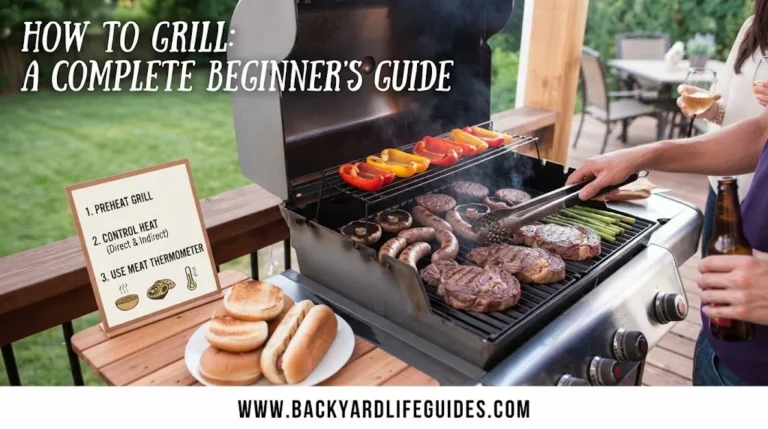
A grill generally produces the more recognizable BBQ flavor. Raised grates, high heat, and smoke can create charred edges and a distinctive grilled taste.
A griddle produces a different type of flavor. Its flat surface encourages browning and caramelization across the food’s contact area.
Grill flavor
Choose a grill when your priority is:
- Smoke
- Char
- Grill marks
- High-heat searing
- Traditional BBQ character
Wood can also influence the final flavor. Hickory is associated with a stronger, bacon-like smokiness, while cherry and apple can contribute sweeter, fruitier notes.
Griddle flavor
A griddle focuses more on:
- Browning
- Crisp edges
- Caramelization
- Moisture retention
- Full-surface searing
The Maillard reaction is particularly important here. Direct contact between food and the heated surface encourages the browning that contributes to color, aroma, texture, and savory flavor.
So the simplest flavor rule is:
Grill = smoke and char
Griddle = browning and crust
Which Is Better for Burgers?
Both work, but they create different burgers.
A grill is a natural choice for a thicker burger when you want grilled flavor, char, and the experience of cooking over grates.
A griddle is especially strong for smash burgers. The flat surface lets the meat make extensive contact with the hot cooking surface, producing crisp, browned edges.
Choose a grill for burgers when you want:
- Smoky flavor
- Char
- Traditional BBQ results
- Thicker patties
Choose a griddle for burgers when you want:
- Crispy edges
- Strong surface browning
- Smash burgers
- Multiple burgers cooked across a broad surface
For burger-focused cooking, the griddle’s biggest advantage is surface contact.
Are Steaks Better on a Grill or Griddle?
For steak, neither appliance wins every situation.
A grill is generally the stronger choice when the goal is a classic steakhouse-style grilled result with char and smoky flavor.
A griddle can be excellent when you want consistent surface contact and controlled browning, particularly with thinner cuts.
Use a grill for:
- Thick filets
- Bone-in steaks
- Large cuts
- Smoky flavor
- Traditional grilled presentation
Use a griddle for:
- Thin steaks
- Skirt steak
- High-volume steak cooking
- Consistent surface searing
The practical rule is simple: thick and smoky favors the grill; thin and evenly seared favors the griddle.
What Foods Are Best on a Griddle?
The flat surface makes a griddle unusually versatile.
Breakfast foods
A griddle is particularly useful for:
- Pancakes
- French toast
- Eggs
- Omelets
- Bacon
- Sausage
- Hash browns
The large flat surface lets you cook several related foods without worrying about smaller ingredients falling between grates.
Quick proteins
You can also use a griddle for:
- Chicken tenders
- Fish fillets
- Shrimp
- Scallops
- Burgers
- Thin steak
- Pork chops
Sandwiches and street-style foods
The flat top is especially useful for:
- Grilled cheese
- Quesadillas
- Paninis
- Gyros
- Fajitas
- Breakfast burritos
- Birria tacos
- Fried rice
- Noodles
Vegetables
Small vegetables are much easier to manage on a solid surface.
Good options include:
- Onions
- Mushrooms
- Zucchini
- Broccoli
- Green beans
- Brussels sprouts
- Potatoes
- Bell peppers
This is one of the strongest practical reasons to choose a griddle: small foods stay on the cooking surface instead of slipping through the grates.
What Foods Are Best on a Grill?
Grills shine when food benefits from direct heat, smoke, char, or larger cooking surfaces.
Meat
Good grill choices include:
- Steaks
- Chicken
- Pork chops
- Lamb chops
- Ribs
- Bone-in chicken
- Burgers
Seafood
Grills can also handle:
- Larger fish
- Shrimp
- Calamari
- Seafood skewers
Vegetables and appetizers
You can grill:
- Vegetable skewers
- Flatbreads
- Naan
- Pita
- Peppers
- Larger vegetable pieces
Grilled desserts
A grill can even be used for fruit.
Examples include:
- Pineapple
- Strawberries
- Fruit kabobs
High heat can caramelize natural fruit sugars and create a completely different dessert texture.
Griddle vs. Grill for Cooking Volume
Cooking volume matters when you regularly prepare food for several people.
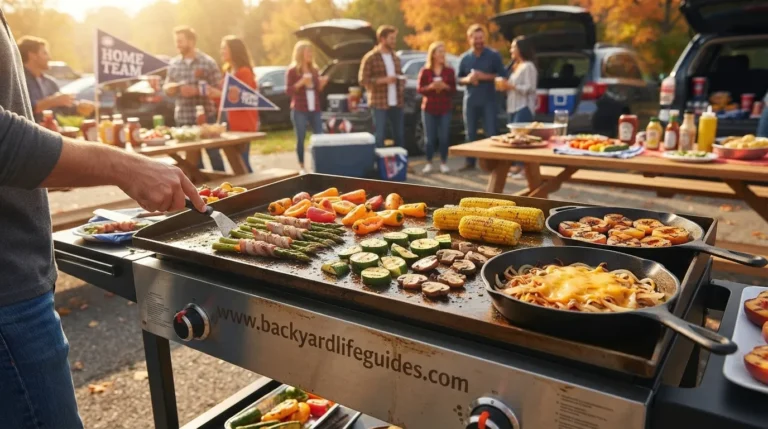
A griddle’s wide, flat surface can accommodate multiple foods at once. That makes it especially useful for breakfast service, sandwiches, burgers, and other foods that can be arranged across a continuous surface.
Commercial kitchen guidance also distinguishes griddles by size:
| Griddle size | Approximate dimensions | Typical use |
|---|---|---|
| Small | 9 × 12 to 12 × 15 inches | A few pancakes, eggs, small sandwiches |
| Medium | 15 × 20 to 18 × 26 inches | About 2–4 people |
| Large | 20 × 32 to 36 × 60 inches | 8+ people and high-volume cooking |
These dimensions illustrate how dramatically cooking capacity can change with surface size.
A grill can also handle high-volume cooking, but individual foods may need more attention, movement, or spacing depending on the food and grill design.
How Many Types of Griddles and Grills Are There?
The exact product categories vary by manufacturer, but commercial cooking equipment commonly falls into several practical types.
3 common griddle formats
- Insert griddle — fits into a countertop or cooking station.
- Freestanding griddle — sits on its own legs and can provide a dedicated cooking station.
- Tabletop griddle — compact and useful for catering, food trucks, events, and limited spaces.
These formats serve different space and workflow requirements.
3 common grill types
Commercial grill categories highlighted by the include:
- Charcoal grill
- Gas grill
- Electric grill
Gas grills can use propane or natural gas, while electric models can be useful where an open flame or charcoal setup is impractical.
Griddle vs. Grill: Ease of Use and Cleanup
If convenience is your top priority, the griddle has several advantages.
A charcoal grill can require arranging briquettes, lighting them, waiting for heat, and managing the cooking temperature.
A griddle generally has a simpler workflow: preheat, cook, scrape, and clean.
Its smooth surface also avoids many of the tight spaces found between traditional grill grates.
Griddle advantages
- Simple setup
- Even surface contact
- Fewer food-falling issues
- Easy movement of ingredients
- Straightforward scraping and cleanup
Grill advantages
- Direct and indirect cooking
- Multiple heat zones
- Smoke generation
- Char marks
- Traditional BBQ experience
The better choice depends on whether you value convenience or grilling character more.
Is a Griddle Healthier Than a Grill?
There is no universal health winner simply because one appliance is called a griddle or grill.
The food, amount of added fat, cooking method, and level of browning all matter.
The comparison notes that grills allow grease to drip away through the grates, while griddles keep food in contact with a flat surface. At the same time, avoiding excessive charring can be an important consideration when cooking over an open flame.
A practical approach is to:
- Avoid excessive burning.
- Use only the amount of cooking fat you need.
- Manage heat carefully.
- Remove heavily charred portions.
- Cook food thoroughly without unnecessarily drying it out.
How Much Do Grills and Griddles Cost?
Price depends heavily on size, fuel type, construction, and intended use.
One comparison places grills broadly around $150–$3,000+ and griddles around $200–$1,500+, illustrating how wide the market can be.
Commercial equipment can cost considerably more.
For example, the current CKitchen page displays commercial griddles ranging from $839 for a 24-inch countertop gas model to several thousand dollars for larger commercial units. One listed model is specified at 60,000 BTU.
These figures should be treated as examples, not universal retail prices, because equipment pricing changes over time.
Griddle vs. Grill vs. Smoker
A smoker belongs in the comparison when deep, slow-cooked smoke flavor is the main goal.
| Feature | Griddle | Grill | Smoker |
|---|---|---|---|
| Main strength | Even surface cooking | Char and grilling | Deep smoke |
| Best foods | Breakfast, burgers, vegetables | Steaks, chicken, ribs | Brisket, ribs, pulled pork |
| Heat style | Direct surface contact | Direct/indirect | Low and slow |
| Smoke flavor | Low | Medium to high | High |
| Cooking speed | Fast | Fast to moderate | Slow |
| Learning curve | Low | Moderate | Higher |
For long smoking projects, cooking can take 8+ hours, making a smoker a very different tool from a quick-cooking griddle or grill.
Should You Buy a Griddle or Grill?
Use your normal menu as the deciding factor.
Choose a griddle if you mainly cook:
- Breakfast
- Pancakes
- Eggs
- Bacon
- Smash burgers
- Sandwiches
- Fried rice
- Stir-fry
- Small vegetables
- Thin proteins
A griddle is also attractive if you value even heating, versatility, and easy food handling.
Choose a grill if you mainly cook:
- Steaks
- Ribs
- Chicken
- Bone-in meats
- Kabobs
- Thick cuts
- BBQ-style meals
A grill makes more sense when smoke and char are central to the experience.
Choose both if you cook a little of everything
There is a strong argument for using both appliances when space and budget allow.
The griddle can handle breakfast, sandwiches, smash burgers, delicate foods, and small ingredients, while the grill handles thick meats, smoky foods, and classic BBQ dishes.
For a commercial kitchen, combining both can provide even greater menu flexibility.
A Simple Decision Guide
Use this quick checklist before buying.
Choose a GRIDDLE when:
- You love smash burgers.
- You make breakfast often.
- You cook lots of vegetables.
- You want even surface contact.
- You prefer quick cleanup.
- You cook small foods that could fall through grates.
- You want a versatile cooking surface.
Choose a GRILL when:
- Smoke is important to you.
- You love char marks.
- You regularly cook thick steaks.
- You make ribs or bone-in meats.
- You enjoy traditional BBQ.
- You want direct and indirect cooking zones.
Choose BOTH when:
- You cook a wide variety of foods.
- You have enough cooking space.
- You want maximum flexibility.
- You regularly entertain larger groups.
Frequently Asked Questions
Is a griddle better than a grill?
Neither is universally better. A griddle is better for even cooking, breakfast, smash burgers, sandwiches, and small foods, while a grill is better for smoky flavor, char marks, thick meats, and traditional BBQ.
Are steaks better on a grill or griddle?
For a classic smoky steak with char, a grill is generally the better choice. A griddle can be excellent for thin cuts when consistent surface contact and even browning are more important.
Can a griddle replace a grill?
A griddle can replace a grill for many foods, including burgers, vegetables, fish, sandwiches, and thin meats. However, it cannot completely reproduce the open-flame smoke and traditional grill-char experience.
What is best for smash burgers?
A griddle is usually the better choice because its flat surface provides broad contact with the meat, helping create the crisp, browned edges associated with smash burgers.
What is best for pancakes and eggs?
A griddle is the natural choice because the flat cooking surface provides room to spread batter and cook several breakfast items without food slipping through grates.
Does a grill give food more flavor?
A grill can provide a stronger smoky and charred flavor, especially when using charcoal or wood. A griddle produces a different flavor profile based more on browning, caramelization, and direct surface contact.
What size griddle should I choose?
Small griddles around 9 × 12 to 12 × 15 inches are suitable for limited cooking. Medium models around 15 × 20 to 18 × 26 inches can serve roughly 2–4 people, while large 20 × 32 to 36 × 60-inch surfaces are designed for larger groups and commercial-style volume.
Is a griddle easier to clean than a grill?
Generally, yes. A smooth griddle surface avoids the narrow spaces between grill grates, making scraping and grease management relatively straightforward. However, proper cleaning still depends on the appliance and cooking method.
Is a grill better for thick steaks?
Yes. A grill is particularly well suited to thick steaks and bone-in cuts because it can combine high heat, searing, grill marks, and smoky flavor.
Can you cook vegetables on a griddle?
Absolutely. A griddle works especially well for sliced or diced vegetables such as zucchini, mushrooms, onions, peppers, broccoli, potatoes, and Brussels sprouts because the flat surface prevents small pieces from falling through.
Final Verdict: Griddle or Grill?
The best cooking surface is the one that matches the food you actually prepare.
A griddle is the versatile option for breakfast, smash burgers, sandwiches, vegetables, fried rice, delicate foods, and even browning. Its flat surface provides broad contact and makes small ingredients easier to manage.
A grill is the better choice for smoky flavor, char marks, thick steaks, bone-in meats, ribs, chicken, and classic BBQ cooking.
If you want one simple rule to remember:
Choose a griddle for surface contact and versatility. Choose a grill for smoke and char.
And if your cooking style includes both, having both surfaces can give you the widest range of results without forcing one appliance to do every job.
The goal is not to find the appliance that wins every comparison. It is to choose the cooking surface that gives you the flavor, control, capacity, and convenience you value most.