
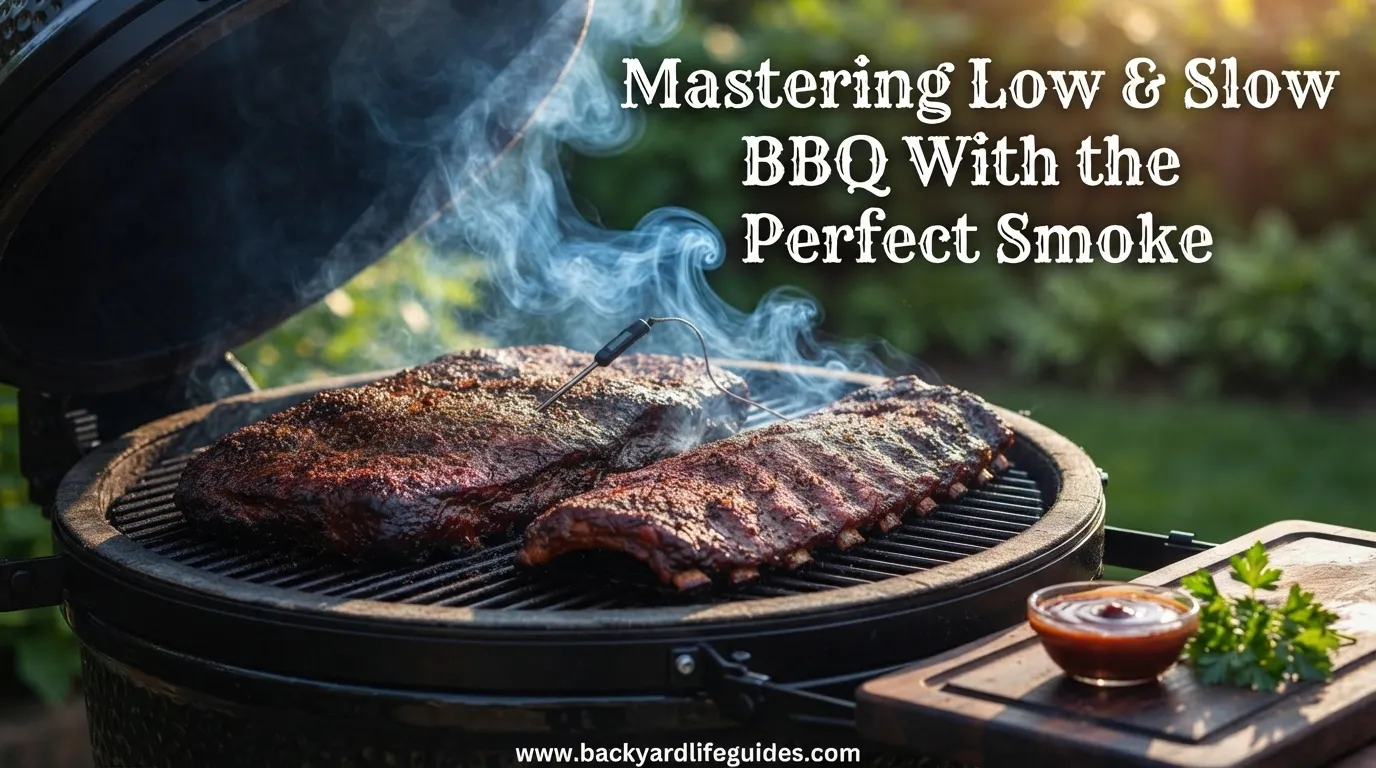
Mastering Low & Slow BBQ With the Perfect Smoke
- Disclosure: This post may include affiliate links. If you click a link and complete a purchase, I may earn a commission. Additionally, as an Amazon Associate, I earn from eligible purchases.
Low-and-slow BBQ is a cooking method built around three things: controlled heat, time, and smoke. Instead of exposing meat to intense heat for a short period, you maintain a relatively low cooking temperature and allow connective tissue, fat, moisture, and smoke to develop gradually.
A practical low-and-slow cooking range is 225–275°F (107–135°C). You do not need to keep the smoker at one perfectly fixed number. Small fluctuations are normal, and an example target around 250°F (121°C) can work well.
The goal is not simply to cook meat slowly. It is to create enough time for tough cuts to become tender while developing a flavorful exterior and controlled smoke character.
That distinction also matters because smoking and low-and-slow cooking are not the same thing. Smoking describes exposure to smoke, while low-and-slow describes the relationship between cooking temperature and time. They often happen together, but either can exist without the other.
Why Low & Slow Works
Low-and-slow cooking works because several processes happen during an extended cook.
The Maillard Reaction
The Maillard reaction contributes to the browning, aroma, crust, and complex flavor associated with well-cooked BBQ. As the surface of the meat cooks, amino acids and naturally occurring sugars undergo reactions that create the darker, more flavorful exterior commonly called bark.
Temperature matters, but the surface environment matters too. A moist surface can slow browning, which is one reason the exterior changes progressively during a long cook.
Collagen Turns Into Gelatin
Many of the best low-and-slow cuts contain substantial connective tissue. Collagen is one of the major components responsible for toughness.
With sufficient heat and time, collagen progressively breaks down and contributes to a more tender texture:
Collagen → Gelatin → Tenderer Meat
One supplied identifies approximately 140°F (60°C) as a point where collagen breakdown can begin, while another emphasizes that collagen conversion is not controlled by one magic internal temperature. In practice, temperature and time work together.
This is why a tough brisket or pork shoulder can require hours even after its internal temperature has already risen considerably.
Energy Transfer and Heat Stability
The cooking environment also matters. Ceramic cookers such as the Big Green Egg are designed to retain and distribute heat, helping create a stable cooking environment.
The broader lesson applies beyond one cooker: a stable smoker makes it easier to maintain the conditions required for a long cook.
The Best Temperature Range for Low & Slow
For traditional low-and-slow BBQ, 225–275°F (107–135°C) is the most useful working range.
| Temperature | Practical Use |
|---|---|
| 225°F / 107°C | Lower end of traditional low-and-slow cooking |
| 235–265°F / 113–129°C | Common fluctuation range |
| 250°F / 121°C | Useful example target |
| 225–275°F / 107–135°C | Main low-and-slow range |
| 284°F / 140°C | Practical upper boundary cited by the supplied guide |
| 300–350°F / 149–177°C | More suitable for poultry skin |
| 325°F / 163°C | Above this, the cook is no longer generally considered slow cooking |
The important point is that 225°F is not automatically better than 275°F. A stable fire, clean smoke, suitable meat, and proper doneness matter more than obsessing over a single number.
Brief temperature fluctuations are not necessarily a problem. However, if the cooker remains substantially above the traditional low-and-slow range, the cooking method begins moving toward hot-and-fast BBQ or smoke-roasting.
Which Meats Benefit Most From Low & Slow?
Low-and-slow cooking is especially useful for cuts containing significant connective tissue and fat.
Recommended options include:
- Beef brisket
- Beef ribs
- Pork ribs
- Pork shoulder
- Boston butt
- Pork belly
- Lamb shoulder
- Beef chuck
- Beef jowl
- Hog jowl
- Cheek
- Larger poultry
- Fatty fish
- Sausages
- Meatloaf-style preparations
These foods can tolerate or benefit from longer cooking because their structure gives the cooking process time to work on connective tissue and fat.
When Low & Slow Is Not the Best Choice
Not every food needs hours in a smoker.
Thin steaks, burgers, shrimp, delicate white fish, and lean pork tenderloin generally make more sense with faster cooking.
Many vegetables also do not require a long low-temperature cook.
Poultry deserves particular attention. Very low cooking temperatures can produce soft or rubbery skin, so a higher finishing temperature can sometimes be preferable when crisp skin is important.
How Much Fat Should Your Meat Have?
Fat can be helpful during a long cook because it contributes flavor, moisture, and richness.
The supplied Big Green Egg-focused article recommends approximately 15–20% fat for extended low-and-slow cooking.
| Meat Condition | Practical Consideration |
|---|---|
| 15–20% fat | Good range for prolonged cooking |
| Less than 15% | Greater risk of becoming dry |
| Very fatty | Can provide richness but may become greasy |
| Lean cut | May benefit from additional fat |
Fat can help insulate portions of the meat while rendering during the cook. However, more fat is not automatically better. Excessive fat can produce a greasy result.
For a particularly lean cut, the supplied material suggests adding approximately 1–2 tablespoons of oil, butter, or bacon as an optional strategy.
Building the Perfect Smoke
One of the most important lessons from the supplied low-and-slow guide is simple:
More smoke does not mean better BBQ.
Good BBQ smoke should generally be clean, light, and pleasant. It may appear thin or almost invisible.
Heavy gray, yellow, or white smoke can indicate problems such as:
- Incomplete combustion
- Damp fuel
- Restricted airflow
- An unstable fire
Instead of trying to produce huge clouds of smoke, focus on maintaining a clean-burning fire.
Choosing Smoking Wood
Common fuel options include:
- Wood chunks
- Wood chips
- Pellets
- Wood splits
Start conservatively. Adding excessive wood early can create an overpowering or bitter smoke flavor, and once that flavor is absorbed, it cannot simply be removed.
Do Wood Chips Need Soaking?
According to the supplied BBQ guide, soaking wood chips is generally unnecessary.
Wet chips must first heat up and dry before producing useful smoke, so soaking does not automatically improve the smoking process.
Equipment You Actually Need
You do not need the most expensive smoker to learn low-and-slow BBQ.
Depending on your setup, useful equipment can include:
- Grill
- Smoker
- Ceramic cooker
- Pellet grill
- Offset smoker
- Gas grill
- Heat deflector
- Pellet grill diffuser
- Pit or ambient thermometer
- Leave-in meat probe
- Suitable fuel
- Smoking wood
A reliable thermometer is particularly useful because the cooker temperature and the meat’s internal temperature answer two different questions.
The cooker thermometer tells you how hot the cooking environment is.
The meat probe tells you what is happening inside the food.
A Simple 10-Step Low & Slow BBQ Process
1. Choose the Right Cut
Start with a cut that benefits from prolonged cooking. Brisket, pork shoulder, beef chuck, ribs, and lamb shoulder are strong examples.
2. Trim the Meat
Remove unnecessary excess fat and unwanted sections while leaving useful fat that can contribute to flavor and moisture.
3. Salt and Season
Apply your preferred seasoning before the cook. Keep the process straightforward and allow the seasoning to complement rather than overpower the smoke.
4. Build and Stabilize the Fire
Do not put the meat on immediately after lighting the cooker.
First, establish the cooking environment and allow the temperature to stabilize around your intended range.
A target around 250°F (121°C) is a useful example.
5. Add the Meat
Once the cooker is stable, place the meat into the cooking chamber.
Avoid repeatedly opening the lid or door because unnecessary opening can disturb airflow and temperature stability.
6. Control the Smoke
Use a moderate amount of suitable smoking wood.
Look for clean smoke, rather than trying to create dense clouds.
7. Decide Whether to Spritz
Spritzing is optional rather than mandatory.
The supplied material recognizes spritzing as one decision within the cooking process. Whether you use it depends on the surface condition and the result you want.
8. Understand the Stall
Large cuts can appear to stop increasing in internal temperature for a period during cooking. This is commonly called the stall.
Do not assume that a stalled temperature automatically means something has gone wrong.
9. Decide Whether to Wrap
Wrapping can be used as part of the cooking strategy, but it is not automatically required for every cut.
The decision should consider bark development, cooking time, moisture management, and the desired final texture.
10. Cook Until Tender, Then Rest
Internal temperature can help you monitor progress, but tenderness is the final goal for many low-and-slow cuts.
Once the meat reaches the desired texture, allow it to rest before serving.
How Long Does Low & Slow Cooking Take?
There is no universal cooking time.
The supplied material describes cooks ranging from approximately 1 hour to double figures, with overnight cooking also being common for larger cuts.
Cooking time depends on:
- Cut size
- Meat type
- Fat content
- Cooker temperature
- Cooker design
- Starting temperature
- Airflow
- Wrapping
- Desired tenderness
For that reason, a fixed “minutes per pound” formula should not replace observation and temperature monitoring.
A large brisket and a smaller piece of pork shoulder can behave very differently even when cooked at the same pit temperature.
Low & Slow BBQ and Moisture
Long cooking creates a balance between tenderness and moisture loss.
High heat can accelerate moisture loss, while a prolonged cook gives connective tissue more time to transform.
Fat can contribute richness and protect portions of the meat, but it cannot completely prevent drying.
This is particularly important when working with cuts containing less than 15% fat. Lean meat deserves more attention because prolonged exposure to heat can leave it noticeably drier.
Low & Slow vs Hot & Fast
Both methods can produce excellent BBQ, but they prioritize different cooking conditions.
| Low & Slow | Hot & Fast |
|---|---|
| Usually 225–275°F | Uses substantially higher heat |
| Longer cooking time | Shorter cooking time |
| Strong focus on connective-tissue conversion | Faster heat penetration |
| Often used for tough cuts | Useful when speed matters |
| Commonly paired with smoking | Can be used with or without heavy smoke |
The key is to match the method to the food.
A tough pork shoulder can reward patience, while a thin steak usually does not need an all-day cooking process.
Common Low & Slow Mistakes
Chasing an Exact Temperature
Trying to hold a smoker at one exact number can make the process unnecessarily stressful.
A controlled range is more realistic. 225–275°F is a useful working window.
Using Too Much Smoke
Dense smoke is not proof of better BBQ.
Excess smoke can create bitter or harsh flavors.
Choosing Lean Meat Without Adjusting Your Approach
Meat containing less than 15% fat may be more vulnerable to drying during extended cooking.
Opening the Cooker Too Often
Every unnecessary opening changes the cooking environment and can interfere with temperature stability.
Treating Internal Temperature as the Only Measure of Doneness
Temperature is an important guide, but texture matters.
For connective-tissue-rich cuts, the goal is not simply reaching a particular number. The meat should become tender.
Cooking Every Food Low and Slow
Low-and-slow is not universally better.
Shrimp, thin steaks, burgers, delicate white fish, and pork tenderloin may be better suited to faster cooking.
Food Safety Still Matters
Low-and-slow BBQ involves long cooking times, so food handling should not be overlooked.
Keep raw meat separate from ready-to-eat foods, maintain clean preparation surfaces, use reliable temperature monitoring, and avoid treating a long cooking time as a substitute for safe food-handling practices.
A smoker’s low temperature is not itself a guarantee of food safety.
Use a reliable food thermometer and follow appropriate food-safety practices for the specific meat you are preparing.
Beginner-Friendly Low & Slow Setup
You can start without buying a professional competition smoker.
A practical beginner setup can consist of:
Grill or smoker + reliable thermometer + suitable fuel + small amount of smoking wood + quality meat
If your cooker can maintain a relatively stable temperature around 225–275°F, you already have the foundation for learning the technique.
Start with a forgiving cut such as pork shoulder or beef chuck rather than beginning with the most demanding brisket.
The supplied BBQ experience also covers a wide variety of cooking platforms, including kettle grills, kamados, pellet grills, gas grills, and live-fire setups. This reinforces an important point: the technique matters more than owning one specific cooker.
A Practical 250°F Example
Suppose you want to run a traditional low-and-slow cook.
Set up the cooker and stabilize it around 250°F (121°C).
Then:
- Prepare and season the meat.
- Stabilize the cooker before adding food.
- Add a moderate amount of smoking wood.
- Place the meat inside.
- Monitor the pit temperature.
- Monitor internal meat temperature.
- Maintain clean smoke.
- Allow the cook to progress through its natural stages.
- Consider wrapping if it fits your desired result.
- Continue until the meat is tender.
- Rest before slicing or serving.
The exact cooking time will vary. The process is more reliable when you monitor temperature, appearance, smoke, and tenderness together.
Frequently Asked Questions
What temperature is best for low and slow BBQ?
A practical range is 225–275°F (107–135°C). Around 250°F (121°C) is a useful example target, while normal fluctuations within the range are acceptable.
Is 300°F still low and slow?
It is generally outside the traditional low-and-slow range. The supplied material places traditional cooking around 225–275°F, with higher temperatures moving toward hot-and-fast cooking.
What meats are best for low and slow?
Brisket, pork shoulder, Boston butt, beef chuck, pork ribs, beef ribs, lamb shoulder, pork belly, and other collagen-rich or fatty cuts are particularly suitable.
Does more smoke make better BBQ?
No. Excessive smoke can produce bitter or harsh flavors. Clean, light smoke is generally preferable to thick clouds.
Should I soak wood chips before smoking?
The supplied BBQ guide says soaking wood chips is generally unnecessary because wet chips must heat and dry before producing useful smoke.
How much fat should meat have for low and slow?
The supplied Big Green Egg-focused guidance recommends approximately 15–20% fat for extended low-and-slow cooking.
What happens if meat has less than 15% fat?
Lean meat can have a greater risk of drying during a prolonged cook. The supplied material suggests that 1–2 tablespoons of oil, butter, or bacon can be considered for supplementing a lean cut.
Does collagen start breaking down at 140°F?
The supplied material identifies approximately 140°F (60°C) as a suggested starting point for collagen breakdown. However, collagen conversion depends on both temperature and time, not one exact temperature.
How long does low-and-slow BBQ take?
It varies significantly. Cooking can take around 1 hour to double-digit hours, and overnight cooking can be used for large cuts. Size, meat type, temperature, fat, and desired tenderness all affect the timeline.
Is smoking the same as low and slow?
No. Smoking refers to exposure to smoke, while low and slow describes cooking at controlled lower heat over an extended period. They often overlap but are technically different concepts.
Final Takeaway
Mastering low-and-slow BBQ is less about following one magic number and more about controlling the entire cooking environment.
Keep the cooker generally within 225–275°F (107–135°C), choose meat suited to extended cooking, understand the role of collagen and fat, use smoking wood carefully, and prioritize clean smoke over heavy smoke.
Most importantly, learn to judge the cook as a complete process. Temperature tells you where the meat is; tenderness tells you when it is ready.
With a stable fire, controlled smoke, suitable meat, and enough time, even a simple grill or smoker can produce deeply flavorful and tender BBQ.
2 Comments