
Controlling Heat on Your Big Green Egg: A Beginner’s Guide to Temperature & Vent Settings
- Disclosure: This post may include affiliate links. If you click a link and complete a purchase, I may earn a commission. Additionally, as an Amazon Associate, I earn from eligible purchases.
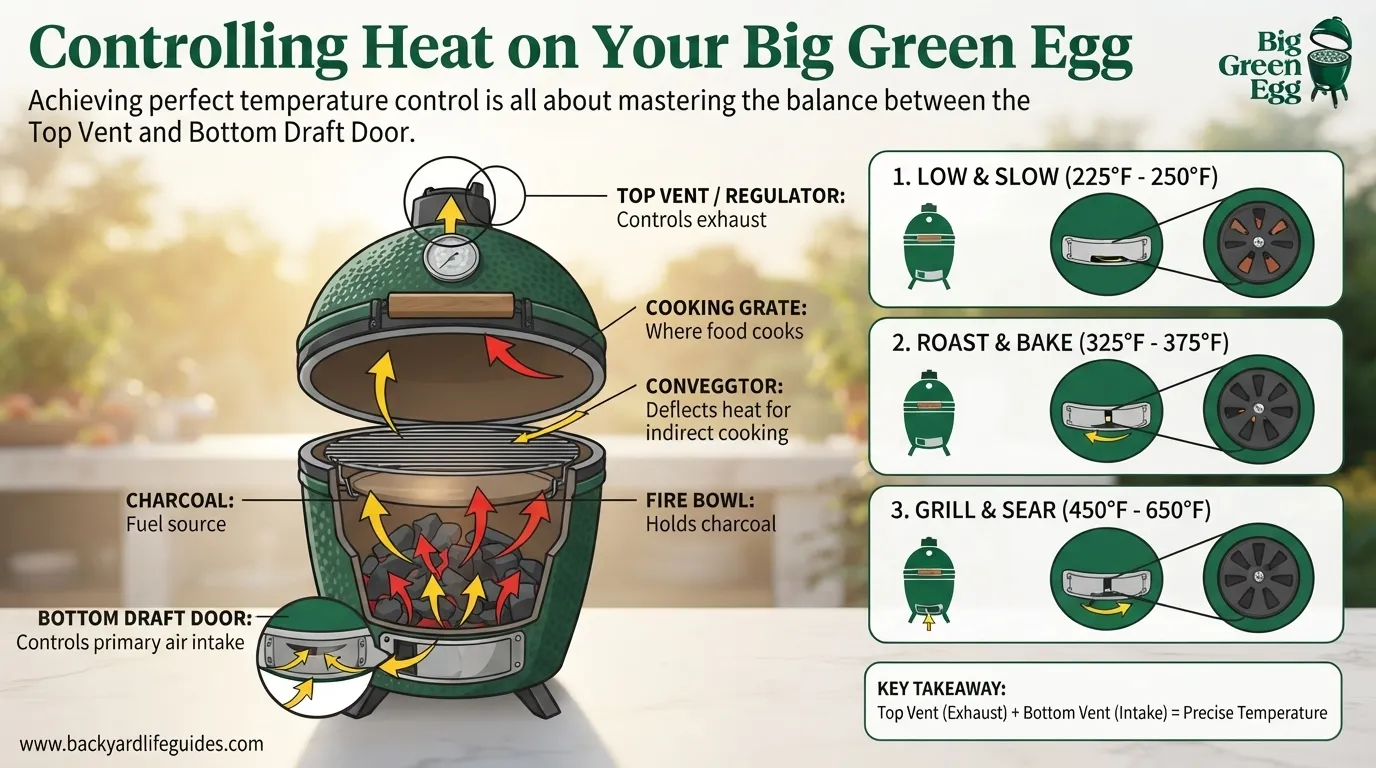
Learning how to control heat on your Big Green Egg becomes much easier once you understand one basic rule: airflow controls the fire. The charcoal needs oxygen to burn, and the two vents on the Egg determine how much oxygen reaches the fire and how quickly heat and smoke leave the cooker.
The challenge for beginners is that a Big Green Egg does not react instantly. Its thick ceramic walls retain heat, so raising the temperature is generally easier than cooling an overheated Egg. That is why successful temperature control is less about constantly moving the vents and more about making small adjustments at the right time.
Whether you are cooking a quick burger, searing a steak at 600°F, smoking pork shoulder at 225°F, or running a low-and-slow cook around 200–275°F, the same principles apply: prepare the fire correctly, control oxygen gradually, watch the temperature, and give the Egg time to stabilize.
New to the Big Green Egg? This beginner’s guide breaks down exactly how to control heat using vent settings, so you can master temperature every time you cook.
How the Big Green Egg Controls Temperature
The Big Green Egg uses two main airflow controls: the bottom draft door and the top rEGGulator or cap. The bottom opening controls how much oxygen enters the fire, while the top opening helps regulate the movement of heat and smoke out of the cooker.
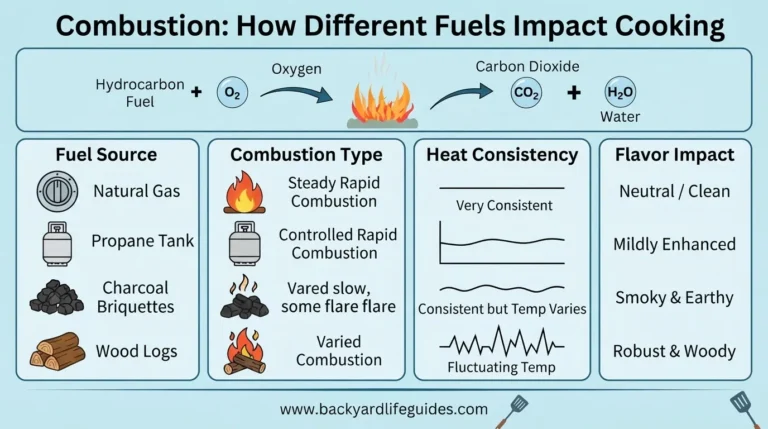
When both openings are more open, more oxygen reaches the charcoal, and the fire becomes hotter. When you restrict the openings, the fire receives less oxygen, and the temperature gradually falls.
The important word here is gradually. Closing the vents does not instantly remove the heat already stored inside the ceramic. If the Egg has climbed significantly above your target, simply shutting the vents may take considerable time to bring the temperature back down.
This is why it is better to control the temperature before you reach your target rather than waiting until the thermometer reaches the exact number and then suddenly closing everything.
Keep the Top and Bottom Vents Working Together
A common beginner mistake is treating the two vents as completely separate controls. In practice, they work together to regulate the fire.
The official Big Green Egg guidance gives a particularly useful starting reference: when the top opening is set to approximately 1 inch / 2.5 cm, the bottom draft door can also be opened approximately 1 inch / 2.5 cm.
This does not mean that every cook will require exactly that setting. Weather, charcoal, cooker size, starting temperature, and the desired cooking temperature can all affect the final position. Think of the 1-inch / 2.5-cm setting as a reference point, not a universal permanent setting.
Once the Egg reaches the temperature you want, make small changes rather than moving the vents dramatically.
Start With Clean Airflow
Before lighting the charcoal, check the bottom of the Egg and remove accumulated ash. Ash can restrict airflow and make the fire behave differently from one cook to another.
For consistent temperature control, the ash pan should be emptied before each cook. Stirring the remaining charcoal with an ash tool can also help move loose ash into the collection area.
This preparation matters because your vent settings only work properly when air can actually move through the cooker. A partially blocked airflow path can make an otherwise correct vent setting produce disappointing results.
Use the Right Charcoal
For Big Green Egg cooking, natural lump charcoal is the preferred fuel across the guidance reviewed here. It burns hot, produces relatively little ash, and supports the airflow that the ceramic cooker depends on.
Avoid treating ordinary briquettes as the default fuel for your Egg. The guidance reviewed consistently favors lump charcoal, particularly for the high temperatures and long cooking sessions the Egg is designed to handle.
How much charcoal you use also depends on the cook. For a shorter grilling session, you do not necessarily need to fill the firebox. A practical starting point for grilling or baking is around three-quarters full, while a long cook such as a 10+ hour pork shoulder can require a full charcoal chamber.
For very high-heat cooking such as steak, using a little more charcoal can provide the fuel needed to reach approximately 600°F.
Light the Charcoal According to the Cook
How you light the charcoal can affect how quickly the Egg reaches temperature.
For a low-and-slow cook, lighting 1 or 2 small spots allows the fire to develop gradually. This is useful when your target is somewhere around 225°F, because you want to avoid creating a large, aggressive fire that is difficult to control.
For high-temperature cooking, lighting multiple areas can establish the fire more quickly.
One practical lighting method uses a grill torch for approximately 1 minute, followed by roughly 10 minutes for the grill to become ready. Another approach described in the research uses a fire starter with the lid open for about 5 minutes, followed by another 5 minutes after closing the lid.
The important lesson is not to chase the clock. These numbers provide useful starting points, but the thermometer and behavior of your Egg should determine when you begin making temperature adjustments.
Watch the Temperature as It Rises
After lighting the charcoal, allow the fire to develop while monitoring the thermometer.
For a new Big Green Egg, keeping the temperature below approximately 177°C / 350°F during the initial use gives the gasket adhesive time to cure and adhere properly.
As the Egg heats, avoid waiting until the exact target temperature before restricting the airflow. Because ceramic retains heat, the cooker can continue climbing after you reduce the vents.
If your target is 225°F, for example, begin reducing airflow before the thermometer reaches 225°F. Then wait and watch how the temperature responds.
This slower approach may feel frustrating at first, but it is much easier than trying to cool an Egg that has already become excessively hot.
Why the Big Green Egg Is Easier to Heat Than Cool
This is one of the most important things for a beginner to understand.
A Big Green Egg’s ceramic body absorbs and retains heat. Once the ceramic becomes very hot, closing the vents reduces oxygen, but it does not immediately remove the stored heat.
That means an Egg that has overshot its target can take patience to recover.
If you want 225°F but allow the cooker to climb to 350°F, closing the vents will not instantly return it to 225°F. The better strategy is to build the temperature slowly and start restricting airflow early.
Preventing overshoot is easier than correcting overshoot.
Low-and-Slow Cooking Temperature
Low-and-slow cooking is where steady temperature control becomes particularly important. Brisket, pork butt, ribs, and beef ribs are commonly cooked in the 200–275°F range, with 225–275°F being a particularly common smoking range.
For a long cook, resist the temptation to keep adjusting the vents every few minutes.
Once the temperature approaches your target, make a small adjustment and give the Egg time to respond. Constantly changing the vents can create unnecessary temperature swings.
A pork shoulder cook lasting 10+ hours is a good example of why stability matters more than speed. You want the fire to remain predictable for hours rather than repeatedly correcting large temperature changes.
High-Heat Cooking Requires a Different Approach
High-temperature cooking is used for foods such as steaks, burgers, chicken thighs, seafood, and vegetables. The recommended range can extend from approximately 350°F to 700°F+, depending on the food and cooking method.
For a steak cook around 600°F, the fire can be established more aggressively than it would be for smoking. Starting the charcoal in the middle and allowing the vents to remain open during the initial fire-building stage can help the Egg climb toward the required temperature.
But the same warning still applies: once the ceramic becomes extremely hot, bringing the temperature down is difficult.
For that reason, high-heat cooks also benefit from anticipating the target instead of waiting until the thermometer reaches it before restricting airflow.
Give the Egg Time to Stabilize
Temperature stability is not immediate.
For low-and-slow cooking, allow roughly 30–45 minutes for the Egg to stabilize properly. Hotter cooks may stabilize more quickly.
During this period, resist the urge to make a new adjustment every time the thermometer moves slightly.
The goal is not to make the thermometer display absolutely motionless. The goal is to reach a reasonably stable cooking environment where the temperature is no longer climbing rapidly or dropping unpredictably.
Once the Egg has stabilized, leave the vents alone unless the temperature genuinely begins moving away from your target.
Keep the Lid Closed
Opening the lid can have a bigger effect than beginners expect.
Every time you open the Egg, heat escapes and additional oxygen can reach the charcoal. That can temporarily disturb the cooking temperature and potentially make the fire more active.
Keep the lid closed as much as practical and use the thermometer to monitor the cooking environment.
This is especially important during long smoking sessions, where repeated lid opening can make temperature management unnecessarily difficult.
Use the ConvEGGtor for Indirect Cooking
When cooking indirectly, the convEGGtor Heat Deflector sits between the charcoal and the food. It blocks direct radiant heat while allowing hot air to circulate around the cooking chamber.
This setup is particularly useful for long cooks such as brisket, pork shoulder, and ribs.
Because the cooking environment changes when a heat deflector and cold food are added, do not immediately start moving the vents simply because the temperature temporarily changes. Allow the Egg some time to recover and stabilize.
Use the Right Thermometer
The dome thermometer is useful for monitoring the overall temperature, but precise cooking can benefit from measuring temperature closer to the cooking grate.
An instant-read thermometer is useful for checking food, while a digital probe thermometer can provide continuous temperature information.
For more advanced temperature management, tools such as Thermapen, Flame Boss, or EGG Genius can provide additional monitoring or control.
For pizza, a laser thermometer can also be useful for checking the actual temperature of the cooking surface. This can help identify situations where the cooking stone has not reached the temperature needed for even cooking.
What to Do When the Egg Gets Too Hot
If the temperature begins climbing beyond your target, do not immediately open the lid.
Opening the cooker introduces additional oxygen and can make the fire even more active.
Instead, reduce the airflow by adjusting the vents and allow the Egg time to respond. If the temperature is only slightly high, a small adjustment may be enough.
For larger temperature differences, more airflow restriction may be necessary, but patience is still important because the ceramic is holding heat.
The biggest mistake is making several large adjustments in rapid succession. That can make it difficult to understand what the fire is actually doing.
How to Safely Open a Very Hot Egg
High-temperature cooking also requires attention when opening the lid.
If the Egg is extremely hot, opening the lid fully and suddenly can allow a large amount of oxygen to reach the fire. A safer approach is to burp the Egg by opening the lid approximately 1–2 inches first and allowing it to breathe before opening it completely.
This is particularly important after high-temperature cooking when the charcoal is burning aggressively.
What to Do After Cooking
When you finish cooking, you do not need to open the Egg to make it cool faster.
Instead, close the top vent and bottom draft door completely. This restricts oxygen and allows the charcoal fire to die naturally.
Opening the lid to speed up cooling can have the opposite effect because the additional oxygen may cause the remaining charcoal to burn more vigorously.
After the Egg has stabilized at your desired cooking temperature, the same principle applies in reverse: avoid unnecessary vent adjustments and allow the cooker to respond naturally.
A Simple Temperature-Control Routine
The easiest way to remember the entire process is to think in terms of prepare, light, approach, stabilize, and leave it alone.
Start with a clean airflow path and the appropriate amount of lump charcoal. Light the charcoal according to the type of cooking you are planning. Keep the vents open during the initial fire-building stage, then begin restricting airflow as you approach your target.
For low-and-slow cooking, aim around 225–275°F and allow approximately 30–45 minutes for proper stabilization. For high-heat cooking, temperatures around 350–700°F+ may be appropriate, with steak cooking potentially reaching around 600°F.
Once the temperature becomes stable, stop chasing the thermometer. Small adjustments are usually better than dramatic ones.
FAQs for Big Green Egg Temperature Control
What temperature should I use for low-and-slow cooking?
A practical range is 200–275°F, with 225–275°F being a common smoking range for foods such as brisket, pork shoulder, and ribs.
How long does a Big Green Egg take to stabilize?
For low-and-slow cooking, allow approximately 30–45 minutes for the temperature to settle properly. Higher-temperature cooks can stabilize faster.
How far should I open the Big Green Egg vents?
There is no single setting that works for every cook. As an official reference, a 1-inch / 2.5-cm top opening can be paired with approximately 1 inch / 2.5 cm at the bottom draft door. From there, make small adjustments based on your target temperature.
Why does my Big Green Egg keep getting hotter after I close the vents?
The ceramic retains heat, and the charcoal can continue burning with the oxygen already inside the cooker. This is why it is better to start reducing airflow before reaching your target temperature.
How much charcoal should I put in a Big Green Egg?
For grilling and baking, approximately three-quarters full is a useful practical reference. Longer cooks, including a 10+ hour pork shoulder, may require a full charcoal chamber.
Can I use briquettes in a Big Green Egg?
The guidance reviewed here consistently recommends natural lump charcoal rather than briquettes for the Big Green Egg.
How do I cool a Big Green Egg down?
Close the top vent and bottom draft door to restrict oxygen. Avoid opening the lid simply to cool the cooker faster because additional oxygen can increase combustion.
What temperature is good for steak on a Big Green Egg?
High-heat cooking can reach 350–700°F+, and the practical guidance reviewed includes approximately 600°F for steak searing.
Should I keep changing the vents while cooking?
No. Once the Egg has reached a stable temperature, frequent vent adjustments can create unnecessary fluctuations. Make a small change, wait for the cooker to respond, and adjust again only when needed.
Final Thoughts
Controlling heat on a Big Green Egg is less about finding one perfect vent position and more about understanding how oxygen, charcoal, ceramic heat retention, and time work together.
Start with clean airflow, use natural lump charcoal, and build the fire according to the type of cooking you are doing. For low-and-slow cooking, think roughly 225–275°F and allow 30–45 minutes for stabilization. For high-heat cooking, temperatures can reach 350–700°F+, with steak cooking around 600°F.
Most importantly, avoid overshooting your target. The Big Green Egg is much easier to heat than cool, so small vent adjustments made early will give you far better control than large corrections made late.

9 Comments